
Rabbit in Chinese Astrology: The Fourth Branch, the Hour of Sunrise, and the Shadow of the Offering
Curious what YOUR chart reveals?
Cast your free BaZi chart and see your Day Master, elemental balance and life patterns through a Jungian lens.
Get Your Free BaZi ChartFree · No sign-up needed
She told me she was the easy one. Forty-one, running a design studio of nine people, and by her own account not much else. Then she described her week. A client with cold feet, a landlord with a new number, a designer who had stopped talking in meetings, her brother's wedding. She had handled all of it, in order, and none of it had been hers.
I asked what she wanted. The pause ran long enough that I stopped counting.
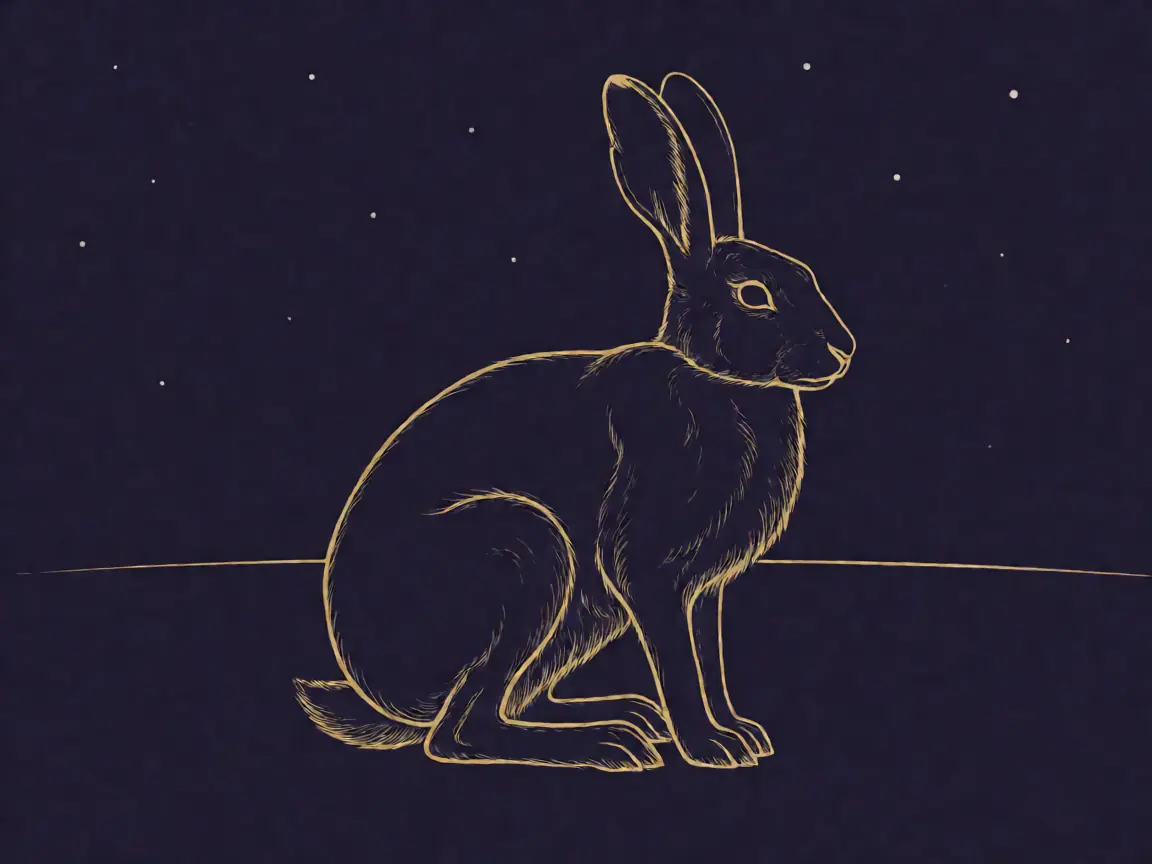
The Rabbit is a Chinese zodiac sign built on the Earthly Branch Mao (卯), a yin Wood branch that rules due east, the second month of spring, and the two hours after sunrise. The tradition files the animal under gentleness and luck. I read the branch as attention: a person who tracks a room closely enough to move through it without disturbing anything.
The Branch Behind the Animal
Mao takes the fourth seat of the twelve, yin Wood, due east, the window from 05:00 to 07:00, and carries a single hidden stem, 乙, one of the four cardinal seats 子午卯酉.
The animal is younger than the character. The Shuowen Jiezi, the Han dictionary, reads 卯 as a picture of a door swinging open. 卯,冒也: the second month, when the ten thousand things push up out of the ground. The entry closes with 故二月為天門, and so the second month is the Gate of Heaven.
Duan Yucai's eighteenth-century commentary on that entry pairs the two gates, with Mao as the spring gate and You as the autumn gate. You is the Rooster's branch, which puts the Rooster post at the far end of the same axis.
Modern philology reads the character differently. Wu Qichang's study of bronze-script forms takes 卯 as two blades standing side by side, and notes that the oracle-bone phrase 卯牛 means to slaughter an ox. Two readings for one character: a door and a knife. I keep both, because a chart built on an opening and a chart built on an offering describe different people.
The Hour of Sunrise
Mao runs from 05:00 to 07:00. The Han-era name for the window is 日出, sunrise, the fourth step of a list that starts at midnight.
Three of the twenty-eight lunar mansions sit in the Mao palace, because the eastern arc is crowded: 氐土貉, 房日兔 and 心月狐. The middle one carries the animal's own name. 房日兔 is Fang, the Sun, the Hare, and a branch whose hour is dawn and whose star is named for the sun over the hare tells you what the seat is for.
Rabbit Years and the Element on Top
| Years | Element | Step in the sixty |
|---|---|---|
| 1927, 1987 | Fire | 4 |
| 1939, 1999 | Earth | 16 |
| 1951, 2011 | Metal | 28 |
| 1963, 2023 | Water | 40 |
| 1975, 2035 | Wood | 52 |
The last Rabbit year was 2023, a Water Rabbit running from January 22, 2023 to February 9, 2024. The next is 2035.
The Second Month
Mao is the middle month of spring, 仲春, opening at Jing Zhe and closing at Qing Ming. Computed against the sun's ecliptic longitude, the 2026 Rabbit month ran from March 5 at 21:59 to April 5 at 02:40 Beijing time. The 2027 one opens March 6 at 03:40.
The Book of Rites gives the month a note. Its Monthly Ordinances pair the months with the twelve pitch pipes, and the second month of spring is 律中夾鐘, tuned to Jiazhong. The Shuogua says the same about due east in seven characters. 萬物出乎震, 震東方也. Everything comes out at Zhen, and Zhen is the east. Kong Yingda's subcommentary supplies the mechanism, 鬥柄指東為春, the handle of the Dipper points east and it is spring.
The second month carries its own figure in the calendar of twelve, Hexagram 34, Dazhuang, Great Vigor, four firm lines grown from below. The Rat month holds Fu, one returning yang line. The Ox month holds Lin, two. The Tiger month holds Tai, three. The Rabbit holds Dazhuang, four, with the pressure moved to the top of the figure.
The current cycle's Rabbit month is written Xin Mao, a yin Metal stem on a yin Wood branch.
What the Tradition Hands You
Read the old columns and you get a soft list. Gentle, diplomatic, refined, artistic, tactful, good with money. Then the list turns. Indecisive. Conflict-avoidant. Easily startled. Prone to keep the peace by paying for it.
Both halves describe one quality of attention. A person who reads a room accurately can steer it with almost no force, and the same accuracy keeps them reading every room long after that stops being useful.
Two Kinds of Wood
The Rabbit sits next to the Tiger on the ring, and the two branches divide Wood between them. Yin is yang Wood, the tree that presses up under a roof. Mao is yin Wood, the vine that goes around. Same element, opposite strategy. In the twelve-stage cycle of growth, yang Wood takes office at Yin and peaks at Mao, so the peak of the element belongs to the branch that bends.
The combination is Rabbit with Dog, 卯戌合, and the pair resolves into Fire. The Dog post covers the other side: Xu stores Fire inside Earth, so the vine's job in the pairing is to hand the vault something to burn.
The Wood trine is Pig, Rabbit and Goat, 亥卯未. The Pig post holds the half that matters here, since Hai keeps Wood inside Water and Mao is where it stands up. It is also the middle of 寅卯辰, the eastern quarter in full.
The clash is Rabbit against Rooster, 卯酉. Dawn axis meeting the dusk one. Clients describe it as a person who keeps every option open meeting a person who has already decided. The harm is Rabbit against Dragon, 卯辰, and harm works underground: friction that never resolves into an argument, inside relationships that look fine from outside. Rabbit against Horse is the break, 午卯相破, which shows up as a plan quietly losing momentum.
Rat punishes Rabbit, 子刑卯, which the tradition files under 無禮之刑, the punishment of discourtesy. The Rat post covers the pair from the other end, and the sources do not agree on the reasoning behind the label. What holds everywhere is the shape: two styles of attention in one house.
The Shadow of the Offering
Jung spent a career on what happens when a person builds a workable face and lives inside it. In Two Essays on Analytical Psychology he wrote:
> "The aim of individuation is nothing less than to divest the self of the false wrappings of the persona."
Carl Jung was describing a mechanism, not a lie. The persona is a working instrument, and the Rabbit's version of it is very good work. The problem sits in the counterweight. In Psychological Types he argues that the dominant function builds consciousness while its opposite goes under, which leaves a chart carried on accommodation with its assertion unexercised in the unconscious.
The oldest reading of the character adds a second layer. A branch drawn as a door and read by the oracle-bone scribes as a blade produces people who keep the passage open by paying the toll themselves. The office that never closes. The one everyone telephones at two in the morning. The bill arrives in the body long before the room does, as vigilance that will not switch off and a startle that lands before any thought.
Jung named that pattern too, in Aion (1951), where the shadow is the part of the personality the ego will not own, and often the part carrying what the conscious attitude needs. For a Rabbit chart the disowned material is usually appetite: wanting things plainly, out loud, without convening a committee first.
Working With a Rabbit Chart
Say the want before the read. Write down what you want from a meeting in one sentence, then read the room as usual. Rabbit charts find this harder than the meeting.
Put an hour on the offering. Keep a week's list of everything you handled for other people, then mark which items were actually yours.
Let one door close. Pick the smallest thing you have been holding open and let it shut. A Rabbit chart will forecast a catastrophe. Watch what happens instead.
Journal prompt. Write down the last three things you wanted and did not ask for, then read the list looking for the ones you still want.
What She Decided
Two months later she sent a note about a stationery order. Her studio had bought paper from the same supplier for six years, because the arrangement was easy and nobody had ever questioned it. She changed suppliers. Four emails, and she called that the entire story.
The line after it was the one I kept: she had told her brother she would not be running the seating chart for his wedding.
This article is offered for spiritual guidance and entertainment purposes only. It is not a substitute for medical, legal, or financial advice.
Curious what YOUR chart reveals?
Cast your free BaZi chart and see your Day Master, elemental balance and life patterns through a Jungian lens.
Get Your Free BaZi ChartFree · No sign-up needed
Frequently Asked Questions
What does the Rabbit mean in Chinese astrology?▼
Which years are Rabbit years?▼
Is the Chinese zodiac Rabbit the same animal as the hare?▼
Why do the sources read the character Mao two different ways?▼
What is the Rabbit's shadow?▼
Recommended Reading
BaZi
Tiger in Chinese Astrology: The Third Branch, the Hour Before Dawn, and the Shadow of Power
BaZi
Ox in Chinese Astrology: The Second Branch, the Metal Vault, and the Burden of Reliability
BaZi
Rat in Chinese Astrology: The First Branch, the Midnight Hour, and the Archetype of Beginnings
BaZi
Pig in Chinese Astrology: The Root, the Last Branch, and the Shadow of Comfort