Astrology: Your Cosmic Blueprint
You probably know your Sun Sign. But judging a person solely by their Sun Sign is like trying to understand a complex symphony by listening to a single note. True Astrology is not about daily sun signs — it is a profound system of psychological mapping and timing.
Natal Chart
Your Natal Chart
Enter your information to see your personalized birth chart.
Your celestial blueprint awaits
What a natal chart actually shows
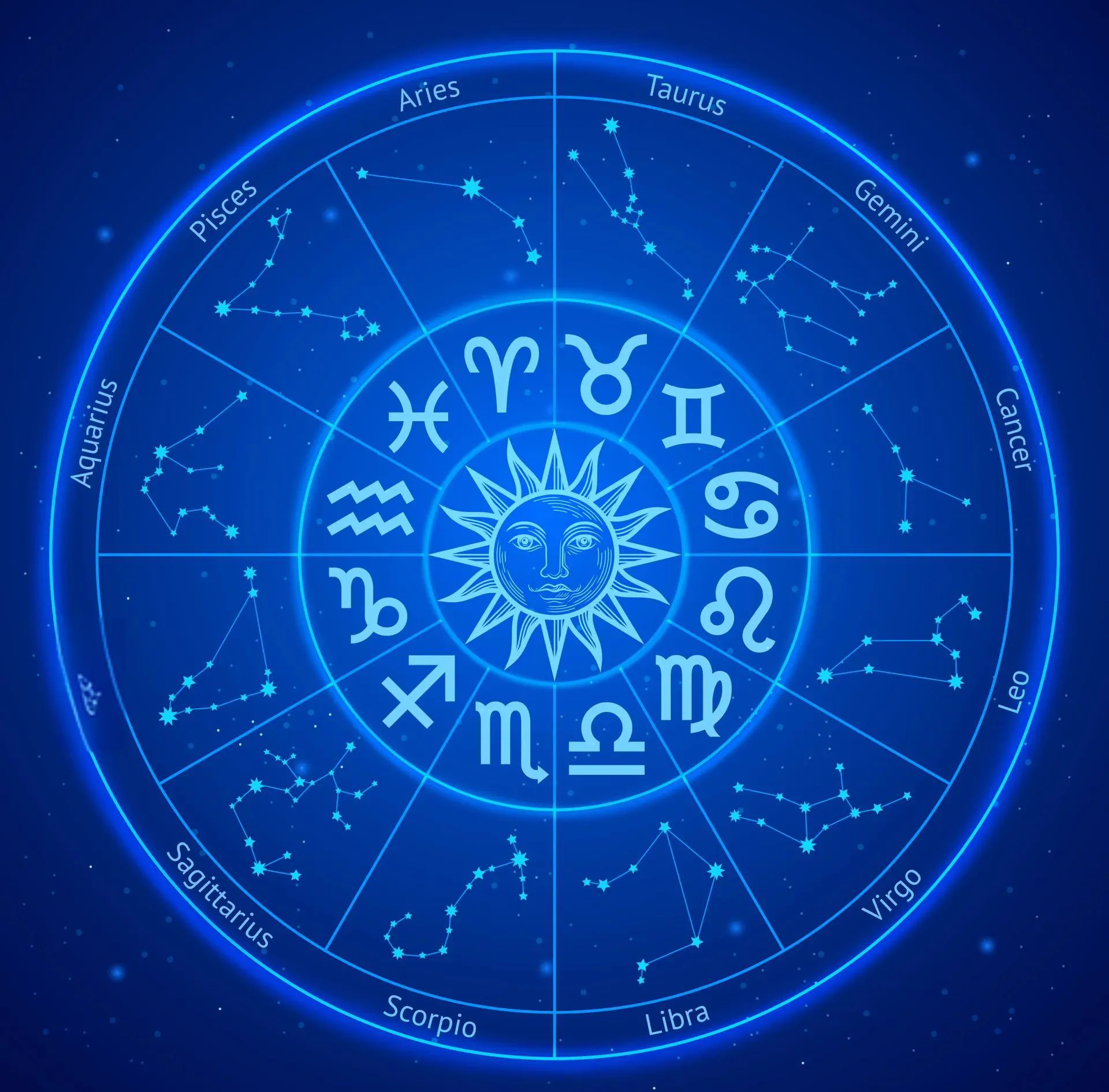
A natal chart is a map of where the planets were at the moment and place you were born, projected onto the twelve zodiac signs and twelve houses. It records ten bodies, twelve signs and twelve houses. Because the rising sign changes roughly every two hours, two people born on the same day can end up with very different charts.
The three placements people usually mean
When someone says “I’m a Scorpio”, they mean their Sun sign. The Sun spends about 30 days in each sign, which is why it is the easiest placement to know and the least specific. The Moon moves through a sign in roughly two and a half days and describes emotional habits. The ascendant, or rising sign, is set by the exact time and place of birth and describes how someone meets the world before deciding how to react.
Reading all three together is the minimum for a chart that says anything specific. A Sun sign alone describes about a thirtieth of one variable.
The twelve signs, by date and element
Dates below follow the tropical zodiac used in Western astrology. Cusp dates can shift by a day depending on the year, so a birth on the 20th or 21st of a month is worth checking against the calculated chart rather than a printed list.
| Sign | Dates | Element | Ruling planet |
|---|---|---|---|
| Aries | Mar 21 – Apr 19 | Fire | Mars |
| Taurus | Apr 20 – May 20 | Earth | Venus |
| Gemini | May 21 – Jun 20 | Air | Mercury |
| Cancer | Jun 21 – Jul 22 | Water | Moon |
| Leo | Jul 23 – Aug 22 | Fire | Sun |
| Virgo | Aug 23 – Sep 22 | Earth | Mercury |
| Libra | Sep 23 – Oct 22 | Air | Venus |
| Scorpio | Oct 23 – Nov 21 | Water | Pluto (Mars trad.) |
| Sagittarius | Nov 22 – Dec 21 | Fire | Jupiter |
| Capricorn | Dec 22 – Jan 19 | Earth | Saturn |
| Aquarius | Jan 20 – Feb 18 | Air | Uranus (Saturn trad.) |
| Pisces | Feb 19 – Mar 20 | Water | Neptune (Jupiter trad.) |
Houses: where, not what
Signs answer “what kind of energy”, houses answer “in which area of life”. There are twelve houses covering themes from identity (first) through partnership (seventh) to dissolution (twelfth). In the Placidus system the houses are unequal in size; in the equal-house system each is exactly 30 degrees. We calculate Placidus by default because it tracks the actual sky at your latitude.
For a closer look at what each house governs, see our guide to the twelve houses explained.
Aspects: the angles between planets
An aspect is the angular distance between two planets, measured in degrees and allowed a margin of error called an orb. Conjunctions (0°) and oppositions (180°) usually get an orb of about 8°; trines (120°) and squares (90°) about 7°; sextiles (60°) about 5°. A tighter orb means a stronger reading. Aspects matter because they describe how two placements interact — a square between Mars and Saturn is not just two planets doing their own thing, it is a specific tension between drive and restraint.
Frequently asked
Does my exact birth time matter?
Yes, for the rising sign and the houses. The ascendant moves roughly one degree every four minutes, so a two-minute error can shift a house cusp. The Sun, Moon and planets stay in the same sign for hours to days, so those placements survive an approximate time.
What if I don't know my birth time?
You can still read the planets, the signs they sit in, and the aspects between them. What you cannot read reliably is the ascendant, the Midheaven, or which house each planet falls in. Some astrologers use a solar chart (Sun placed on the first house) as a substitute; it is a workaround, not a replacement.
Is a natal chart a prediction?
No. A natal chart describes dispositions and timing patterns, not fixed events. Two people with nearly identical charts live different lives. The chart is read as a map of tendencies — what someone is likely to notice, avoid, or gravitate toward — rather than a script.
How accurate are the planetary positions on this page?
Positions are calculated with the Swiss Ephemeris, the same library used by most professional astrology software, and are accurate to within a few arc-seconds for the twentieth and twenty-first centuries. Time zone handling is the most common source of error in any chart, so check the birth place before reading.
Last updated: October 25, 2026 · Planetary positions computed with the Swiss Ephemeris.
Explore more archetypal frameworks — Tarot · BaZi (Four Pillars) · Plum Blossom