
Pig in Chinese Astrology: The Root, the Last Branch, and the Shadow of Comfort
Curious what YOUR chart reveals?
Cast your free BaZi chart and see your Day Master, elemental balance and life patterns through a Jungian lens.
Get Your Free BaZi ChartFree · No sign-up needed
A woman in her early fifties came to me for a relationship reading and spent the first fifteen minutes describing herself as easy. Easy to live with, easy to feed, easy to please. Then she said she had never really wanted much. Nine years into a job she could do on four hours of sleep, she could not name one thing she wanted for herself. When I asked her to try, she laughed for a while and then stopped.
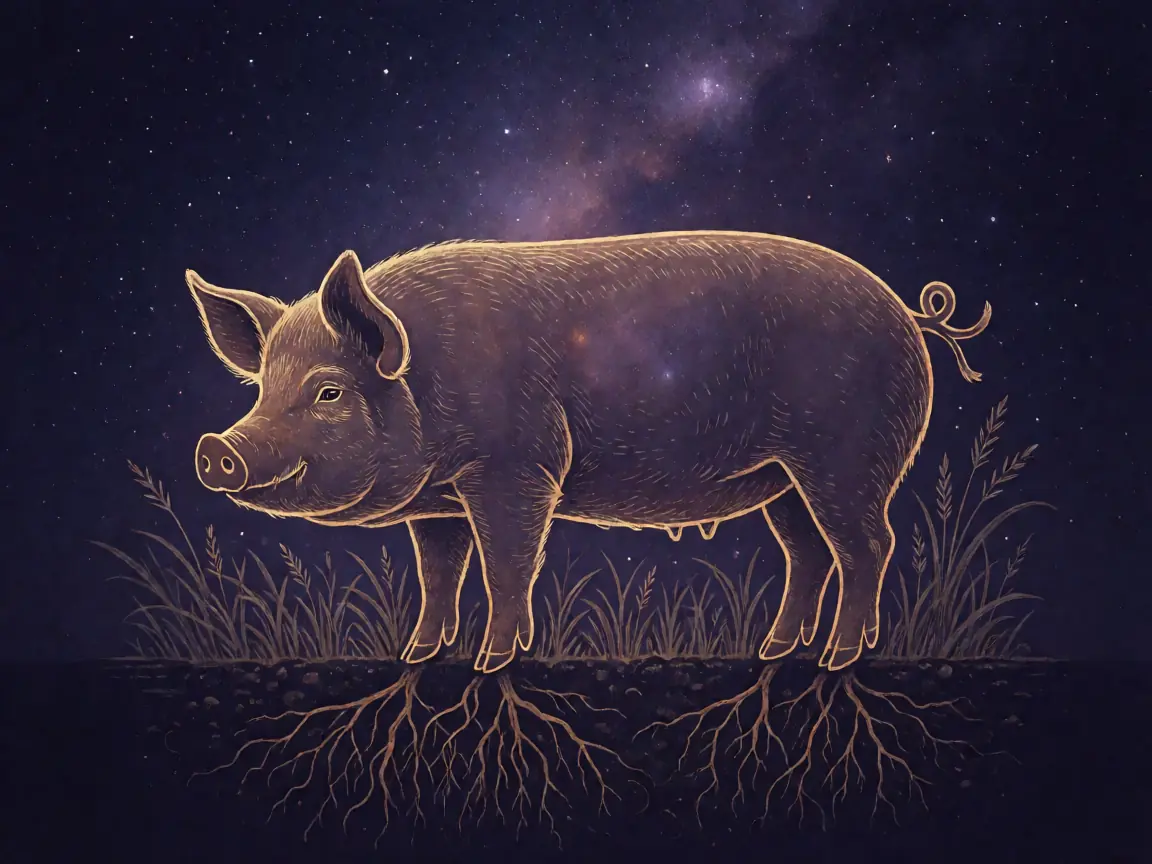
The Pig is the twelfth and last sign of the Chinese zodiac, built on the Earthly Branch Hai (亥), a yin Water branch that rules the north-northwest, the first month of winter, and the two hours before midnight. The tradition reads it as the sign of ease and good nature. Underneath those words sits a branch the old texts call the root of wood.
Her chart carried a second Pig in the hour pillar and a Jia wood day master with no root of its own. The tradition has a phrase for that arrangement, and it concerns appetite gone underground.
The Branch Behind the Animal
Hai closes the ring. Eleven branches run before it and the count turns into the Rat at midnight, so the Pig's hours are the last two of the day, nine to eleven at night, when a house goes quiet. The old explanation is that pigs settle and sleep then.
Its element is yin Water, and its direction is north-northwest. Two stems hide inside it: Ren, yang Water, as the principal qi, and Jia, yang Wood. A branch of water holding a seed of wood.
The character is older than the animal list. In the Shuowen Jiezi, the Han dynasty dictionary, Hai is glossed as the root of grass, and its month is the one where faint yang rises to meet abundant yin. It also notes that the older script wrote the character the same way as the word for pig. Wang Chong confirms it in the Lunheng around 80 CE: Hai is the pig. The Earthly Branches are the machine, and the Pig is the twelfth picture painted on its side.
Pig Years and the Element on Top
| Years | Element | What the pairing adds |
|---|---|---|
| 1935, 1995 | Wood | Water feeding wood, the root showing above ground |
| 1947, 2007 | Fire | Fire on water, warmth that evaporates as fast as it arrives |
| 1959, 2019 | Earth | Earth on water, an appetite that gets dammed early |
| 1971, 2031 | Metal | Metal feeding water, appetite that finds a channel |
| 1983, 2043 | Water | Doubled water, the deepest and least movable of the five |
The 2026 Pig month is Ji Hai, an earth stem on a water branch, opening at the Start of Winter on November 7 and closing at Major Snow on December 7. Four weeks is a fair stretch to ask one question. What have you wanted for years and never said out loud?
What the Tradition Hands You
Read the classical descriptions and you get generosity, honesty, an even temper, and an eye for what is in front of you. Then the list turns. Lazy. Gullible. Self-indulgent. Careless with money.
The tradition is describing one faculty from two angles. The person who does not guard resources reads as generous while things are plentiful and careless when they are not. The same refusal to fight reads as peace in a calm house and silence in a loud one.
Born in a Pig year, you are handed a role before a personality. You are the one who is fine with whatever. Families issue that role to the child who complains least, and employers renew it every year. Jung called this layer the persona, the face a group hands you before you have built your own.
The Root Under the Water
Here is the part most Western readings of the sign miss. The Sanming Tonghui, a Ming dynasty text on the branches, states it in four characters. 亥者,木之根. Hai is the root of wood. The same passage adds that when a tree falls its leaves return to the root.
Look back at the hidden stems and it holds together. Water is the phase that stores, and Jia wood sits inside Hai the way a seed sits inside soil. In the twelve stages of growth, wood is born at Hai. The Wood triangle is Hai with Rabbit and Goat, and the combination of Tiger and Pig transforms into Wood as well. Three mechanics, one answer: the last branch in the ring is the nursery for the phase that grows first in spring.
Jung framed the personality the same way. The self, he wrote in Psychology and Alchemy, is not only the centre but the whole circumference which embraces both conscious and unconscious. A circle that closes is the only place where everything is contained.
Read that into a life and the sign's comfort changes meaning. Rest is not idleness when something is being grown in it. The shadow of the same arrangement is the person who has mistaken patience for hiding, who has rested for eleven years and calls it temperament.
The Snake, the Monkey, and the Tiger
Three relations matter most.
The first is the clash with the Snake. Hai and Si sit directly opposite each other, Water against Fire, and practitioners read that axis as comfort meeting scrutiny. Clients live it as a partner or a manager who asks the direct question they had filed away. It lands badly, and it is also the right one.
The second is the harm with the Monkey. Shen and Hai fall into the quieter category the texts call harm, and the pattern is trust meeting cleverness. It looks like a charming person who handles your affairs well, right up until the part where your affairs are theirs.
The third is a combination. Tiger and Pig combine, and the combination produces Wood. The Tiger supplies drive and the Pig supplies material, so a Pig with a Tiger in the chart finds that the thing stored for years finally moves.
When Water Rots
Self-punishment is a category for four branches that meet themselves badly: Dragon, Horse, Rooster, and Pig. The Rooster turns precision inward, and a Pig turns appetite the same way.
The classical descriptions are specific. Demands never stated as requests, tears out of proportion to the event, thought that will not stop, often about a conversation from years ago. All of it happens inside someone who has spent a lifetime being the easy one.
The Sanming Tonghui explains the mechanism. 亥者,水之生,旺則朽. Hai is the birth of water, and when it prospers it rots. A branch that stores and never gets drawn from goes stagnant, and the remedy is neither more comfort nor more discipline. It is motion, and one named want.
Working With a Pig Chart
Three moves, in the order I use them.
Find the second Pig and the missing wood. Check the year, month, day, and hour branches for a repeat of Hai, then check whether the wood in the chart has a root of its own. A repeated Pig with rootless wood reads as appetite with nowhere to go.
Name one want out loud, weekly. One thing you actually want, said to one person who hears it. The Pig keeps its wants private because they were refused early and nobody discussed the refusal.
Move the water. Water that sits goes stale. Walk somewhere, change a room, or finish the small thing you have been stepping around. Root material only grows when something is built above it.
Journal prompt, if you want one. Write the last time you said some version of I do not need much. Then write what you needed that week, and who knew.
What Changed for the Woman Who Was Easy
She wrote to me in July. By then she had asked for the transfer, started a pottery class on a Tuesday night, and told her husband she was bored, which she said was the sentence that frightened her most. Two of her wants were answered inside a month by people who had no idea they were holding anything back.
The line she ended on is the one I pass on now. Comfort was never the problem. The point where she stopped asking was.
This article is offered for spiritual guidance and entertainment purposes only. It is not a substitute for medical, legal, or financial advice.
Curious what YOUR chart reveals?
Cast your free BaZi chart and see your Day Master, elemental balance and life patterns through a Jungian lens.
Get Your Free BaZi ChartFree · No sign-up needed
Frequently Asked Questions
What does the Pig mean in Chinese astrology?▼
Which years are Pig years?▼
Is the Pig compatible with the Snake?▼
What does self-punishment mean for a Pig?▼
Does a Pig year change a Pig's luck?▼
Recommended Reading
BaZi
Dog in Chinese Astrology: The Guardian, the Fire Vault, and the Wound of Ingratitude
BaZi
Rooster in Chinese Astrology: The Sentry, the Standard, and the Inner Critic
BaZi
Chinese Zodiac Years: Your Animal Sign as Persona, Your Chart as Self
BaZi
What Is BaZi Astrology? The Four Pillars as a Map of the Psyche