
Rooster in Chinese Astrology: The Sentry, the Standard, and the Inner Critic
Curious what YOUR chart reveals?
Cast your free BaZi chart and see your Day Master, elemental balance and life patterns through a Jungian lens.
Get Your Free BaZi ChartFree · No sign-up needed
A man in his forties came to me for a career reading and spent the first twenty minutes correcting his own birth time. He had three versions, all within half an hour of each other, and none would stand. I built the chart three times. The same pattern surfaced in every version. Born in a Rooster year, with a second Rooster sitting in his day pillar, and a standard he had been measuring himself against since childhood. When I used the tradition's own word for that pattern, self-punishment, he laughed once and said that was the whole story. Then he listed the jobs he had left, each one roughly a week before it would have been finished.
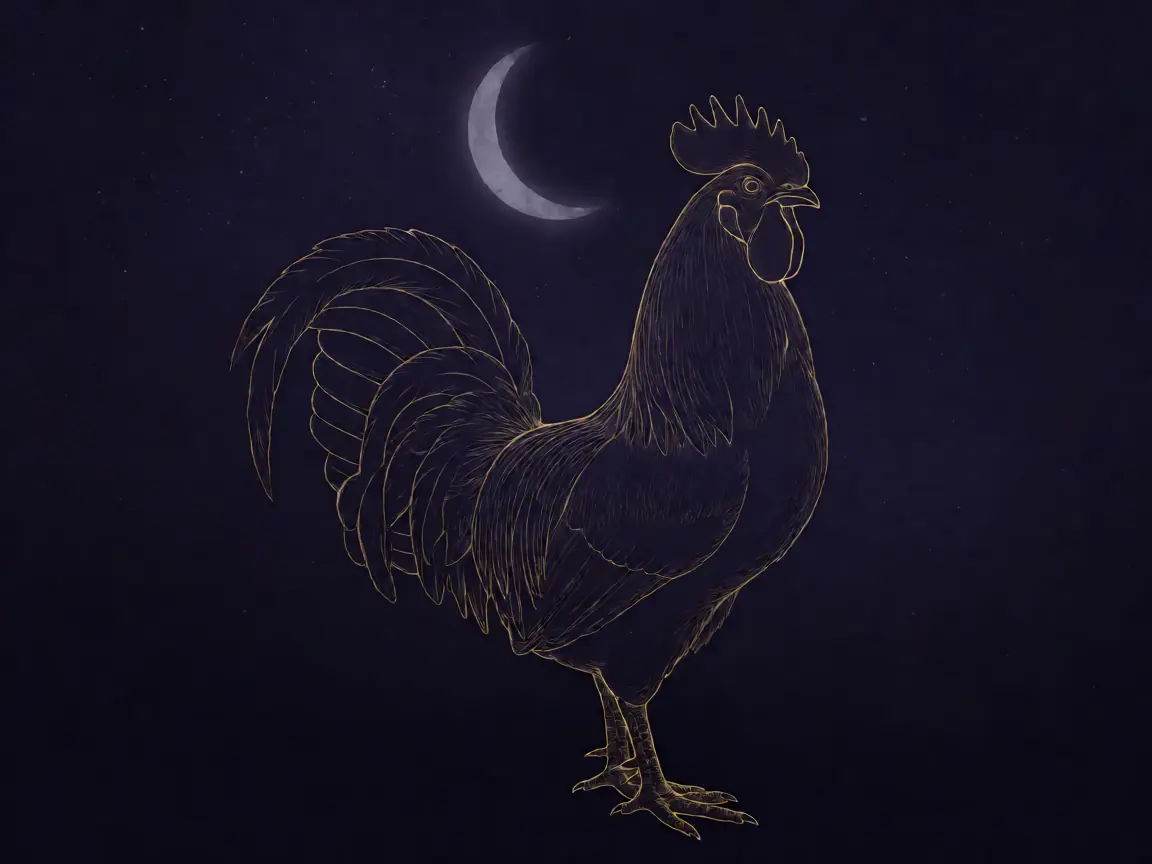
The Rooster is the tenth sign of the Chinese zodiac, built on the Earthly Branch You (酉), a yin Metal branch that rules the west, the autumn season, and the two hours before dusk. It is a branch of precision and standards. It is also one of four branches the tradition marks as capable of turning that precision against itself.
The Branch Behind the Bird
You carries yin Metal, the same quality as the Xin stem in a chart. Think jeweler's metal rather than the axe. Its direction is west and its season is autumn, the stretch of year when the harvest gets sorted. Its hours are five to seven in the evening. The old explanation for that assignment is plain. Roosters walk back to the coop at dusk, and the branch borrowed the image of birds going home.
Long before the animals arrived, scribes were already counting in these twelve. A sixty-day version of the count appears on Shang dynasty oracle bones, and the Eastern Han philosopher Wang Chong set the twelve-animal cycle down in writing around 80 CE in the Lunheng. The Earthly Branches are the machine. The animals are the picture painted on the side of it. The Rooster is the tenth picture, and ten is not an accident of the race story.
The Great Race puts Goat, Monkey, and Rooster in places eight, nine, and ten because the three crossed the river on a single raft. The Rooster found the raft. The Monkey and the Goat did the pulling. The Jade Emperor rewarded the teamwork and named them in the order they reached the far bank. Read that as a description of the sign and it lands. A Rooster is often the one who notices the tool the group needed and nobody had named yet.
Rooster Years and the Element on Top
| Years | Element | What the pairing adds |
|---|---|---|
| 1933, 1993 | Water | Metal feeding water, output ahead of polish |
| 1945, 2005 | Wood | The blade asked to grow something |
| 1957, 2017 | Fire | Warm flame sitting on a cold edge |
| 1969, 2029 | Earth | Ore still in the ground, slower and steadier |
| 1981, 2041 | Metal | Metal on metal, the doubled standard |
The months run on the same principle at a faster tempo. The 2026 Rooster month opened at White Dew on September 7 and closes at Cold Dew in early October, and its stem that year is Ding, a yin Fire sitting on a yin Metal branch. Warm flame over a cold blade. A useful exercise for those four weeks is watching how you handle one unfinished task.
What the Tradition Hands You
The classical descriptions give the Rooster confidence, sharp observation, honesty of speech, and a strong instinct for presentation. It is the best-dressed sign in the zodiac, and the tradition says so out loud. Born in a Rooster year, you get handed exactly that. The description is closer to a job than a personality. It names what a family, a school, or a market wanted from you. Jung called this layer the persona, the face a group issues before you have had time to build your own.
Roosters get issued a demanding one. Competence is the persona. The child praised for being the reliable one, the sensible one, the one who could be trusted with the details, learns early that the way to be loved is to be correct. Twenty years later that same gift can be doing the work of a prison. I have watched the pattern in engineers, surgeons, and one pastry chef who could not plate a dessert without redoing it twice.
The Trap of the Two Roosters
The tradition keeps a category for branches that meet themselves badly. It is called self-punishment, and the Rooster is one of the four. Rooster with Rooster, in a chart, a year, or a month, produces friction that arrives from inside rather than outside. The classical texts list the ordinary symptoms. Overthinking. Repeating the same error. Difficulty letting go. A run of small troubles with your own name on them.
Fifteen years of clients with that configuration has taught me one thing about it. The faculty causing the trouble is the same faculty that makes the work good. Precision aimed outward makes fine craft. The Rooster's problem is that the same faculty turns inward and starts auditing. Jung set the mechanism out in Psychological Types in 1921, writing that the dominant function characterizes consciousness while its opposite is repressed and characterizes the unconscious. Judgment leads the chart. Mercy waits in the back room, and it gets louder the longer nobody answers.
The five elements offer the exit. Metal generates Water, which means the product of a blade is flow. Relief for a Rooster comes from producing something and letting it leave the house. One more round of checking pays the critic and nobody else. Polishing consumes the metal. Producing releases it.
Precision and Expression
Two relationships in the branch system describe how a Rooster handles people. The Rooster sits directly opposite the Rabbit. You meets Mao, Metal meets Wood, and practitioners read that axis as precision against expression. In practice a Rooster finds the Rabbit careless. The Rabbit finds the Rooster rigid. What the Rooster usually cannot see is that the mess he objects to is the part of himself he filed away in childhood, along with the play and the half-built projects.
The easy pairings run in the other direction. Snake, Ox, and Rooster form the Metal triangle of autumn, and a Rooster among them stops defending the standard because everyone at the table already agrees on it. Dragon is the sign the tradition joins to Rooster by combination, the pairing that can meet a Rooster without either side reaching for a blade.
Working With a Rooster Chart
Three moves, in the order I use them with clients.
Find the second Rooster. Check the year, month, day, and hour branches for a repeat of You. If it is there, expect the internal critic to speak in the language of high standards rather than cruelty, which is exactly why it survives so long. Nobody argues with a standard.
Give the standard a face. In these charts the critic usually speaks in the voice of a parent, a first manager, or a school that sorted children by output. Naming it as a voice moves it out of the category of fact.
Ship at eighty percent. Pick one thing and hand it over while it still feels unfinished, then watch what happens to the sky.
Journal prompt, if you want one. Write down the last three things you did not finish, then write what you were protecting by stopping one week early. The answer tends to repeat, and it rarely has anything to do with the work.
What Changed for the Man With Three Birth Times
He wrote to me about a year later. He had finished a course he had been eight weeks from completing, and he admitted he handed in the final project with two errors still in it. Then he said the line I repeat to Roosters now. The errors were not his problem. The years of stopping early were his problem, and the stopping had been the one habit keeping his standard intact.
Jung, writing after a long dark stretch of his own work, noted that every descent is followed by an ascent. For a Rooster the descent has an address. It is the workshop where the standard lives, and the way out runs through the door marked finished.
This article is offered for spiritual guidance and entertainment purposes only. It is not a substitute for medical, legal, or financial advice.
Curious what YOUR chart reveals?
Cast your free BaZi chart and see your Day Master, elemental balance and life patterns through a Jungian lens.
Get Your Free BaZi ChartFree · No sign-up needed