
Rat in Chinese Astrology: The First Branch, the Midnight Hour, and the Archetype of Beginnings
Curious what YOUR chart reveals?
Cast your free BaZi chart and see your Day Master, elemental balance and life patterns through a Jungian lens.
Get Your Free BaZi ChartFree · No sign-up needed
A man in his late forties sent me the same birth details three times in one week. He was born at 23:40. Three practitioners handed him three answers about his day pillar, and they disagreed about his day master, the sign a BaZi reading works from. He had spent twenty years building a sense of himself on the first answer.
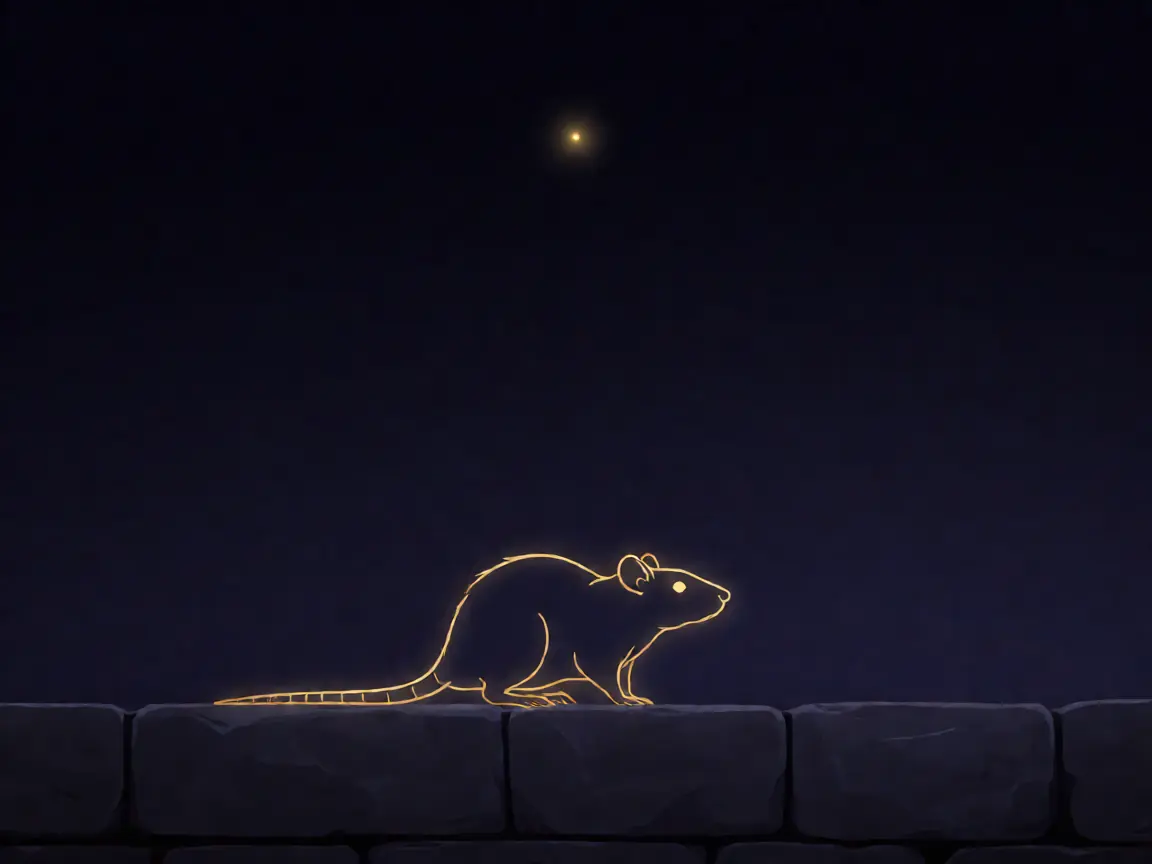
The Rat is a Chinese zodiac sign built on the Earthly Branch Zi (子), a yang Water branch that rules due north, the eleventh month of the solar year, and the two hours around midnight. It is the first of the twelve, and the only branch whose window straddles two calendar days. The tradition's hidden-stem table gives Zi one stem, Gui, yin Water, which makes it one of the four branches of undiluted qi.
His hour pillar was Zi. Everything he wanted from that reading depended on a technicality about midnight.
The Branch Behind the Animal
Zi opens the count. Its element is yang Water, its direction due north, its season midwinter, and its hour the two around midnight.
The character is older than the animal list. In the Shuowen Jiezi, the Han dynasty dictionary, the earliest form of 子 is a picture of an infant. The branch that starts the twelve is named after a child. The same tables give it the eleventh month, the pitch pipe Huang Zhong, and the three lunar mansions Girl, Emptiness, and Danger.
Wang Chong's Lunheng gives the earliest complete listing pairing each branch with an animal, and it says plainly that Zi is the rat. The Earthly Branches are the twelve-slot clock, and the Rat is the picture painted on its first slot.
The month carries as much as the hour. The eleventh month has its own figure in the calendar of twelve, Hexagram 24, Return: one firm line at the bottom under five yielding ones, drawn at the winter solstice. The first branch in the ring belongs to the thing that comes back.
The Hour That Splits the Day
Zi runs from 23:00 to 01:00, so a birth at 23:40 sits in a window straddling midnight. Two schools have argued about which day that birth belongs to ever since clocks arrived.
The Tang calendar treatise in the New Book of Tang records the earlier rule in four characters, 古曆分日,起於子半, old calendars divided the day at the middle of the Zi hour. A Song and Yuan astronomical text, the Gexiang Xinshu, states the split directly: the half of the Zi hour before midnight belongs to the previous day, and the half after midnight belongs to the current one. Follow midnight and a 23:40 birth keeps the pillar of its own day, while the 23:00 rule advances it.
There is a proverb for the result. 神仙難斷子時命: even an immortal cannot judge a chart cast in the Zi hour.
The arithmetic is small. Day pillars move one place per day, so the two candidates differ by one stem and by polarity, yang Metal against yin Metal. The day master names the element that every other stem in the chart is read against, so the two readings hand you different people.
If your birth time lands in that window, do not pick a school in advance. Read both pillars and notice which one you push away. In my experience the rejected reading is the useful half, because it holds the material the persona was built to cover.
Get the clock time right before any of that. The method is true solar time, which corrects the recorded hour for longitude and the equation of time.
Rat Years and the Element on Top
| Years | Element | Step in the sixty |
|---|---|---|
| 1924, 1984 | Wood | 1 |
| 1936, 1996 | Fire | 13 |
| 1948, 2008 | Earth | 25 |
| 1960, 2020 | Metal | 37 |
| 1972, 2032 | Water | 49 |
Rats are in a clash year as of this writing. 2026 is a Fire Horse year, and the Horse stands directly opposite Zi, so the opposition runs from February 17, 2026 until February 5, 2027. In chart work that stretch reads as pressure on whatever a household has settled into.
What the Tradition Hands You
Read the classical columns and you get a good list, quick, resourceful, alert, sociable, thrifty, and good at finding the way into a situation.
Then the list turns. Calculating. Suspicious. Restless. Hoarding.
Both halves describe one faculty. The person who scans a room notices what everyone wants and never fully sits down. Jung called the handed-out version of a self the persona, the face a group gives you before you have made one of your own. A Rat child gets the alert role early. A household that needs someone awake finds that child fast.
Water That Peaks at Midnight
Zi holds the middle seat of the Water trine with the Monkey and the Dragon, 申子辰, and a trine has a birth station, a peak, and a grave. Zi is the peak, so a chart with two or three Rats runs deep and slow.
The combination with the Ox, 子丑合, resolves into Earth, and earth over water reads as a container for what water will not release.
The clash with the Horse, 子午沖, sets water against fire and midnight against noon. It arrives as a person or a demand that moves at a speed you never use.
The last relation matters most to me. Rat and Rabbit punish each other, 子刑卯, and the classics name that pair 無禮之刑, the punishment of discourtesy. The explanation is that water feeds the wood and the wood does not acknowledge the debt. As psychology it describes the supplier who never gets named for it. In a chart it reads as friction with the people you have carried longest, and the classical symptom is resentment that arrives years after the event that earned it.
The Child in the Dark
Jung wrote about the child motif as an archetype in The Archetypes and the Collective Unconscious (CW 9i). The child appears in myth abandoned, exposed, and in danger, and it survives anyway. Jung read it as a symbol of futurity, the part of a psyche that is already the future while the present looks settled, and it shows up at the low point rather than at the height.
Put the two calendars side by side and the Rat is that figure twice over: the first branch is the infant, and its month is Return, one yang line under the earth at the solstice, when nothing visible supports the thing that has turned.
That arrangement gives the sign its gift and its trap. The gift is that a Rat chart recovers. The trap is that starting is the easy part, so a life can be assembled out of openings. The shadow of this branch is a full shelf of beginnings.
Working With a Rat Chart
Three moves, in the order I use them.
Settle the hour. If the birth falls between 23:00 and 01:00, get the original record, fix the time zone, and correct for true solar time. Then read both day pillars and note which one you resist.
Find the outlet. Water needs somewhere to go, through wood that grows, an earth bank that holds it, or metal upstream. Zi carries a single stem, so a chart with two or three Rats is concentrated water, and concentration without an outlet reads as a mind that will not stop turning.
Count the starts. Name the last three things you began this year and where each one stands now.
Journal prompt. Write the thing you started most recently and describe its current state in one plain sentence. Then write what finishing it would cost you.
What the Man Released
He stopped asking which pillar was correct. He told me the yang Metal version sounded like a job he had held for a decade, and the yin Metal version sounded like him.
He wrote in August to say the birth-hour question had stopped mattering. What mattered was that a technicality had held a self-image in place for twenty years, and once he saw it he stopped defending the image.
One line from his last note is worth passing on. He said the first branch of anything is the branch of the thing that comes back.
This article is offered for spiritual guidance and entertainment purposes only. It is not a substitute for medical, legal, or financial advice.
Curious what YOUR chart reveals?
Cast your free BaZi chart and see your Day Master, elemental balance and life patterns through a Jungian lens.
Get Your Free BaZi ChartFree · No sign-up needed
Frequently Asked Questions
What does the Rat mean in Chinese astrology?▼
Which years are Rat years?▼
Why do practitioners disagree about the Rat hour?▼
Is the Rat compatible with the Horse?▼
What is the punishment of discourtesy?▼
Recommended Reading
BaZi
Pig in Chinese Astrology: The Root, the Last Branch, and the Shadow of Comfort
BaZi
Dog in Chinese Astrology: The Guardian, the Fire Vault, and the Wound of Ingratitude
BaZi
Rooster in Chinese Astrology: The Sentry, the Standard, and the Inner Critic
BaZi
Chinese Zodiac Years: Your Animal Sign as Persona, Your Chart as Self