Dragon in Chinese Astrology: The Fifth Branch, the Water Vault, and the Shadow of Overfill
Curious what YOUR chart reveals?
Cast your free BaZi chart and see your Day Master, elemental balance and life patterns through a Jungian lens.
Get Your Free BaZi ChartFree · No sign-up needed
He ran operations for a company of four hundred people. Eleven years, two acquisitions, one near miss with insolvency. When I asked what he did with a free Saturday, he laughed and said he supposed he would find out.
Then he described the week. His sister's mortgage paperwork, a board member's son who needed an internship, and a warehouse manager in the middle of a divorce. All of it handled, in order, none of it his.
I asked what would happen if he stopped. He said the whole thing would come apart, and he said it the way a person states a fact.
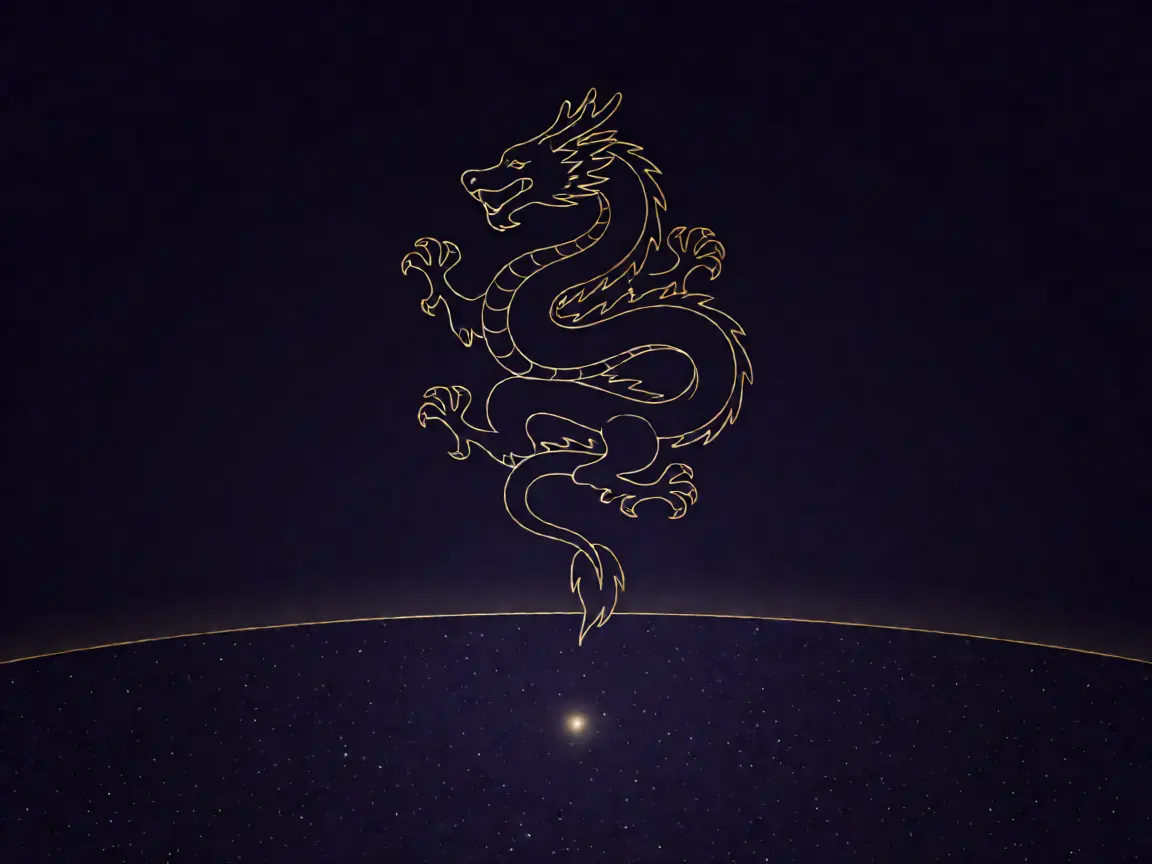
The Dragon is a Chinese zodiac sign built on the Earthly Branch Chen (辰), a yang Earth branch that rules the third month of spring, the two hours after seven in the morning, and the vault where water is kept. Eleven of the twelve animals in the cycle exist. This is the one that does not, and the tradition has read that gap ever since.
The Branch Behind the Animal
Chen takes the fifth seat of the twelve, yang Earth, east by southeast, and its hidden stems are 戊 earth as the principal qi, 乙 wood, and 癸 water: soil with a reservoir inside it.
Ask the Zuo Zhuan what chen means and the answer is 日月之会是谓辰: the meeting of the sun and the moon is what is called chen. Du Yu's third-century commentary counts twelve a year, 一歲日月十二會,所會謂之辰, each taking a name.
The Shuowen Jiezi, the Han dictionary, opens with a pun that is also a definition. 辰,震也. Chen means to shake. 三月,陽氣動,雷電振,民農時也,物皆生: in the third month the yang qi stirs, thunder and lightning shake, it is the farmers' season, and everything grows.
Why the Fifth Branch Is a Dragon
In the Erya, the oldest dictionary in the language, two of the twenty-eight lunar lodges sit in the section it names 壽星, the Longevity Star, and Guo Pu explains the name in his fourth-century commentary: 數起於角,列宿之長,故曰壽星, the count starts at Jiao, which heads all the lodges.
Those two lodges are 角, the Horn, and 亢, the Neck. The old star lists give each an animal, and both animals are dragons: 角木蛟, Horn, Wood, the horned river-dragon, and 亢金龍, Neck, Metal, Dragon. A thirteenth-century compilation of star lore agrees in four characters, 壽星會辰.
So the zodiac's Dragon is a neck and a pair of horns coming up in the east, and neighbouring calendars fill the seat from their own skies, among them a nāga in the Buddhist zodiacs of Thailand and Cambodia.
Parents in Chinese-speaking countries still time births to Dragon years, hard enough that hospitals report capacity strain. The one animal in the cycle that nobody has ever seen is the one most wanted.
Carl Jung's term for that arrangement was archetype: an inherited image that shapes how a person meets the world while corresponding to no object they have met.
Dragon Years and the Element on Top
| Years | Element | Step in the sixty |
|---|---|---|
| 1928, 1988 | Earth | 5 |
| 1940, 2000 | Metal | 17 |
| 1952, 2012 | Water | 29 |
| 1964, 2024 | Wood | 41 |
| 1976, 2036 | Fire | 53 |
The Last Month of Spring
Chen closes the season, from Qing Ming to Li Xia, 季春. Computed against the sun's ecliptic longitude, the 2026 Dragon month ran from April 5 at 02:40 to May 5 at 19:49 Beijing time. The 2027 one opens April 5 at 08:18.
The Book of Rites pairs the twelve months with the twelve pitch pipes, and the third is 律中姑洗, tuned to Guxi, while the star compilation adds a picture worth keeping: 動則變故龍,以春分升而為雷, when it moves it changes, and at the spring equinox it rises up out of the ground as thunder.
Spring's own quarter closes here. 寅卯辰 runs from the Tiger at the opening through the Rabbit in the middle, and the Dragon takes the corner where spring turns over into summer.
The month carries Hexagram 43, Guai, five firm lines under a single yielding one, and the site keeps a full hexagram reference for the shapes.
What the Tradition Hands You
Read the old columns and you get a bright list, confident, ambitious, generous, quick to act. Then the list turns. Impatient. Proud. Allergic to being managed. Prone to overpromise.
Chen is a vault. A container takes what it is given and holds it, which is why a Dragon chart keeps getting handed other people's problems. Nothing inside it can weigh the contents either, so the load always looks reasonable from outside.
The Vault, the Clash and the Harm
The six combination runs Chen with You, the Rooster, 辰酉合, resolving into Metal, and the old commentaries call this a 生合, a productive union, since earth generates metal.
Monkey, Rat and Dragon make up the water trine, 申子辰, and Chen holds the grave of the three. Water is born at Shen, peaks at Zi in the Rat post, and is stored here. The Sanming Tonghui gives it a logic: 辰者,水之府。言水流趨東,必東流逝而不返也, Chen is the treasury of water, and water that runs east does not come back.
Dragon and Dog are in clash, 辰戌, and it runs loud because both branches are vaults. One holds water, one holds fire, and neither can take the other's contents.
The harm is Rabbit against Dragon, 卯辰, which the Rabbit post calls friction that never resolves into an argument. The break is Chou against Chen, 丑辰, a split slow enough to look like drift, and Chen sits in no punishment triad, one of the four that punish themselves.
The Shadow of Overfill
The Sanming Tonghui works the four self-punishing branches out with arithmetic first. Each group of four seats leaves one member with nothing to pair against: 蓋無別物相加,乃曰自也, since no other thing is set against it, it is called self.
Then each seat gets its own sentence. 辰者,水之墓,滔則盈。午者,火之旺,暴則焚。酉者,金之位,剛則缺。亥者,水之生,旺則朽。Chen is the grave of water, and when it floods it overfills, while Wu is fire at its peak and burns when it rages, You sits where metal chips when it is hard, and Hai is the birth of water that rots when it prospers. Each seat carries qi already too full, and brings the harm on itself.
滔則盈 is the Dragon's shadow in three characters. Nothing outside corrects a Chen chart, because nothing outside is ever set against it. The correction comes from inside, and it usually arrives as the body first.
The old symptom list is specific: 沉靜內毒, quiet on the surface and corrosive underneath, 察見淵漁, seeing the fish at the bottom of the pool, and 多肢節手足之災, trouble in the joints and limbs. Jung described the same plateau from another direction:
> "Confrontation with the shadow produces at first a dead balance, a standstill that hampers moral decisions... nigredo, tenebrositas, chaos, melancholia."
Carl Jung wrote that in the language of alchemy, and the alchemy has the timing right. The descent does not announce itself. In a chart with no external opponent, the standstill reads as competence, and competence is the last thing anyone thinks to question.
The animal is the clue, and the man at the start of this piece shows the shape: a vault full for eleven years that had never once been weighed. Jung's shadow is the material the ego will not own. For a Dragon chart the disowned material is usually need, wanting something nobody else requires, without a reason attached.
Working With a Dragon Chart
Write the capacity number. Keep a week's list of what you took on, then mark what was yours to carry. Dragon charts find the ratio embarrassing, which makes it useful.
Leave one thing unfinished on purpose. A vault closes on principle, and letting something stay open costs a Dragon chart more than anyone else. The cost is the data.
Move before the reading is complete. 動則變故龍: a container that never moves cannot find out what it was holding, and nothing outside it will ever move it.
Journal prompt. List the last three things others asked you to carry, then find the one you would have chosen.
What He Decided
Four months later he sent a note about a Tuesday. He had taken the whole day and driven to the coast without telling anyone where he was going. No crises. His sister had filed her own paperwork, and the intern had found somewhere else to go.
The sentence I kept was further down. He said the company had been fine without him, and that this had been worse news and better news than he expected.
This article is offered for spiritual guidance and entertainment purposes only. It is not a substitute for medical, legal, or financial advice.
Curious what YOUR chart reveals?
Cast your free BaZi chart and see your Day Master, elemental balance and life patterns through a Jungian lens.
Get Your Free BaZi ChartFree · No sign-up needed
Frequently Asked Questions
What does the Dragon mean in Chinese astrology?▼
Which years are Dragon years?▼
Why is the Dragon the only mythical animal in the zodiac?▼
What does it mean that the Dragon is a self-punishing branch?▼
What is the Dragon's shadow?▼
Recommended Reading
BaZi
Rabbit in Chinese Astrology: The Fourth Branch, the Hour of Sunrise, and the Shadow of the Offering
BaZi
Tiger in Chinese Astrology: The Third Branch, the Hour Before Dawn, and the Shadow of Power
BaZi
Ox in Chinese Astrology: The Second Branch, the Metal Vault, and the Burden of Reliability
BaZi
Rat in Chinese Astrology: The First Branch, the Midnight Hour, and the Archetype of Beginnings