The Trigrams of the I Ching: The Eight Foundational Symbols of the Collective Unconscious
Ask the oracle a question
Cast a hexagram and receive a reflection rooted in the I Ching — your question, answered by ancient wisdom.
Cast Your Free HexagramFree · No sign-up needed
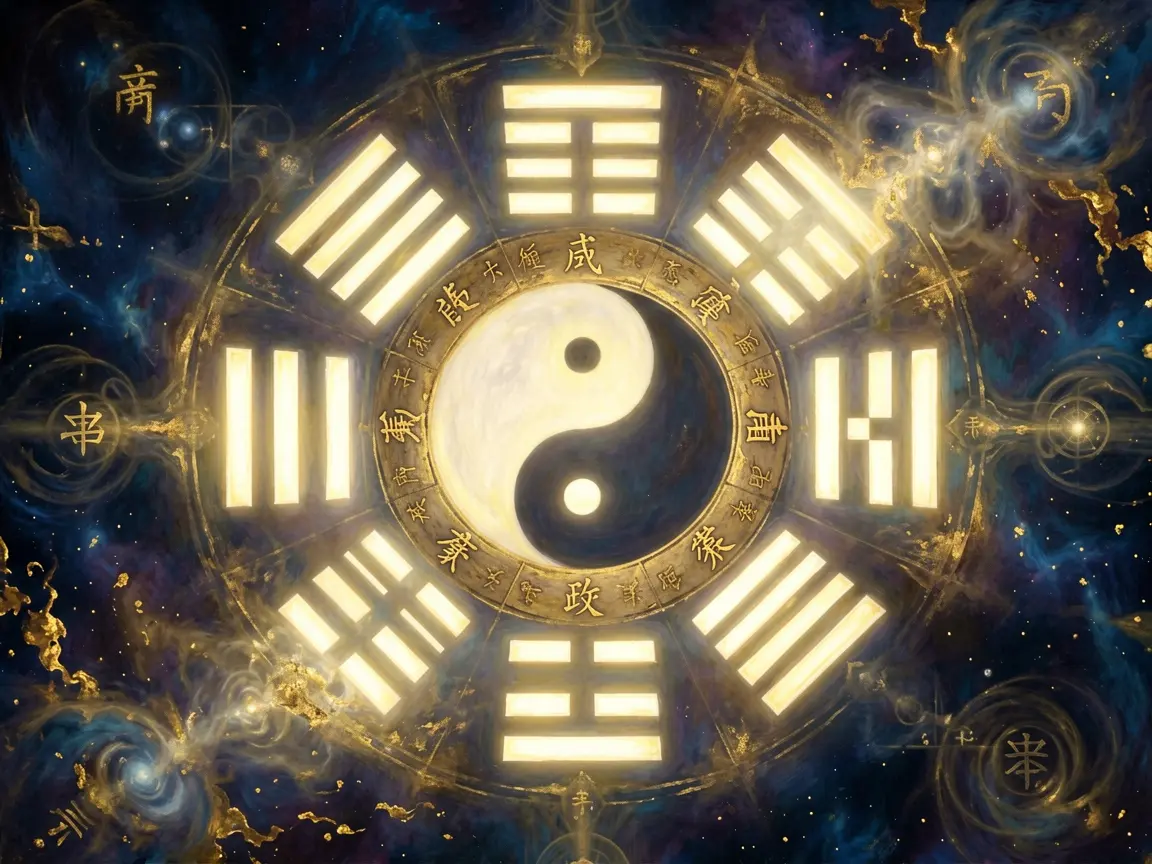
A trigram is a symbol of three stacked lines, each either yang (unbroken) or yin (broken). The eight possible combinations form the bagua, the foundational alphabet of the I Ching. Paired, they generate all sixty-four hexagrams. In Jungian terms, the trigrams are archetypes: eight inherited patterns through which the psyche organizes experience.
The Architecture of the Archetypal Mind
Carl Jung spent over a decade with the I Ching. He consulted it regularly. He co-wrote the psychological commentary for Richard Wilhelm's translation. He called it "the only completely satisfying book I know."
That's strong praise from the founder of analytical psychology for a text composed three thousand years before his birth.
The eight trigrams hold the answer. These eight foundational symbols stack in pairs to produce all sixty-four hexagrams. Jung saw them as an archetypal grammar. A symbolic language the psyche uses to express its deepest patterns.
This is a psychological exploration. The trigrams as mirrors of the inner architecture that shapes how you experience the world.
What Is a Trigram?
A trigram (卦 gua) is three lines stacked. Each line is either unbroken (yang, ⚊) or broken (yin, ⚋). Two lines give four possibilities. Three give eight. The ancient Chinese called this complete set the ba gua.
More than a binary code. Each of those eight combinations became a living symbol with a name, an elemental quality, a family role, and a set of psychological attributes. Together they describe the fundamental states of energy and consciousness that cycle through human experience.
Jungian terms: the eight trigrams are archetypes. Universal, inherited patterns of psychic energy that show up across cultures and inside every individual psyche. Jung mapped the Mother, the Shadow, the Anima, the Self. The I Ching offers eight foundational archetypes through which the psyche organizes reality.
The Eight Trigrams as Archetypal Patterns
☰ 1. Qian (乾) — The Creative, Heaven
Symbol: Three unbroken yang lines. Element: Heaven. Family role: Father.
Qian is pure yang. Undifferentiated creative power. In psychological terms: the capacity for initiative, vision, generative action. The archetype of the originator, the force that brings something new into being.
Jung linked this energy to the masculine principle. Not gendered, not literal. Qian is consciousness initiating, the will that shapes raw potential into form. When this trigram surfaces in a reading, the question becomes: Where in your life are you being called to initiate instead of react?
Shadow side: Overbearing dominance, inability to receive, burnout from relentless doing.
☷ 2. Kun (坤) — The Receptive, Earth
Symbol: Three broken yin lines. Element: Earth. Family role: Mother.
Kun is pure yin. The receptive field creative energy descends into and takes form. Psychologically: surrender, containment, deep listening. Where Qian initiates, Kun receives. Nurtures. Brings to fruition.
Jung called this the feminine principle. A profound openness that lets things reveal themselves. Kun is the psyche holding space, letting experiences land without immediately shaping them. The fertile ground of the unconscious where new insights grow.
Shadow side: Martyrdom, passivity disguised as virtue, loss of boundaries.
☳ 3. Zhen (震) — The Arousing, Thunder
Symbol: One yang line beneath two yin lines. Element: Thunder. Family role: First son.
Zhen is sudden movement. Awakening. The shock that breaks stagnation. Psychologically: the disruptive energy that jolts the psyche out of comfortable patterns. The moment a long-denied truth surfaces. The crisis that forces a change you had been sidestepping.
In Jungian terms, Zhen is the activation energy of individuation. The rupture that pushes the ego toward growth. The archetype of the wake-up call.
Shadow side: Chronic restlessness, anxiety-driven action, inability to find stillness.
☵ 4. Kan (坎) — The Abysmal, Water
Symbol: One yin line between two yang lines. Element: Water. Family role: Second son.
Kan is the most psychologically layered of the trigrams. Water flowing through an abyss. Dangerous, unpredictable, and the source of life all at once. Kan represents the unconscious itself. The deep currents of emotion and instinct moving beneath the surface.
Jung wrote at length about the descent into the unconscious. Confronting the shadow. Integrating the repressed material that shapes behavior from below. Kan is that descent. The dark night of the soul. The disorientation that precedes genuine transformation.
Shadow side: Depression, addiction, drowning in emotion without reflective distance.
☲ 5. Li (离) — The Clinging, Fire
Symbol: One yin line between two yang lines. Element: Fire. Family role: Second daughter.
Li is fire. Sustained flame, unlike the sudden shock of Zhen's thunder. Psychologically: consciousness itself. The capacity to illuminate, perceive, understand. Li gives clarity, discernment, focused attention.
In the Jungian framework, Li maps to the conscious ego. The spotlight of awareness that examines the unconscious without being consumed by it. The archetype of insight. Of seeing clearly.
Shadow side: Obsessive over-analysis, detachment from feeling, intellectualization as defense.
☶ 6. Gen (艮) — The Stillness, Mountain
Symbol: One yang line above two yin lines. Element: Mountain. Family role: Third son.
Gen is the energy of stopping. The wisdom of knowing when to hold still. Psychologically: meditation, boundaries, the grounded presence that makes real perception possible.
Jung understood the necessity of the still point. A mountain does not chase experience. It stands. By standing, it offers perspective. Gen is the observer archetype. The part of the psyche that witnesses without grasping, holds without clinging.
Shadow side: Stubbornness, emotional rigidity, disconnection from the flow of life.
☱ 7. Dui (兑) — The Joyous, Lake
Symbol: One yin line above two yang lines. Element: Lake. Family role: Third daughter.
Dui is the energy of joy, connection, open expression. A lake reflecting the sky. Its surface mirrors the surroundings while holding depth beneath. Psychologically: relationship, communication, the joy of authentic contact.
In Jungian terms, Dui is the archetype of relatedness. The psyche's capacity to connect, express feeling, find pleasure in meeting. The energy that makes relationship nourishing rather than transactional.
Shadow side: People-pleasing, loss of self in social performance, avoiding solitude.
☴ 8. Xun (巽) — The Gentle, Wind
Symbol: One yin line beneath two yang lines. Element: Wind. Family role: First daughter.
Xun is the energy of gentle penetration. Wind moving through a forest, finding every opening, touching everything without force. Psychologically: adaptability, subtle influence, the quiet power of persistence.
Jung recognized this as the energy of the subtle. Changes that happen through gradual infiltration, not confrontation. Xun is the archetype of organic growth. Tendencies that shift direction by yielding, not by willpower.
Shadow side: Indecisiveness, lack of conviction, being blown by every influence.
The Psychological Function of the Trigrams
You are not a "Qian type" or a "Kun person." The trigrams are not personality labels. They are states, and every psyche moves through all eight.
The real question: which one is speaking right now? And can you hear it?
In a single day you cycle through multiple trigrams. Qian when you start a project. Kun when you listen to a friend. Zhen when unexpected news arrives. Gen when you pause to breathe.
The trigrams map psychological motion. A vocabulary for the inner weather that changes moment to moment, season to season, life stage to life stage.
Practical Application: A Journaling Exercise
Try this the next time you feel stuck or at a turning point.
First, identify your current trigram. What energy is most alive right now? A Qian phase of initiation? A Kan phase of descent and confusion? A Gen phase of stillness?
Second, find the missing trigram. Stuck in Kan? You might need Li, the clarifying fire of consciousness. Burning out in Qian? You need Kun, receptivity and rest.
Third, journal with the trigram. Write for ten minutes on what that archetypal energy is asking of you. Not "what should I do." Ask instead: "what is this energy trying to teach me?"
This practice uses ancient symbolic language to articulate what the psyche already knows but has not yet spoken.
Frequently Asked Questions
What are the eight trigrams of the I Ching?
The eight trigrams (bagua) are the foundational symbols of the I Ching: Qian (Heaven/Creative), Kun (Earth/Receptive), Zhen (Thunder/Arousing), Kan (Water/Abysmal), Li (Fire/Clinging), Gen (Mountain/Stillness), Dui (Lake/Joyous), and Xun (Wind/Gentle). Each is three stacked yin or yang lines.
How are the eight trigrams related to the 64 hexagrams?
Every hexagram is two trigrams stacked, one above the other. That gives 8 x 8 = 64 combinations. The lower trigram is the inner, subjective situation. The upper trigram is the outer environment.
What do the eight trigrams mean psychologically?
From a Jungian perspective, each trigram is an archetype, a universal pattern of psychic energy. Together they cover the full range of fundamental psychological states: initiative (Qian), receptivity (Kun), awakening (Zhen), descent (Kan), consciousness (Li), stillness (Gen), joy (Dui), and gentle influence (Xun).
Are the eight trigrams the same as the bagua in feng shui?
The same eight symbols appear in feng shui, Taoist cosmology, and Chinese medicine, but their meanings shift by context. In the I Ching they describe temporal processes and psychological states. In feng shui they map to spatial directions and life areas. The underlying symbolic logic holds. The application differs.
How can I use the eight trigrams for self-inquiry without fortune-telling?
Treat each trigram as a question you ask yourself. Which energy dominates my life right now? Which is absent? Where am I fused with one trigram at the expense of its complement? The trigrams offer a symbolic vocabulary for the archetypal patterns the psyche is navigating.
Ask the oracle a question
Cast a hexagram and receive a reflection rooted in the I Ching — your question, answered by ancient wisdom.
Cast Your Free HexagramFree · No sign-up needed
Recommended Reading
Meihua
Mei Hua Yi Shu: How Plum Blossom Divination Turns the Moment Into a Hexagram
Meihua
The 64 I Ching Hexagrams: A Complete Reference (A Jungian Guide)
Meihua
What Is Chinese Divination? A Jungian Guide to the I Ching, BaZi, and Plum Blossom
Meihua
Shao Yong and the Plum Blossom Oracle: The Song Dynasty Sage Who Gave Synchronicity a Grammar