Shao Yong and the Plum Blossom Oracle: The Song Dynasty Sage Who Gave Synchronicity a Grammar
Ask the oracle a question
Cast a hexagram and receive a reflection rooted in the I Ching — your question, answered by ancient wisdom.
Cast Your Free HexagramFree · No sign-up needed
Shao Yong (1011-1077 CE) was a Song Dynasty philosopher who founded Plum Blossom Numerology, a method of I Ching divination that converts the numbers of the present moment into hexagrams. Where Jung later named synchronicity, Shao Yong built a working grammar for it, translating what the psyche is already doing into symbols the conscious mind can hold.
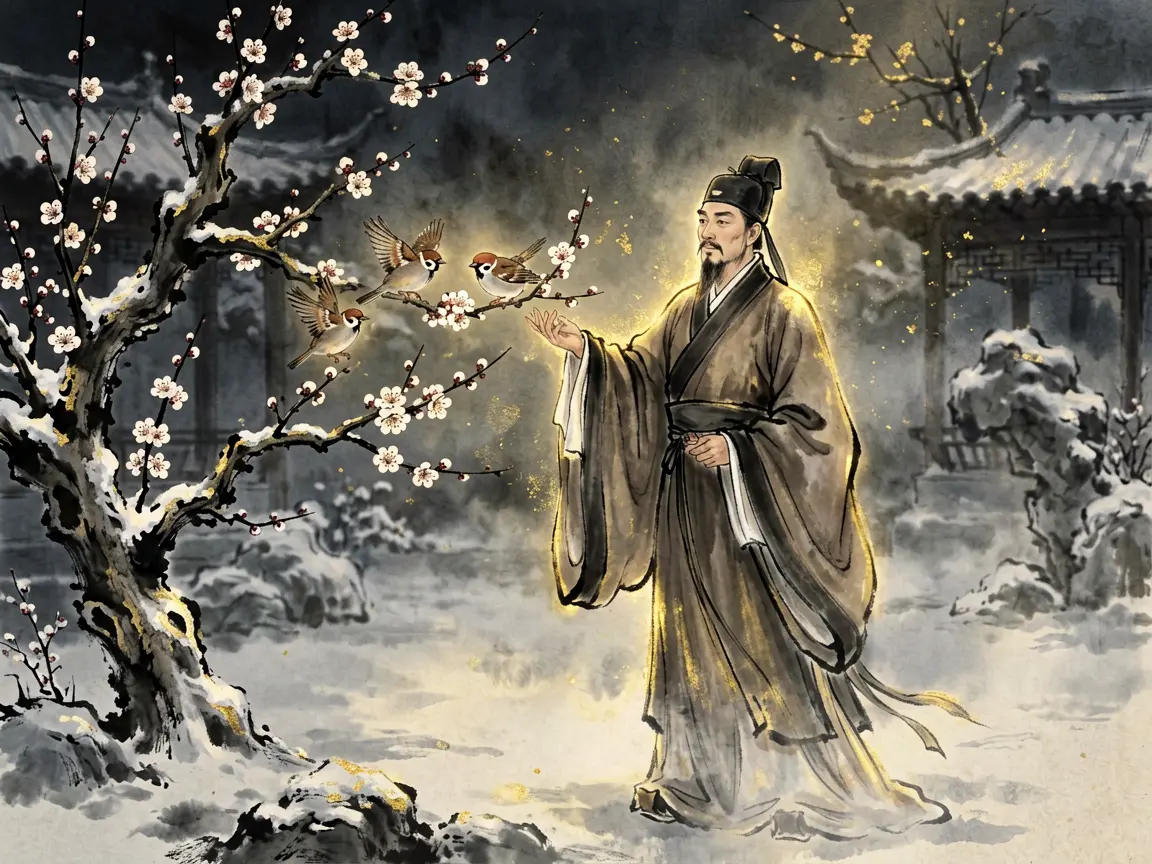
A client asked me once, in the middle of a reading, whether the plum blossom oracle only worked for people who were naturally "gifted" at divination. I laughed. The tradition says the whole method was born when a middle-aged philosopher stepped into his garden and saw two sparrows fighting over a plum blossom branch. No gift involved. Just attention, and a mind that had spent decades learning to read numbers the way other people read faces.
Shao Yong (1011-1077 CE) was a Song Dynasty philosopher who founded Plum Blossom Numerology. Mei Hua Yi Shu is a method of I Ching divination that converts the numbers of the present moment into hexagrams, reading what the psyche is already doing without coins or a spoken question. The distinction matters. He did not invent a machine for predicting events. He invented a language for translating what the psyche is already doing into a form the conscious mind can hold.
The Happy Man of Luoyang
Shao Yong was one of the Five Masters of the Northern Song, the group of thinkers who rebuilt Chinese philosophy in the eleventh century. He lived in Luoyang, then the cultural heart of the empire, in a small garden hermitage he called the Nest of Peace and Happiness. He called himself Master Anle, which means the Happy Gentleman. Contemporaries wrote that he spent whole winters inside, reading, with a fire lit and the curtains drawn, and that his copies of the I Ching wore thin from his hands.
That detail is the whole man. Most scholars of his era wrote commentaries about the Book of Changes. Shao Yong did something stranger. He treated the 64 hexagrams the way a physicist treats equations, as a working description of how energy moves, and he built a cosmology around them called the Huangji Jingshi, or Supreme Principles Governing the World. In it he mapped dynasties, seasons, and human lives onto the same cycles of change. The tradition also says he predicted the exact date of his own death and told his son, and that he was right. He died in 1077.
Two Sparrows and a Girl
The origin story of plum blossom divination goes like this. One winter day Shao Yong was resting in his garden when he saw two sparrows fighting on a plum blossom branch. The branch broke. Both birds fell to the ground. He took the numbers of that instant, the year, the month, the day, the hour, and the direction of the fight, and he built a hexagram. He told his servant that a young woman would come to pick plum blossoms the next day, trip over the broken branch, and hurt her knee.
She came. She tripped. She hurt her knee. And a method was named after the flowers.
I have told this story to a hundred clients, and the question they always ask is whether it really happened. I think that misses the point. The story is a teaching about attention. The branch did not break to announce anything. It broke, and Shao Yong happened to be the person on the planet best prepared to read what that moment contained. The oracle is not in the event. The oracle is in the prepared mind.
The Grammar of Synchronicity
Here is where the story gets strange in the best way. In 1952 Carl Jung published his essay on synchronicity, which he defined as a meaningful coincidence of inner and outer events that no cause can explain. He had written the foreword to Richard Wilhelm's translation of the I Ching two years earlier, in 1950, after years of studying how the hexagrams seemed to mirror the psychological state of whoever consulted them. Jung believed the Book of Changes, which dates to the Western Zhou dynasty around 1000 BCE, was the oldest working example of an acausal principle in action.
Shao Yong beat him to it by nine centuries. The plum blossom method is synchronicity with a procedure. Instead of waiting for meaningful coincidences to happen and then marveling at them, Shao Yong built a way to sit down inside the coincidence and take its measurements. The sparrows were an equation, and Shao Yong was the man who had trained himself to solve it.
The Former Heaven Map
Shao Yong built his numerology on the Former Heaven arrangement of the eight trigrams, the circular order that tradition attributes to the mythical emperor Fu Xi. In that layout Heaven and Earth face each other across the circle, Fire and Water do the same, and the trigrams turn in a fixed rotation that mirrors the year's cycle. He claimed this map showed the true order of creation, the structure behind the visible world. Whatever you make of that claim, the psychological insight underneath it is sharp. He believed the psyche runs on an order you do not choose, an inherited structure already in motion before you arrive. That is nearly identical to what Jung called the collective unconscious, the shared layer of archetypes underneath the personal story. Shao Yong called it the Former Heaven. Jung called it the archetypes of the collective unconscious. Two maps of the same country, drawn nine hundred years apart.
Reading the Number That Finds You
In my years of reading hexagrams, the thing that matters most in a plum blossom cast is the choice of number, before the hexagram is even drawn. You look up from your desk and the clock says 11:47. You count the stairs without meaning to. A license plate repeats your birth year. The method says take that number, divide by eight for the upper trigram, divide the sum by eight again for the lower, and use the remainder to find the moving line. The mechanics are simple. The psychology behind the choice is where the work happens.
Whatever number finds you, finds you for a reason, and the reason lives in your psyche, not in the universe. The same clock face is there for everyone in the room. You are the only one who noticed it. Jung would say your unconscious arranged the noticing, because the number resonates with something unfinished in you. That is why I always ask a client what the number made them feel before I touch the trigram table. The feeling is the reading. The hexagram is just the translation.
This is also where plum blossom work becomes shadow work. The number that irritates you, the number you try to ignore, those are the ones worth casting. I had a client who kept seeing the number four everywhere for a week. It meant nothing to her. Then she mentioned, offhand, that she was the fourth child and the one who had been sent away to school. The oracle had been pointing at an old grief the whole time. She did not need the hexagram to tell her that. She needed the hexagram to make her sit still long enough to hear it.
A Small Exercise
Try this for one day. Carry a notebook and write down every number that finds you: the clock when you first look up, the page number your eyes land on, the change in your pocket. At the end of the day, line them up and ask one question of each: what in my life right now carries this same shape? A 9 might map to completion. A 3 to the argument you keep rehearsing. The numbers will not predict your week. They will show you what your attention has been circling, which is a different and better gift.
Frequently Asked Questions
The tradition behind this practice runs deep, but the questions people bring to it are usually the same handful. I have answered them many times in sessions, and they are worth writing down here.
Ask the oracle a question
Cast a hexagram and receive a reflection rooted in the I Ching — your question, answered by ancient wisdom.
Cast Your Free HexagramFree · No sign-up needed
Frequently Asked Questions
Who was Shao Yong?▼
What is Plum Blossom Numerology (Mei Hua Yi Shu)?▼
Did Shao Yong really predict the future?▼
How is Shao Yong's method connected to Jung's synchronicity?▼
Is Plum Blossom Numerology the same as the I Ching?▼
Recommended Reading
Meihua
Mei Hua Yi Shu: How Plum Blossom Divination Turns the Moment Into a Hexagram
Meihua
The 64 I Ching Hexagrams: A Complete Reference (A Jungian Guide)
Meihua
What Is Chinese Divination? A Jungian Guide to the I Ching, BaZi, and Plum Blossom
Meihua
How to Interpret Changing Lines in I Ching: A Jungian Guide