What Is Chinese Divination? A Jungian Guide to the I Ching, BaZi, and Plum Blossom
Ask the oracle a question
Cast a hexagram and receive a reflection rooted in the I Ching — your question, answered by ancient wisdom.
Cast Your Free HexagramFree · No sign-up needed
Suggested opening paragraph (place before the client anecdote):
> Chinese divination is a family of self-inquiry arts, not fortune-telling. For three thousand years, systems like the I Ching, BaZi, and Plum Blossom have used hexagrams, elements, and numbers to mirror the state of your psyche back to you. They read patterns already in motion, never fixed fates.
(48 words. Leads with the quotable definition so AI-search crawlers extract it from paragraph one, then lets the Abysmal hexagram story follow as lived proof.)
A client came to me once with a plum blossom cast she had done herself on a phone app. She had asked whether her business partner was lying to her. The cast produced the Abysmal, water over water, and she spent a week reading it as drowning. Business over. Trust gone. She barely slept. When we walked through the reading together, the hexagram was describing her state at the exact moment she asked. The partner was a real problem. But the water was mostly her, her exhaustion, her certainty that she could not survive a loss. The oracle had shown her something true. Her fear dressed it up as a prophecy.
That confusion, between the mirror and the prophecy, is where Chinese divination picks up its bad reputation in the West. We import the tools and leave the psychology behind. So let me define the thing properly.
Chinese divination is a family of self-inquiry arts, developed in China over the past three thousand years, that use symbolic systems, such as the 64 hexagrams of the I Ching or the Five Elements of BaZi, to mirror the state of the psyche back to the person consulting them. Its defining feature is that it reads patterns in motion, never fixed fates. Its oldest surviving text, the I Ching, predates the Greek classics by centuries, and the tradition is still alive. That is more than most schools of ancient thought can claim.
Three Thousand Years of Asking
Three systems carry most of the weight in modern practice. They are easy to tell apart once you see what each one is for.
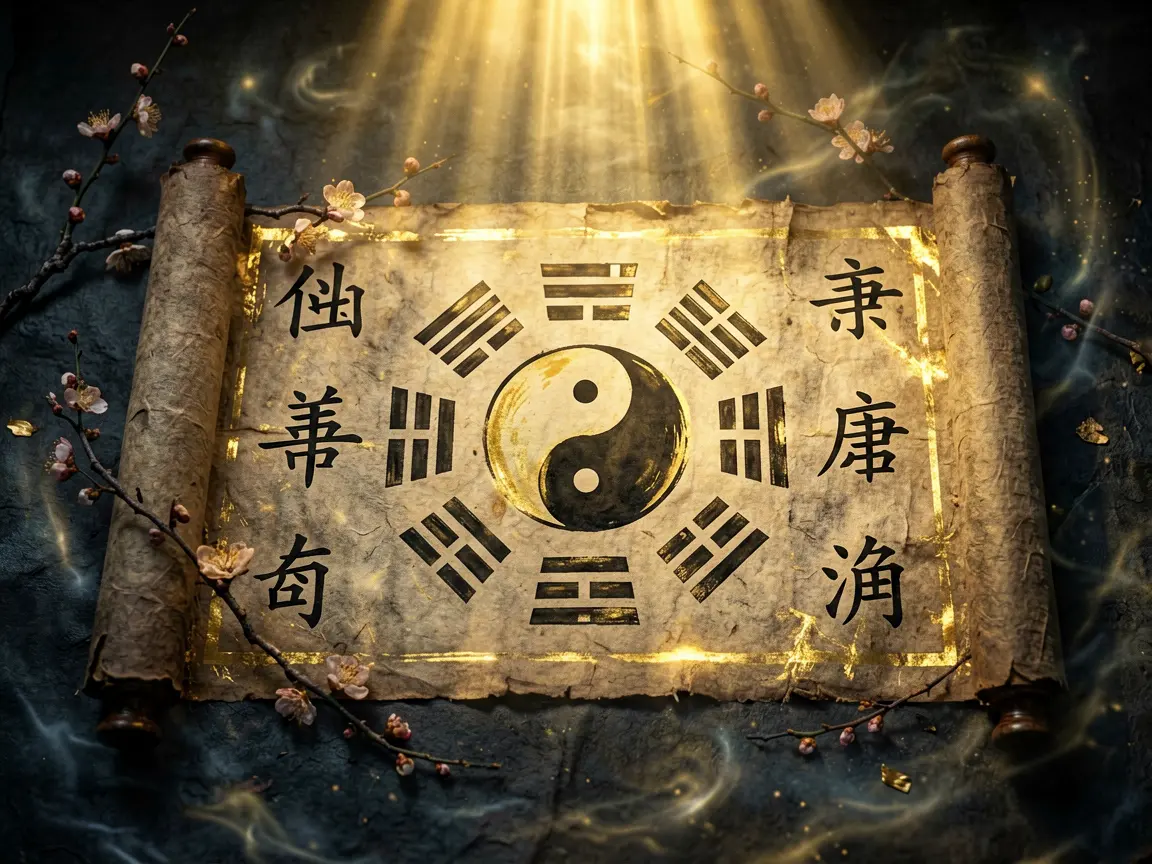
The I Ching, or Book of Changes, is the oldest. Its core text took shape during the Western Zhou dynasty, around 1000 BCE, and its 64 hexagrams, six-line figures built from eight trigrams, have been read continuously ever since. Carl Jung called it the oldest working example of an acausal principle in action. I will come back to that.
Plum blossom divination, Mei Hua Yi Shu, came much later. The tradition credits the Song dynasty philosopher Shao Yong, who lived from 1011 to 1077, with founding it after he watched two sparrows fight over a plum blossom branch and turned the numbers of that instant into a hexagram. No coins, no ritual. Just the moment, measured.
BaZi, the Four Pillars of Destiny, is the youngest of the three in its modern form. It took its current shape in the Song dynasty, in the work of a practitioner named Xu Ziping, though its roots reach back to the Han dynasty. Where the I Ching reads a question, BaZi reads a birth. Four pillars, eight characters, arranged from the moment you arrived in the world.
The Book That Will Not Finish
I want to slow down on the I Ching, because everything else in Chinese divination is a variation on its grammar. The 64 hexagrams each name a situation, a phase, a weather system of the psyche. The Creative. The Abysmal. Development. After Completion. Outcomes play no part in the naming.
The Book of Changes reached Europe through Richard Wilhelm, whose German translation appeared in 1923, and reached the English-speaking world in 1950 with a foreword by Carl Jung. In 1952 Jung published his essay on synchronicity, his name for meaningful coincidence that no causal chain can explain. He had spent years convinced that the hexagrams mirrored the psychological state of whoever consulted them. The oracle was accurate, he thought, because the unconscious arranges the moment of asking.
That sentence is the key to the whole tradition. The coin toss looks like chance. Jung read it as a fingerprint of the psyche at a specific moment, which is why the I Ching stays useful after three thousand years. You are consulting your own state, translated into a symbol you can hold. The book is only the translation.
The Oracle Without Coins
Plum blossom divination takes that logic and drops the ceremony. You take a number from the present moment, the time on a clock, a page number, a passing car, divide it by eight for the upper trigram and again for the lower, and read the hexagram that falls out. Shao Yong built the method on a conviction. The psyche is always broadcasting, and any moment, properly measured, contains the state of the person living it.
In my practice I reach for plum blossom when a client needs a snapshot instead of a saga. It answers the question underneath the question, which is what am I actually doing right now, under the surface. The I Ching asks you to sit with a ritual and a text. Plum blossom catches you mid-motion, the way a shop window catches your own face before you compose it.
The Map of the Birth Hour
BaZi is the slowest oracle and the most structural. Your birth moment becomes four pillars, year, month, day, hour, and each pillar pairs one Heavenly Stem with one Earthly Branch. Ten stems and twelve branches combine into a sixty-year cycle. Your day master, the stem of your birth day, becomes the protagonist of the chart. The Five Elements, wood, fire, earth, metal, water, move through the pillars, and their balance describes your inherited temperament, the way a natal chart describes temperament in Western astrology.
Here is the reading I actually give clients. A BaZi chart maps the equipment you arrived with. Which elements flow easily in you. Which ones starve. Which ones you overproduce when you are under stress. The ten gods, the system's names for the interactions between elements, read like a cast of archetypes, authority, resource, friend, wealth, and their shadows. People often come to me with a chart and expect a script. I hand back a description of recurring patterns. That is a different and far more useful thing.
What All Three Are Actually Doing
Strip away the tools and the three systems share one engine. Jung's psychology calls it projection. The psyche cannot see itself directly, so it meets its own contents in the world, in other people, in symbols. An oracle is a projection screen with a grammar. The hexagram, the plum blossom number, the day master, all of them are structured enough to catch the projection, hold it still, and hand it back for inspection. The reading always fits. It fits because you made it, with your attention, in the moment you asked.
Skip the accuracy question entirely. The real question is whether you are willing to look at what your psyche hands you. A mirror shows the face in front of it, including the parts you have been avoiding.
I had a client, a manager passed over for a promotion, who drew the Receptive, earth over earth, in a session about her career. She read it as proof that she was too soft to lead. We sat with that for a while. Then she said, quietly, that she had never once asked for the promotion. She had waited to be noticed. The hexagram had told her nothing she did not already know. It made her sit still long enough to hear it. That is the whole craft.
A Small Exercise
You can do this without any training. Take one question you are actually circling. Skip the test questions, the ones with no charge. Pick something that hums. Cast once, coins or numbers, whichever you like. Write the symbol down. Then write three lines: what the symbol says, what it makes you feel, and what you wish it said. The gap between the second line and the third is where the shadow lives. That gap is the reading. Everything else is decoration.
Frequently Asked Questions
The questions people bring to Chinese divination tend to be the same handful, whether they come from a tarot background or no background at all. Here are the ones I answer most often in sessions.
Ask the oracle a question
Cast a hexagram and receive a reflection rooted in the I Ching — your question, answered by ancient wisdom.
Cast Your Free HexagramFree · No sign-up needed
Frequently Asked Questions
What is Chinese divination?▼
Is Chinese divination accurate?▼
What is the difference between the I Ching, BaZi, and Plum Blossom?▼
Can Chinese divination predict the future?▼
Is Chinese divination a religion?▼
Recommended Reading
Meihua
Mei Hua Yi Shu: How Plum Blossom Divination Turns the Moment Into a Hexagram
Meihua
The 64 I Ching Hexagrams: A Complete Reference (A Jungian Guide)
Meihua
Shao Yong and the Plum Blossom Oracle: The Song Dynasty Sage Who Gave Synchronicity a Grammar
Meihua
How to Interpret Changing Lines in I Ching: A Jungian Guide