Mei Hua Yi Shu: How Plum Blossom Divination Turns the Moment Into a Hexagram
Ask the oracle a question
Cast a hexagram and receive a reflection rooted in the I Ching — your question, answered by ancient wisdom.
Cast Your Free HexagramFree · No sign-up needed
Mei Hua Yi Shu is a method of I Ching divination that turns two numbers from the present moment into a hexagram, without coins, cards, or ritual. Formalized by Song dynasty philosopher Shao Yong (1011 to 1077 CE), the plum blossom method treats the world itself as the casting tool, reading what the psyche is doing right now.
A client came to me last spring with a question about a job offer that felt too good to be true. I did not reach for a deck or open a chart. I asked her for two numbers, the first two that surfaced without thinking, and she said three and six. Three minutes later she was staring at the ceiling, because the hexagram I built from those numbers described the exact fight she had been having with herself all week. Everything already decided. One question that would not close.
That is Mei Hua Yi Shu working. No coins. No cards. No ritual. Just a moment, two numbers, and a three-thousand-year-old language for what the psyche is doing right now.
Mei Hua Yi Shu is a method of I Ching divination that converts the numbers of the present moment into hexagrams, reading the psyche's current state without coins, cards, or a spoken question. The name is usually translated as Plum Blossom Numerology, and it is the branch of the Book of Changes that treats the world itself as the casting tool. It was formalized by Shao Yong, a Northern Song philosopher who lived from 1011 to 1077 CE and was counted among the Five Masters of the Northern Song.
The Legend Behind the Name
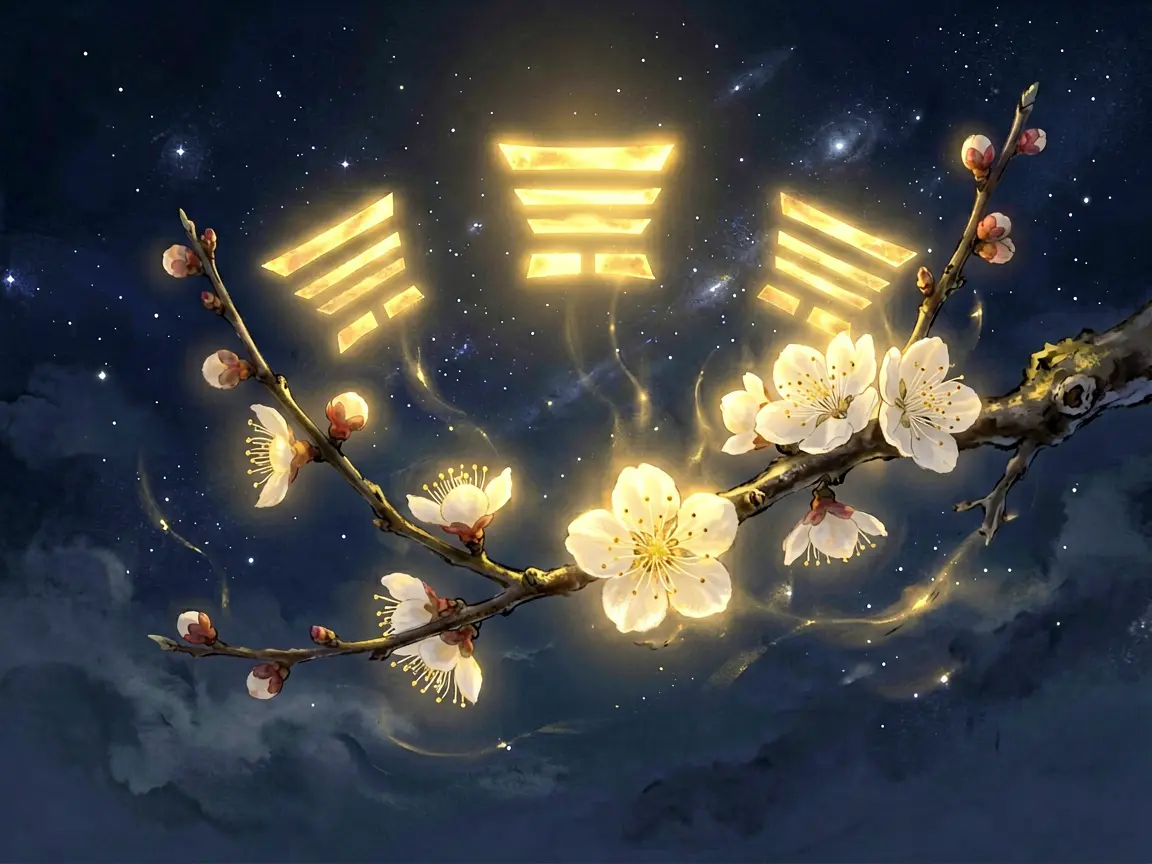
Tradition says the method was born on a winter day in Shao Yong's garden. Two sparrows fought over a plum blossom branch. The branch broke and both birds fell to the ground. Shao Yong took the numbers of that instant, the year, the month, the day, the hour, and the direction of the fight, and he built a hexagram. He told his servant that a young woman would come the next day to pick blossoms, trip over the broken branch, and hurt her knee. She did, and the method took its name from the flowers.
I have told this story for years, and the lesson I draw from it was never about prediction. It is about attention. The branch did not break to announce anything. Shao Yong was simply the person on earth best prepared to read what the moment contained. The oracle is not in the event. The oracle is in the prepared mind.
The Whole World Is a Casting Tool
The I Ching, which dates to the Western Zhou dynasty around 1000 BCE, traditionally asks you to cast coins or yarrow stalks to build a hexagram. Mei Hua Yi Shu skips the equipment entirely. Any number that reaches your awareness can become the oracle: the time on the clock, the number of stairs you climbed, the petals you counted without meaning to, the car that passed twice. The method assumes that what catches your attention in the moment of the question is not random noise. It is the psyche's own handwriting.
The method rests on the Former Heaven arrangement of the eight trigrams, the circular order that tradition attributes to the mythical emperor Fu Xi. In that order each trigram carries a fixed number:
| Number | Trigram | Pinyin | Element |
|---|---|---|---|
| 1 | Heaven | Qian | Metal |
| 2 | Lake | Dui | Metal |
| 3 | Fire | Li | Fire |
| 4 | Thunder | Zhen | Wood |
| 5 | Wind | Xun | Wood |
| 6 | Water | Kan | Water |
| 7 | Mountain | Gen | Earth |
| 8 | Earth | Kun | Earth |
The Arithmetic of the Moment
Casting a plum blossom hexagram takes three small steps. Take two numbers, whichever two the moment gives you. Divide the first by eight to find the upper trigram. Divide the second by eight to find the lower trigram. Add the two numbers, divide by six, and the remainder marks the moving line, the one line in the hexagram that is in motion.
My client's numbers were three and six. Three is Fire, the trigram of the Clinging, of brightness that needs something to hold. Six is Water, the trigram of the Abysmal, of depth and danger. Fire below, Water above makes Hexagram 63, After Completion, the image of a task finished, water and fire settled into balance. The moving line fell at the third place, the transition point, the position the old readers called the most honest line of the hexagram.
Here is what I told her. The offer looks complete, but the situation is water and her own fire is still finding its footing. The reading was a mirror held up to the part of her that already suspected the answer: the decision was made, and the question still burning at the third line was whether she could carry it.
Two Trigrams, One Conversation
The moving line does more than mark a position. It decides which trigram is which. The trigram holding the moving line becomes the function, the matter at hand. The other trigram becomes the body, the one who asks. In my client's cast the moving line sat in the lower trigram, so Water became the function and Fire became the body, and their elements began to speak to each other.
Water controls Fire. In the language of the five elements, that is a situation that currently outweighs the person in it. Same element means harmony. Function generating body means the matter feeds you. Body generating function means you are pouring yourself out and the drain is real. Function controlling body means the situation is bigger than you right now. Body controlling function means you can manage it.
I have found this is the part clients remember longest. Every reading is a relationship diagram between you and the situation, drawn in the oldest grammar we have. You are not being told what will happen. You are being shown the shape of the space between you and the thing you are asking about.
Why the Moment Knows
In 1952 Carl Jung published his essay on synchronicity, which he defined as a meaningful coincidence of inner and outer events that no cause can explain. Two years earlier he had written the foreword to Richard Wilhelm's translation of the I Ching, after years of watching hexagrams mirror the psychological state of whoever consulted them. Jung believed the book was the oldest working example of an acausal principle in action.
Shao Yong built a procedure out of that same insight nine centuries before Jung named it. Where Jung observed meaningful coincidences and wondered at them, Shao Yong sat down inside the coincidence and took its measurements. The Former Heaven circle makes the point visible. Heaven and Earth face each other across the circle, Fire and Water face each other likewise, and the trigrams turn in a fixed rotation that mirrors the year. Shao Yong drew that map in the eleventh century. Jung redrew it in the twentieth when he described the collective unconscious, the inherited layer of archetypes underneath the personal story. Same territory, two cartographers.
A Practice You Can Try Tonight
You do not need a master to begin. Each evening this week, take the first two numbers that reach you when you sit down to journal, the minute on the clock, the number of pages left in your book, anything. Build the trigrams, find the hexagram, mark the moving line. Then ask yourself three questions. What is the element relationship between me and the situation? Where is the motion in this picture? What is the honest thing I keep not saying?
The shadow work prompt I give clients is simpler still. What in my life right now is all water and no fire? Where am I pouring myself into something that does not feed me back? Write without editing for ten minutes. The hexagram gives the shape. You bring the courage.
Mei Hua Yi Shu will not tell you your future. What it can do, if you let it, is show you the present with the anesthesia removed. That is the plum blossom gift, and it has been blooming for a thousand years.
This article is offered for spiritual guidance and entertainment purposes only. It is not a substitute for medical, legal, or financial advice.
Ask the oracle a question
Cast a hexagram and receive a reflection rooted in the I Ching — your question, answered by ancient wisdom.
Cast Your Free HexagramFree · No sign-up needed
Frequently Asked Questions
What is Mei Hua Yi Shu?▼
How do you cast a plum blossom hexagram?▼
Is Mei Hua Yi Shu fortune telling?▼
What is the difference between Mei Hua Yi Shu and the coin-toss I Ching?▼
What does the moving line mean in plum blossom divination?▼
Recommended Reading
Meihua
The 64 I Ching Hexagrams: A Complete Reference (A Jungian Guide)
Meihua
What Is Chinese Divination? A Jungian Guide to the I Ching, BaZi, and Plum Blossom
Meihua
Shao Yong and the Plum Blossom Oracle: The Song Dynasty Sage Who Gave Synchronicity a Grammar
Meihua
How to Interpret Changing Lines in I Ching: A Jungian Guide