Plum Blossom Oracle vs I Ching: Two Speeds of the Same Oracle — A Jungian Guide
Ask the oracle a question
Cast a hexagram and receive a reflection rooted in the I Ching — your question, answered by ancient wisdom.
Cast Your Free HexagramFree · No sign-up needed
Plum blossom oracle and the I Ching share one alphabet of eight trigrams and sixty-four hexagrams, but they cast at different speeds. The I Ching builds a hexagram slowly with coins or yarrow stalks; plum blossom reads two numbers from the present moment and casts instantly. One is a patient conversation with the unconscious, the other a snapshot.
A client came to me last winter with a worn copy of the Wilhelm I Ching and a question that had been bothering her for weeks. "I keep seeing plum blossom readings online," she said. "The hexagrams look identical. But the readings feel completely different. Are they even the same practice?"
She had spotted something real. Plum blossom and the I Ching share one alphabet: eight trigrams, sixty-four hexagrams, moving lines. But they are not the same practice. One is a slow conversation with the unconscious. The other is a snapshot of the moment it was taken. Same symbols, two different psychologies.
A Family Tree You Should Know
Plum blossom divination, Mei Hua Yi Shu, was born in the Song Dynasty, roughly two thousand years after the I Ching became the most studied text in China. Its creator, Shao Yong, was a philosopher who knew the Book of Changes the way a master carpenter knows his tools. The origin story says he watched two sparrows fighting over a plum blossom branch, read the numbers of the moment, and predicted that a girl would come to pick the flowers and hurt herself. The story may be legend, but it carries the method's soul: the oracle reads what is already happening, in the instant it happens.
The I Ching is older and heavier. Its core was fixed in the Zhou dynasty, and for three thousand years scholars added layer after layer of commentary. Carl Jung worked with it for decades, wrote the foreword to the Wilhelm translation, and treated it as an experiment in what he called synchronicity, the meaningful coincidence of inner and outer events.
The Cast: Coins or the Clock
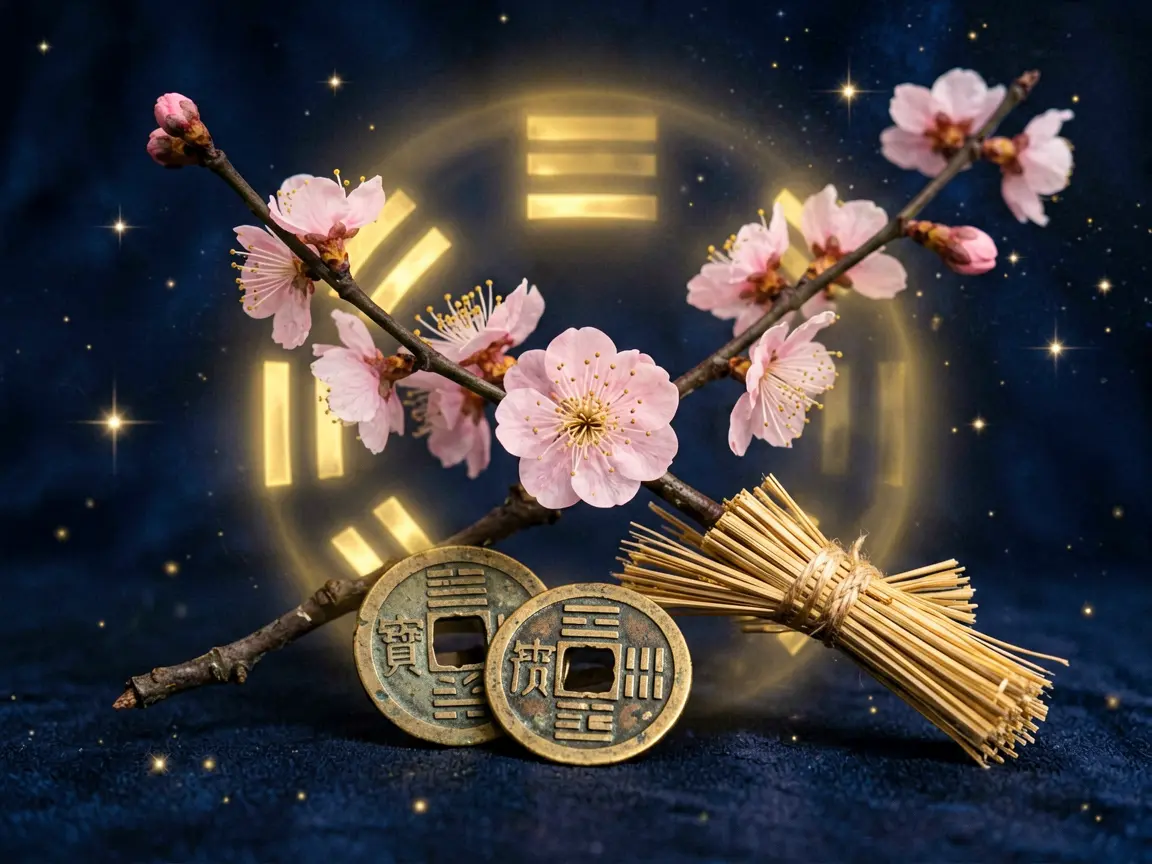
The first difference is the cast. The I Ching asks for ceremony. You take three coins, or fifty yarrow stalks, and you build the hexagram line by line, from the bottom up. Six throws. Each throw is a chance to breathe, to hold the question, to let the mind settle. The ritual takes minutes, and the minutes are part of the medicine.
Plum blossom skips the ceremony entirely. You take two numbers from the present moment: the hour and minute on a clock, a page number, the number of steps to your door. The hour becomes the upper trigram, the minute becomes the lower. Add the day of the month, divide by six, and the remainder names your moving line. One cast, no equipment, under a minute.
I tell clients the cast reveals which mode of attention they need. Coins say: slow down, this question wants company. Numbers say: the answer is already in your hands. You only need to see it.
The moving line also behaves differently in each system. In the I Ching, a moving line transforms the whole hexagram, so a cast hands you a before and an after: the situation now and the situation it is becoming. Plum blossom uses the moving line differently. The line names the pressure point, and the practice stays with the single hexagram, reading that one line with the five elements around it. One system gives you a story with a sequel. The other gives you a frame and trusts you to finish the picture.
The Text: A Thousand Voices or Your Own
The second difference is what you do after the hexagram appears. The I Ching hands you a page. Every hexagram carries a name, a judgment, an image, and six line texts composed over centuries. Cast Hexagram 29, the abyss, and the book speaks to you in the voice of a thousand dead scholars.
Plum blossom hands you nothing but two trigrams and a moving line. No judgment text, no commentary. You work with what the trigrams mean: water over water, the abyss. Fire over thunder, the lightning. Then you apply the five elements and everything you know about the person asking. The reading is built in the reader's mind, not on the page.
This is why I consider plum blossom the harder art. The I Ching gives you a text to wrestle with. Plum blossom gives you a structure and asks you to do the wrestling. Both are honest work. One just leaves more room for you.
Time: Dialogue or Photograph
The third difference is time itself, and this is where the psychology lives. The I Ching is a dialogue. You cast, you read, you sit with the text, and you cast again when the situation has moved. Jung treated it as a conversation partner, something to return to the way you return to a trusted friend.
Plum blossom is a photograph. It captures the psyche at one instant and asks you to recognize yourself in it. There is no second cast. The moment has passed and the reading stands. The moving line names what is shifting, and you meet that shift in real time or you miss it.
A client of mine used the I Ching for years and only came to plum blossom when her schedule collapsed. "I still love the coins," she said. "But some questions are decided in the time it takes to tie my shoes. I needed an oracle that matched the speed of my life."
When to Reach for Each
I use a simple rule with clients, and it has held for years.
Reach for the I Ching when the question is big and the answer deserves a conversation. A career change. A marriage. A decision you will live with for a decade. The slow cast forces you to sit with your own ambivalence, and the sitting is usually the real answer.
Reach for plum blossom when the moment is asking you to notice something. A conflict that just flared up. A feeling you cannot name. The question that keeps arriving at odd hours. Plum blossom names what is already moving, which makes it a superb daily practice and an honest mirror for avoidance.
For relationship questions I lean toward the I Ching when a couple wants to understand the pattern between them, and plum blossom when one person needs to see their own part tonight.
A Week With Both Oracles
Here is an exercise I give clients who want to feel the difference themselves.
For one week, use both. Each morning, cast plum blossom from the clock and write the hexagram down with one line about your day ahead. Each evening, cast the I Ching with coins and ask one question: where did I avoid being honest with myself today?
At the end of the week, read the two lists side by side. My clients almost always find that the plum blossom casts tracked the weather of their days, while the I Ching named the patterns underneath the weather. That is the whole distinction in miniature. One oracle keeps a diary. The other reads the biography.
Jung never lived to see plum blossom arrive in the West, but he would have recognized it instantly. Synchronicity is the meaningful coincidence of inner and outer events, and Shao Yong's sparrows were exactly that. The plum blossom oracle predicts nothing. It reports what the psyche and the world are already doing, together, right now. Plum blossom shows you the moment. The I Ching shows you how to meet it.
Frequently Asked Questions
What is the difference between plum blossom oracle and I Ching?
In my practice the simplest way to put it is speed. The I Ching builds a hexagram slowly with coins or yarrow stalks and gives you three thousand years of commentary to sit with. Plum blossom takes two numbers from the present moment, casts instantly, and leaves the interpretation to you. Same sixty-four hexagrams, two very different psychologies.
Is plum blossom divination based on the I Ching?
Yes. Mei Hua Yi Shu, the plum blossom method Shao Yong developed in the Song Dynasty, uses the same eight trigrams and sixty-four hexagrams as the I Ching. It is a descendant of the Book of Changes, not a rival to it. I describe it to clients as the I Ching's fastest branch.
Which is more accurate, I Ching or plum blossom?
After years of reading both, I do not think accuracy is the right frame. Both systems mirror what is already moving in the psyche. The I Ching gives you a richer text to work with, while plum blossom captures the exact instant you ask. I choose by the question, never by which tool I trust more.
Do I need coins to cast the plum blossom oracle?
No equipment at all. You take two numbers from the moment, the hour and minute of a clock, a page number, anything present when you ask. That is the whole point of the method. The first number you notice is the honest one, so I tell clients never to shop for a better number.
Can I use I Ching and plum blossom together?
I encourage it. In my practice the I Ching is the long conversation and plum blossom is the daily mirror. A morning plum blossom cast tracks the weather of your day, and an evening I Ching question names the pattern underneath it. Used together they cover what each alone misses.
Ask the oracle a question
Cast a hexagram and receive a reflection rooted in the I Ching — your question, answered by ancient wisdom.
Cast Your Free HexagramFree · No sign-up needed
Frequently Asked Questions
What is the difference between plum blossom oracle and I Ching?▼
Recommended Reading
Meihua
Mei Hua Yi Shu: How Plum Blossom Divination Turns the Moment Into a Hexagram
Meihua
The 64 I Ching Hexagrams: A Complete Reference (A Jungian Guide)
Meihua
What Is Chinese Divination? A Jungian Guide to the I Ching, BaZi, and Plum Blossom
Meihua
Shao Yong and the Plum Blossom Oracle: The Song Dynasty Sage Who Gave Synchronicity a Grammar