I Ching vs Tarot: Two Doorways Into the Same Unconscious — A Jungian Comparison
Ask the oracle a question
Cast a hexagram and receive a reflection rooted in the I Ching — your question, answered by ancient wisdom.
Cast Your Free HexagramFree · No sign-up needed
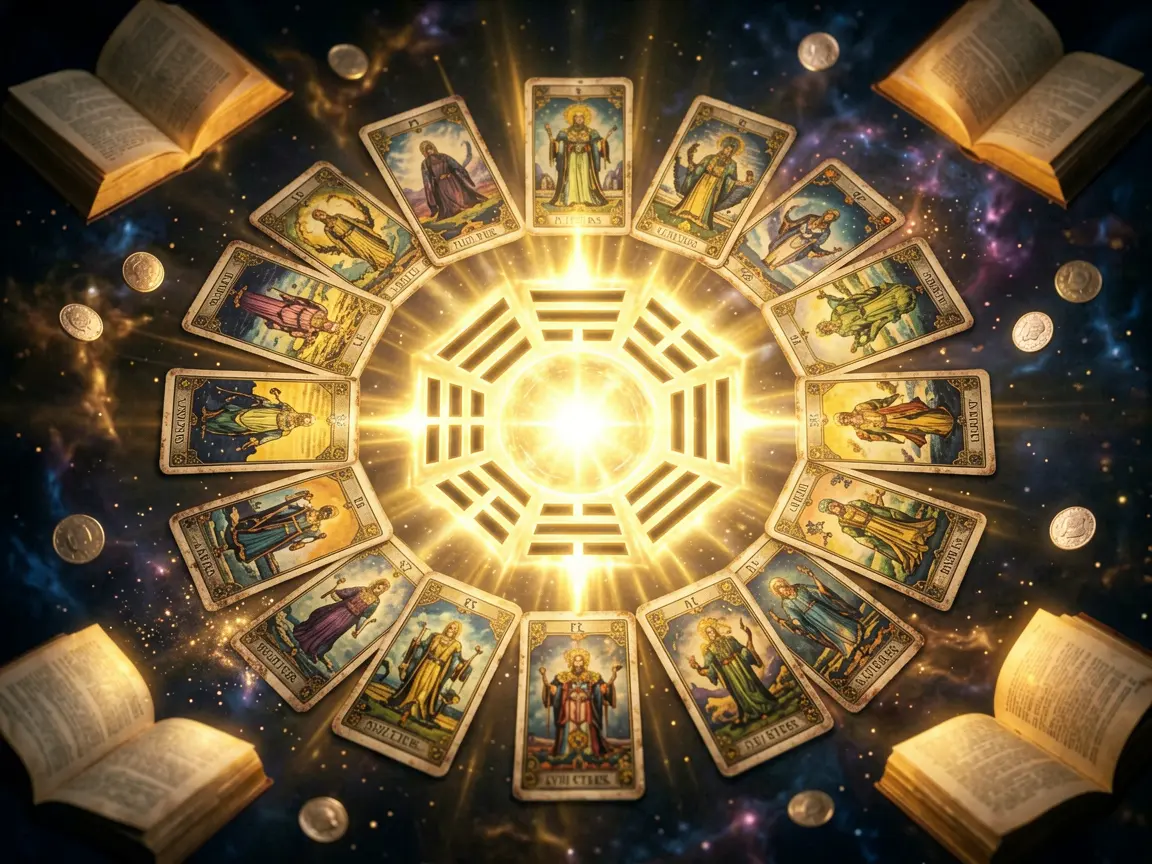
The I Ching and Tarot are two symbolic oracles that map the same archetypal patterns of the unconscious: one speaks through 64 binary hexagrams rooted in Daoist cosmology, the other through 78 Renaissance-era images. This Jungian comparison shows how each system mirrors the psyche back to you, and which language fits the question you are actually asking.
A client sits across from me, hands wrapped around a mug gone cold. She has pulled the same card three mornings running. The Tower. Collapse. Structures falling apart. She wants to know what it means. Whether she should be afraid.
I ask if she knows the I Ching.
She shakes her head. I pull out three old Chinese coins, worn smooth. I tell her to hold her question, the same one behind The Tower, and toss them six times.
The hexagram that comes up is Hexagram 23, Bo / Splitting Apart. A tall house whose foundation crumbles, beam by beam. The I Ching version of The Tower. Same archetype. Same message. Different language.
After eight years of reading both systems, I can tell you this: the Tarot and the I Ching are two dialects of the same underground river. Which one you pick matters less than the depth you bring.
Two Systems, One Unconscious
Carl Jung kept a copy of the I Ching on his desk in Bollingen for decades. He wrote the foreword to Richard Wilhelm's translation. He consulted it regularly. But Jung also knew the Tarot. In a 1934 letter to the sinologist Erwin Rousselle, he called the Major Arcana a gallery of archetypal images straight from the collective unconscious (see Jung's published Letters, Vol. 1).
Jung saw both systems as the same psychological law at work. The psyche projects itself into symbols. Those symbols, read with awareness, reflect the psyche back.
The Tarot does this through images. The I Ching through text and abstract lines. Both activate what Jung called active imagination: the conscious mind talking to the unconscious through symbol.
The way each system speaks is different though. That difference is the key to using both.
How the Tarot Speaks: The Language of Images
The Tarot is visual. Seventy-eight cards carrying centuries of iconographic weight. The images jump past your analytical defenses and hit the emotional brain first.
Pull The High Priestess. You do not need commentary. The image does the work. A woman between two pillars, a scroll in her lap, the moon at her feet. You feel the mystery before you name it.
In my practice, the Tarot shines at emotional immediacy. A client asks about a relationship and draws the Two of Cups. They feel it before I speak. The image activates something pre-cognitive. I have found the Tarot works best for people in the middle of something. People who need clarity about feelings, timing, or relational dynamics right now.
The Tarot also runs on narrative. The Fool's Journey through the twenty-two Major Arcana maps onto Joseph Campbell's hero's journey. The individuation process. The path from unconscious identification to conscious integration. Every card shows where you stand on that road.
How the I Ching Speaks: The Language of Process
The I Ching works differently. Instead of seventy-eight fixed images, you get sixty-four hexagrams made from six Yin and Yang lines. The system is procedural. You generate the answer through the casting ritual.
Where the Tarot shows a frozen moment, the I Ching shows a process unfolding. Every reading has moving lines that transform the hexagram into a second hexagram. The oracle reveals the trajectory of the energy you inhabit right now, not a snapshot of your current state.
I once worked with an academic who found the Tarot too emotional. The images triggered his defenses. When I showed him the I Ching, something clicked. The hexagrams felt like algorithms. Patterns to study, analyze, map. The moving lines gave him a sense of objective process. He needed structure to access his own depths. The I Ching gave him that.
The I Ching works better for clients who need distance from the intensity of their feelings. It speaks to the reflective, analytical psyche. It offers perspective.
When to Use Each
I tell clients the two systems map to different psychological functions.
The Tarot suits the feeling and intuitive functions. Use it when you need emotional clarity, when you want to understand your own feelings, when you work with relationship dynamics and need immediate guidance you can feel in your body.
The I Ching suits the thinking and sensing functions. Use it when you need to see the larger pattern behind a recurring problem, when your emotions are too loud for direct confrontation, when you face long-term decisions and want systemic understanding.
This division is softer than it sounds. I have seen the I Ching bring clients to tears with a single line. I have seen a Tarot card lay out someone's entire career trajectory. The map is not the territory. The system is a doorway. What happens on the other side depends on you.
The Archetypal Architecture: 78 Cards vs 64 Hexagrams
The numbers carry meaning.
The Tarot breaks into twenty-two Major Arcana and fifty-six Minor Arcana. The twenty-two correspond to the Hebrew alphabet in Kabbalistic tradition. Jung recognized them as the archetypal journey of individuation. Each card names a stage of psychological development. The Fool is the ego setting out. The World is the self integrated. Everything between is the work.
The Minor Arcana mirrors everyday life through four suits mapping to fire, water, air, and earth. Each suit runs from aces (pure potential) to tens (completion), with court cards showing how these energies show up in personality.
The I Ching's sixty-four hexagrams come from eight trigrams representing eight fundamental forces: Heaven, Earth, Thunder, Wind, Water, Fire, Mountain, Lake. Stack each trigram over every other, and you get sixty-four archetypal situations.
The difference matters. The Tarot gives you a fixed vocabulary of images. The I Ching gives you a generative grammar. You cannot create a new Tarot card, but every I Ching reading is unique, generated by the specific moment you cast. The Tarot is a library. The I Ching is a living algorithm.
In my practice, this hits beginners harder than they expect. Clients stuck in their circumstances often find the I Ching liberating because the hexagram is never the same twice. Every reading is a unique configuration. Every moment carries its own potential. The Tarot can feel confronting because the images stay fixed. You might pull Death three Tuesdays in a row. That confrontation is medicine too.
I had a client who kept drawing the Five of Pentacles. The card of material worry and spiritual isolation. She felt stuck in scarcity. When she cast the I Ching, she got Hexagram 4, Meng / Youthful Folly. The judgment spoke of a young fool seeking wisdom, knocking on doors not yet open. The oracle told her to wait. To sit with the feeling of lack and let it teach her.
The Tarot showed her where she stood. The I Ching showed her what the standing meant.
Combining Both Systems
The deepest work comes from using both.
Start with one Tarot card to name the emotional field. This tells you what you are feeling about the situation, consciously and unconsciously. Then cast the I Ching. Ask for the process. What is the trajectory of this energy? Where is it moving?
The Tarot names the present. The I Ching reveals the becoming.
Which One Should You Choose?
You do not have to choose. But if you are new to this work, here is honest advice.
If you trust images before words, if you process emotionally before logically, start with the Tarot. The cards will meet you where you are.
If you need structure, if you think in systems, if you relate to patterns before feelings, start with the I Ching. The hexagrams will honor your need for order while quietly opening your psyche to something deeper.
If you are both, and most of us are, you have a gift. Two doorways into the same unconscious. You get to walk through both.
Journaling Prompts
After reading this comparison, sit with these questions.
Which system calls to you more strongly right now? What does that tell you about your current psychological state?
If you already use one system, what might the other reveal that your preferred system cannot see?
What would it mean to trust both the image and the process as valid sources of inner guidance?
Frequently Asked Questions
Which is more accurate, the I Ching or Tarot?
In my practice, accuracy depends less on the system and more on the reader's relationship with it. Both are profoundly accurate when used with psychological depth. The real question is which one mirrors your psyche's native language more clearly.
Can I use the I Ching and Tarot together?
Absolutely, and I encourage it. In my sessions, I often use the Tarot for emotional clarity and immediate guidance, then turn to the I Ching when a client needs a wider lens on a recurring pattern. They complement each other beautifully.
Which system is easier for beginners, Tarot or I Ching?
Tarot is usually more accessible for beginners because the images speak directly to your intuition. The I Ching requires more study. You need to learn the hexagram system and the philosophical framework. But neither is truly hard if you approach them as psychological tools rather than prediction machines.
Did Carl Jung use Tarot or I Ching?
Jung wrote extensively about the I Ching and collaborated with Richard Wilhelm. His foreword to the Wilhelm-Baynes translation is essential reading. He engaged less with Tarot in his published work, but the archetypal structure of the Tarot aligns deeply with his theories of the collective unconscious.
Is I Ching Chinese divination and Tarot Western, and how do they compare philosophically?
The I Ching emerges from Daoist cosmology. It works with the flow of Qi, the balance of Yin and Yang, and the natural cycles of change. Tarot emerged from European Renaissance hermetic traditions. Both describe the same archetypal patterns through different cultural lenses. I have found that each illuminates what the other leaves in shadow.
Ask the oracle a question
Cast a hexagram and receive a reflection rooted in the I Ching — your question, answered by ancient wisdom.
Cast Your Free HexagramFree · No sign-up needed
Frequently Asked Questions
Which is more accurate, the I Ching or Tarot?▼
Recommended Reading
Meihua
Mei Hua Yi Shu: How Plum Blossom Divination Turns the Moment Into a Hexagram
Meihua
The 64 I Ching Hexagrams: A Complete Reference (A Jungian Guide)
Meihua
What Is Chinese Divination? A Jungian Guide to the I Ching, BaZi, and Plum Blossom
Meihua
Shao Yong and the Plum Blossom Oracle: The Song Dynasty Sage Who Gave Synchronicity a Grammar