
I Ching vs BaZi: Which Tool for Which Question? A Jungian Guide
Ask the oracle a question
Cast a hexagram and receive a reflection rooted in the I Ching — your question, answered by ancient wisdom.
Cast Your Free HexagramFree · No sign-up needed
I Ching vs BaZi asks which divination tool fits which question. BaZi maps the fixed architecture of a life from your exact birth data; the I Ching reads the weather of a single moment through a cast hexagram. In Jungian terms, one reveals the psyche's archetypal skeleton, the other synchronizes psyche and situation. Choose by question, not accuracy.
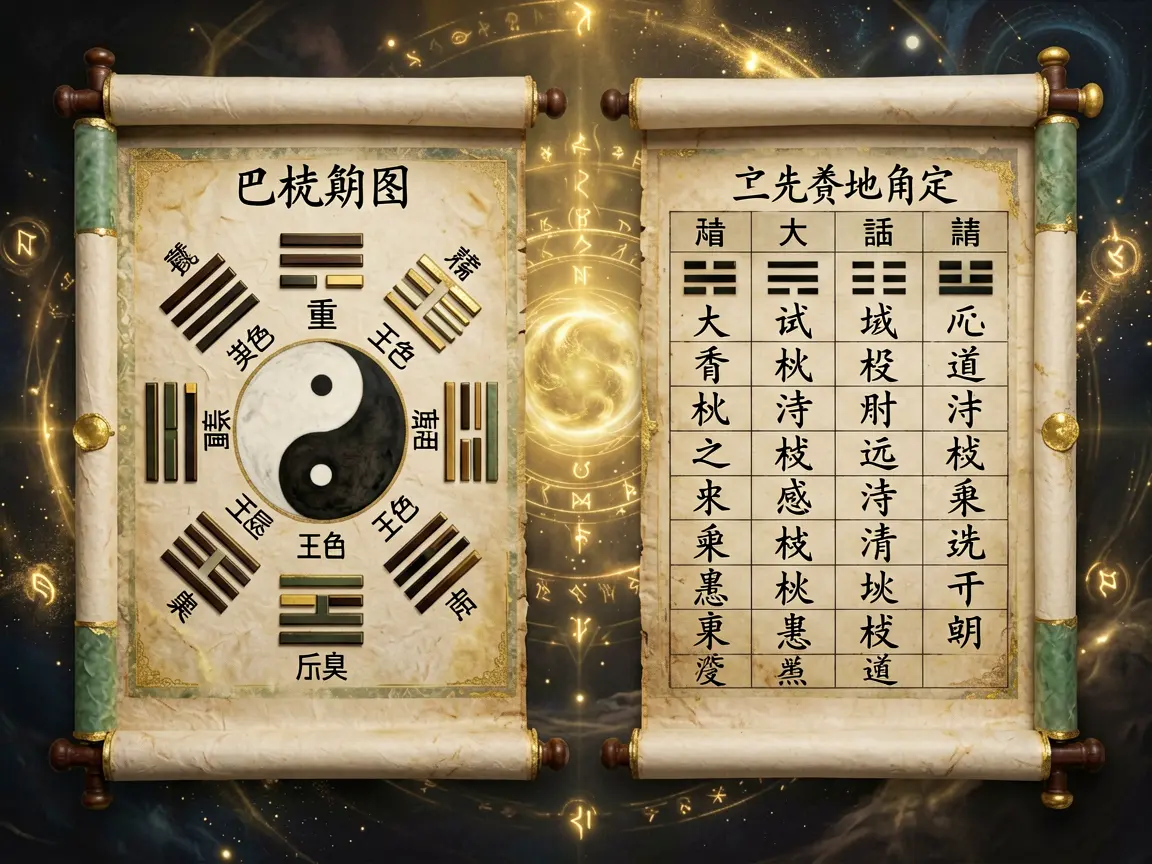
A client came to me last spring with two questions she thought were one. Should she leave her architecture firm, and what was her work actually for? She had cast the I Ching on her own and pulled Hexagram 29, the abyss. Then a friend's BaZi reader told her she carried a weak Metal day master drowning in autumn water.
She had information. No way to sort it.
That sorting is the whole art of this work. In eight years of reading charts and casting coins, the most common mistake I see is people reaching for the wrong tool. The I Ching and BaZi both come out of Chinese metaphysics. Both work. They answer different kinds of questions, and mixing them up turns signal into noise.
Jung understood the difference without ever stating it outright. He wrote the foreword to Richard Wilhelm's translation of the I Ching and kept the book on his desk at Bollingen for decades. "The I Ching does not offer itself with proofs and results," he wrote. "Like a part of nature, it waits until it is discovered."
BaZi does not wait. It was fixed the moment you were born, and it asks you to study it.
One tool reads the architecture of a life. The other tracks the weather of a single moment.
BaZi: The Architecture of a Life
BaZi, the Four Pillars, is a structural system. Feed it your exact birth date and time and it returns four pillars: year, month, day, hour. Each pillar holds a Heavenly Stem and an Earthly Branch. The day stem is your day master, the ego of the chart.
Think of a house. Foundation, load-bearing walls, the way the rooms connect. In Jungian terms, this is the archetypal skeleton of the psyche. The day master is your ego's native element. The Ten Gods around it are the inner cast: Resource, Wealth, Officer, Peer, Output. The names sound like fortune-telling jargon, but read psychologically and they come alive as figures in the internal drama Jung spent his life mapping.
One client in her forties kept sinking her own business despite obvious competence. Her chart named the architecture behind the pattern: a strong day master buried under too much indirect Resource. She was swimming in ideas and starved for execution. Once she saw it, she could work with it.
BaZi also carries a time axis. Luck cycles, ten-year phases driven by the elements. I avoid calling them destiny. A chart is a climate. Your luck cycles are the weather inside it.
When someone asks about the shape of a life, I reach for BaZi. Career direction. Relationship compatibility. Core gifts and recurring blind spots.
The I Ching: The Movement of a Moment
The I Ching works the other way. No birth data. You hold a question, cast three coins six times, and a hexagram rises out of the chance. Six lines of yin and yang. A snapshot of the moment.
This is synchronicity in its purest form. Jung coined the word for events connected by meaning rather than cause. When you cast, the coins landing the way they land is the psyche and the moment agreeing on a symbol. The hexagram shows the field of forces around your question. The moving lines show where that field is heading.
The I Ching reads a situation. That is its whole job.
Same client, six months later. A partner offered her a deal, and the terms felt wrong, but she could not say why. I did not open her chart. I had her cast. She drew Hexagram 59, Dispersion, with a moving line in the fifth place. The text spoke of ice melting as authority dissolves. She answered her own question before I finished reading. The deal required her to hand over control of the part of the business she loved most.
BaZi would have described the architecture of her ambition. The oracle showed her the exact knot in the present moment.
Which Tool for Which Question
Here is the test I give every new client. Write the question down. Then decide: are you asking about the river or about the water?
River questions belong to BaZi. They concern the shape of things over years. What am I here to do? Why do I keep attracting the same kind of partner? Where are my gifts and my blind spots? Am I in a season of building or of rest?
Water questions belong to the I Ching. They concern the surface of this moment. Should I take this offer? How do I handle this conversation on Thursday? What am I not seeing right now? Where is this feeling pointing me?
Get this backwards and both tools fail you. I have watched people cast the I Ching about whether they will ever marry, a structural question no single cast can answer. I have watched people order BaZi readings about whether to move house next month, a timing question the chart was never built for. When question and tool do not fit, the reading comes back as noise.
The Deep Work: Using Both
The strongest readings use both tools. BaZi sets the stage. The I Ching directs the scene.
A young man came to me about a transfer to another city. The career case was clear. His chart showed a ten-year Metal luck cycle beginning, and Metal was his needed element. Structure said go. He was terrified anyway. We cast, and he drew Hexagram 42, Increase, whose image is moving the center of the state. The oracle confirmed the direction and added a warning. The gain only comes if the move serves more than his own comfort.
Structure said go. The moment said go, but for a reason he had not considered.
When the two tools agree, you move with rare confidence. When they disagree, you have found the spot where your shadow is doing the driving.
A Protocol You Can Start Tonight
I keep a question log, and I recommend the same to clients. Every entry records the question, the tool, the reading, and what actually happened.
Before a reading, run three steps. Name the question in one sentence. Most muddle comes from questions that are really two questions fused. Classify it. Structure or moment? River or water? If the pattern spans years, BaZi. If the decision lives in the present, the I Ching. Genuinely both? Go in order, chart first, cast second.
The log has taught me more than any book. After a few months, patterns surface that a single reading hides. Last year I noticed that every big cast which aged poorly involved a question I had secretly decided before asking. The tool was fine. My hand was already on the answer.
If you want a shadow work exercise, try this. Take a question you care about and run it through both tools on the same day. Write both answers down. When they disagree, do not smooth the disagreement over. Sit with it for a week. Both answers are usually right inside their own frame, and the tension between them is the psyche working.
What This Looks Like in Practice
Here is the honest summary of my years at this work. Want to understand a person, yourself, a partner, a child, a hire? BaZi is the tool. It shows gifts, shadow patterns, the seasons ahead. Want to understand a moment, a decision, a conflict, a feeling? The I Ching answers faster. And when you want the person in the moment, use both. That is where the two systems become one practice.
Jung said the psyche speaks in images and in numbers. BaZi gives you the numerology of your birth. The I Ching hands you the image of your present. Between them, the whole psyche gets a voice.
Frequently Asked Questions
Which is more accurate, the I Ching or BaZi?
In my practice, accuracy is a matter of fit, not of the system. BaZi is precise about the structure of a life. The I Ching is precise about the present moment. Ask each the question it was built for, and both answer with striking clarity. Ask the wrong question, and both will confuse you.
Can I use the I Ching and BaZi together?
Yes, and I recommend it. In my sessions I use BaZi to set the frame of a client's life structure, then cast the I Ching for the specific decision in front of them. They work like a map and a compass. The map shows the terrain. The compass shows which way you face right now.
Does BaZi predict my future?
No, and this is the hardest myth to unwind. BaZi describes the energetic architecture you were born with and the seasons you will move through. Two people with identical charts live completely different lives. The chart shows the climate. It never dictates the harvest.
Is the I Ching better for quick decisions?
That is exactly what it was built for. You hold a question, cast the coins, and a hexagram mirrors the present field within minutes. But keep it to moment questions. For life direction and long patterns, BaZi is the better tool, and I say that as someone who loves the oracle.
Do I need my exact birth time for a BaZi reading?
Yes. The hour pillar is a quarter of the chart. It carries the children palace, the drive of later life, and one of the sharpest views of your work style. Without it, a full reading is simply not possible. The I Ching needs nothing from you but an honest question.
Ask the oracle a question
Cast a hexagram and receive a reflection rooted in the I Ching — your question, answered by ancient wisdom.
Cast Your Free HexagramFree · No sign-up needed
Frequently Asked Questions
Which is more accurate, the I Ching or BaZi?▼
Recommended Reading
Meihua
Mei Hua Yi Shu: How Plum Blossom Divination Turns the Moment Into a Hexagram
Meihua
The 64 I Ching Hexagrams: A Complete Reference (A Jungian Guide)
Meihua
What Is Chinese Divination? A Jungian Guide to the I Ching, BaZi, and Plum Blossom
Meihua
Shao Yong and the Plum Blossom Oracle: The Song Dynasty Sage Who Gave Synchronicity a Grammar