How to Use Plum Blossom Oracle Like Tarot: A Jungian Guide to Daily Draws and Shadow Work
Ask the oracle a question
Cast a hexagram and receive a reflection rooted in the I Ching — your question, answered by ancient wisdom.
Cast Your Free HexagramFree · No sign-up needed
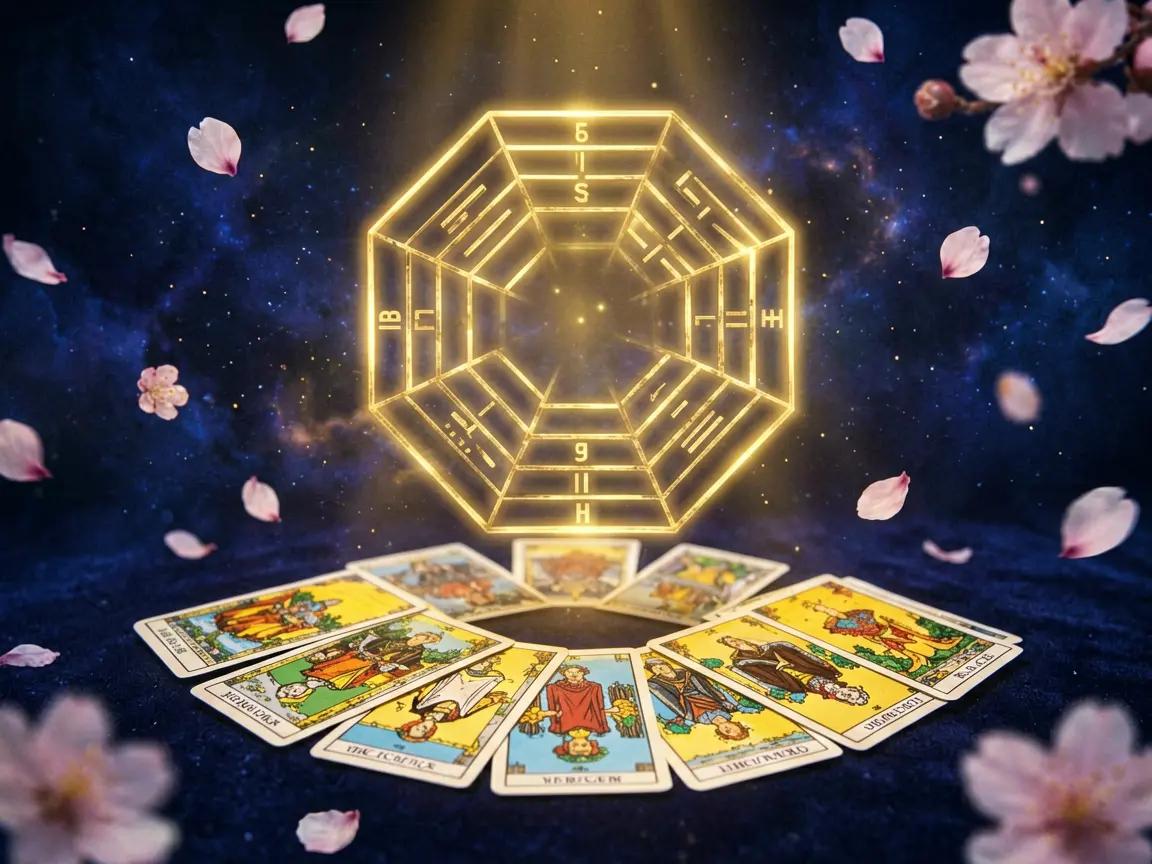
Plum blossom oracle is a cardless Chinese divination method that turns numbers from the present moment into an I Ching hexagram. For tarot readers it becomes a deckless tarot: keep the daily draw, swap the shuffle for a number the moment offers, and read the trigrams and moving line as your spread, pure synchronicity you can practice daily.
A client came to me two years ago, a tarot reader with ten years of practice and a wall of beautiful decks. She wanted to learn plum blossom divination but confessed she had no idea where to begin. "With tarot," she said, "I know the ritual. Shuffle, breathe, pull. With this, I just see numbers everywhere."
She already knew how to do the work. She only thought she did not.
Plum blossom oracle, the Mei Hua Yi Shu of the Song Dynasty sage Shao Yong, looks nothing like tarot. No cards. No images. No spread cloth. You take numbers from the present moment, convert them into a hexagram, and read the movement of your psyche as it is happening. Jung would have loved it, because it is synchronicity with a grammar. He defined synchronicity as a meaningful coincidence of inner and outer events, and that is precisely what a plum blossom cast is. The number you notice is not random. It is the outer world agreeing with your inner state.
Everything you have learned as a tarot reader translates. Here is how I teach it.
The Daily Draw, Without the Cards
Your daily tarot draw has a rhythm: clear the mind, state the intention, pull one card, sit with it. Keep that rhythm and change one thing only. Instead of a card, take a number from the moment.
My method is the clock. Look at the time you ask the question and split it into two parts. The hour becomes your upper trigram, the minute becomes your lower trigram. At 9:47, that is 9 and 47. Reduce each to a number between 1 and 8 by dividing by 8 and keeping the remainder, with 8 itself counting as 8. Then add both together with the day of the month, divide by 6, and the remainder tells you which line of the hexagram is moving. That moving line is the heart of the reading.
Do not let the arithmetic scare you. After a week it takes less time than a shuffle.
The ritual matters more than the math. I tell every client to pause the same way they pause before pulling a card. Name the question inside your head. Notice the first number that presents itself. The moment you start hunting for a nicer number, the oracle goes quiet.
The Spread You Already Know
A tarot spread gives the unconscious structure: this position means the past, this one the hidden influence, this one the outcome. Plum blossom has its own positions, and they map cleanly onto what you already practice.
The hexagram is two trigrams stacked. The upper trigram is the outer world, the other people, the visible situation. The lower trigram is your inner world, your attitude, the part of the situation you carry. When a client asks about a relationship, I read the upper trigram as the other person and the lower as them. When the question is about a decision, the upper is the circumstance and the lower is the chooser.
The moving line plays the role of the significant card in a spread. Line one sits at the bottom of the hexagram, line six at the top. A moving line in the lower region points to something stirring in your foundations, your habits, your body. A moving line in the upper region points to the situation itself shifting. I have seen this hold again and again: clients report back that the moving line named exactly the part of their life that was already in motion.
Questions That Work
Tarot has taught you to ask open questions. "What do I need to see here?" beats "Will it work?" The plum blossom oracle answers the same way. Give it a forced yes or no and it will hand you a hexagram that feels evasive, because you asked it to collapse a living process into a switch. Give it an open question and it shows you the field you are standing in.
My favorite framing comes from a client who studied with me for a year. She asks, "What is the energy of this decision, and where is it trying to move me?" That question has never failed her. It invites the hexagram to describe, not to sentence.
The Journal
You keep a tarot journal. Keep a plum blossom one in the same notebook. Date, question, cast, first impression, follow-up. Write down the numbers you used, because you will want to verify them later. The single most instructive habit I know is reviewing a month of casts with fresh eyes. Patterns surface that a single reading hides.
I learned this the hard way. Early in my practice I logged every cast dutifully but never reread the log. When I finally did, I found that every reading that aged poorly shared one trait: I had asked with my answer already chosen. The oracle was fine. My hand was already on the page.
The Unwelcome Hexagram
Here is where plum blossom becomes shadow work.
When a tarot reader pulls the Tower, the instinct is to flinch. The mature practice is to sit with it and ask what the psyche is trying to tear down. The plum blossom equivalent is drawing a hexagram you do not want, like Hexagram 29, the abyss, or Hexagram 47, oppression. The number came from your moment. That means some part of you already knows this material is present, and the cast is simply the part of you that does not want to admit it.
I had a client who cast Hexagram 29 five times in two weeks. She kept recasting because she disliked the answer. When she finally stopped and sat with it, she named the pattern herself: she was avoiding a conversation with her business partner that had become an abyss of unspoken resentment. The hexagram did not make the conversation happen. It made the avoidance visible.
A Shadow Work Exercise for This Week
Try this at home. For seven days, cast once each morning using the clock method. Do not ask anything. Just note the hexagram and one line: where this image showed up in your day.
On the seventh evening, read all seven entries together. Look for the hexagram you kept resisting, the one you wrote down with a sigh. That is your shadow announcing itself. Take that single hexagram and journal three questions. What in my life currently looks like this? Which part of me refuses to see it? What would change if I stopped refusing?
One week of this has produced more honest material for my clients than a year of asking the oracle what it wants them to hear.
Two Languages, One Psyche
I have read tarot for clients for over a decade, and I have cast plum blossom for just as long. They do not compete. Tarot gives you archetypal images to dream with, figures straight out of the collective unconscious. Plum blossom gives you the structure of the present moment, a synchronicity you can hold in your hand. Jung worked with the I Ching for decades and consulted the Tarot as a psychological instrument. He never chose between them, and neither should you.
Start with the daily draw. Use the clock. Keep the journal. Sit with the hexagram you do not like. That is the whole curriculum, and it is the same curriculum you already mastered with cards.
Frequently Asked Questions
Can I use plum blossom oracle like a tarot deck?
Yes. In my practice I treat it as a cardless tarot. The daily draw, the spread, the journal, all of it translates. You swap the shuffle for a number taken from the moment, and the hexagram becomes your card of the day.
Do I need cards to use the plum blossom oracle?
No cards at all. Plum blossom reads the present moment through numbers: the time on a clock, a page number, the count of something near you. That is why I call it the most portable oracle in Chinese metaphysics.
What is the difference between plum blossom oracle and tarot?
Tarot hands you fixed images and asks you to meet them. Plum blossom hands you a structure made of the moment itself: an upper and lower trigram plus a moving line. Tarot speaks in archetypal pictures. Plum blossom speaks in pure synchronicity.
Is plum blossom oracle good for daily draws?
It is excellent for daily draws, and some of my clients prefer it once they learn it. One cast takes under a minute, and the hexagram gives you material for a whole day. The trick is to treat it like a card pull: one clear question, one cast, one line in the journal.
How do I choose numbers for a plum blossom reading?
Anything present at the moment of asking. The hour and minute, a license plate, the page you open to, the number of steps to your door. I tell clients to use whatever arrives first and never to shop for a better number. The first number is the honest one.
Ask the oracle a question
Cast a hexagram and receive a reflection rooted in the I Ching — your question, answered by ancient wisdom.
Cast Your Free HexagramFree · No sign-up needed
Frequently Asked Questions
Can I use plum blossom oracle like a tarot deck?▼
Recommended Reading
Meihua
Mei Hua Yi Shu: How Plum Blossom Divination Turns the Moment Into a Hexagram
Meihua
The 64 I Ching Hexagrams: A Complete Reference (A Jungian Guide)
Meihua
What Is Chinese Divination? A Jungian Guide to the I Ching, BaZi, and Plum Blossom
Meihua
Shao Yong and the Plum Blossom Oracle: The Song Dynasty Sage Who Gave Synchronicity a Grammar