Chinese Lunar Mansions and the Twelve Sky Divisions Behind the Zodiac
Curious what YOUR chart reveals?
Cast your free BaZi chart and see your Day Master, elemental balance and life patterns through a Jungian lens.
Get Your Free BaZi ChartFree · No sign-up needed
The Date Written in a Planet
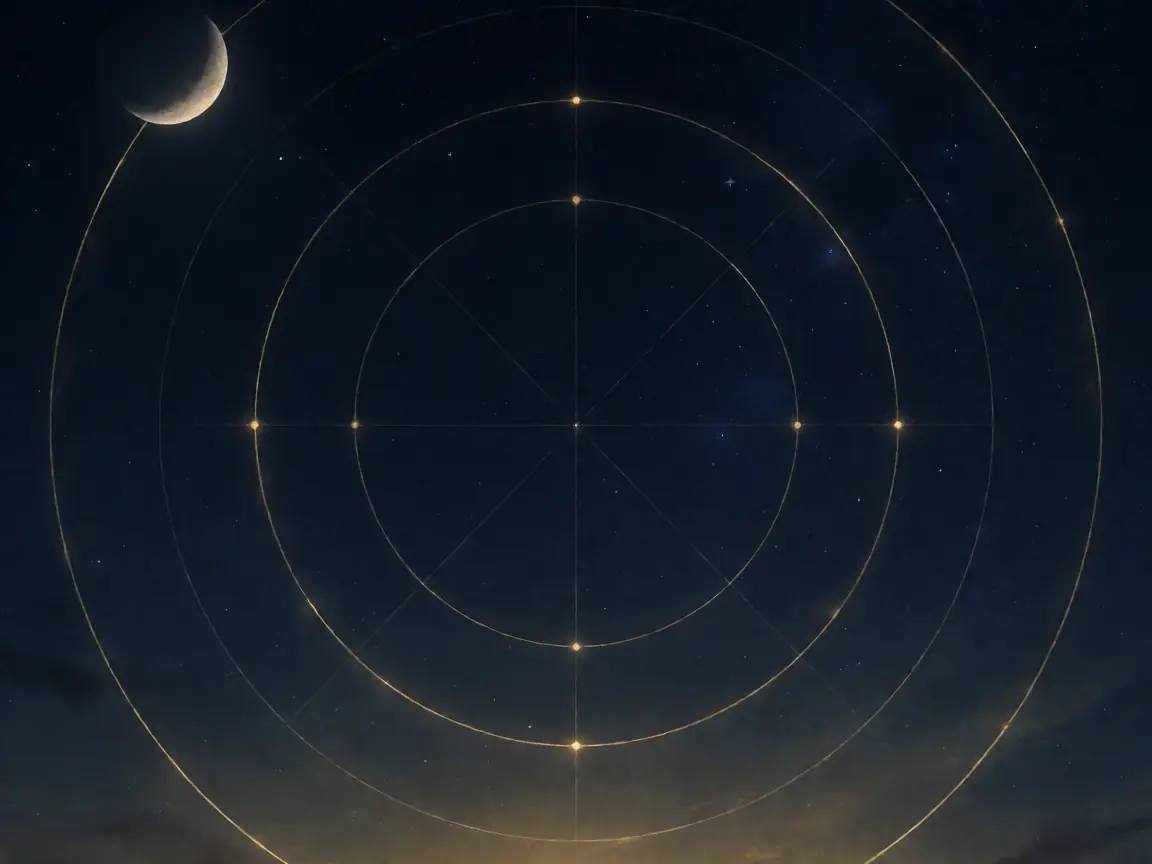
The oldest timestamp that leans on the twelve-fold ring comes from the Discourses of the States, court speeches compiled between the fifth and fourth centuries BCE. The diviner Lingzhou Jiu is arguing with King Jing of Zhou about whether conquest settles anything. His evidence is a planetary position. 武王伐殷,歲在鶉火: when King Wu attacked Yin, Jupiter stood in Quail Fire, one of the twelve divisions of the sky.
That ring was keeping records five hundred years before anyone hung an animal on a year.
What the Lunar Mansions and Divisions Are
Chinese lunar mansions are a system of twenty-eight star stations that mark the Moon's nightly progress around the ecliptic, grouped into four seasonal quarters of seven. They sit inside the twelve sky divisions, equal arcs that track Jupiter's slow passage along the same path over roughly twelve years.
Two clocks, one sky. The Moon's clock gives you the night and Jupiter's gives you the year. The animal signs arrived last.
The Moon's Twenty-Eight Stations
The Moon returns to the same star about every 27.32 days. Sky-watchers cut that path into twenty-eight stations, close to one per night. Four symbols hold seven each.
Inside each quarter the seven run through one sequence, wood, metal, earth, sun, moon, fire, water, and every element carries an animal. The eastern week opens 角木蛟 and 亢金龍, then 氐土貉, 房日兔, 心月狐, 尾火虎, 箕水豹. The western quarter repeats the pattern with a wolf, a dog, a pheasant, a rooster, a crow, a monkey and an ape.
So the sky held four copies of one week, and the week was the five phases plus the two lights. Rome built its week from the same seven objects.
The paper trail is datable. The phrase 二十有八星, the twenty-eight stars, first appears in the Rites of Zhou. The complete list of station names first appears in the Lüshi Chunqiu, compiled around 239 BCE. The oldest object carrying the full set is the lid of a lacquered box from the tomb of Marquis Yi of Zeng, dated to about 433 BCE.
The Sky Is Named After a House
Read that list again. Winnowing Basket. Rooftop. Wall. Room. Net. Well. Chariot.
Whoever named these stations used the objects in reach. A winnowing basket is a flat tray for tossing grain so the wind carries the chaff off. Four stations name body parts instead: Horn, Neck, Root, Heart, Tail. No gods were drafted in to furnish this sky. It reads like an inventory of a working household.
Nobody discovers a sky. Somebody looks up one night and finds their own household there.
Jupiter's Twelve Steps
Jupiter takes 11.86 years to come back to the same star. Round the ring into twelve equal arcs and you have a year counter.
| Division | Branch | Western sign | Station group |
|---|---|---|---|
| 星紀 Star Chronicle | 丑 | Capricorn | Dipper, Ox |
| 玄枵 Dark Emptiness | 子 | Aquarius | Girl, Emptiness, Rooftop |
| 娵訾 Stubble | 亥 | Pisces | Encampment, Wall |
| 降婁 Descending Tower | 戌 | Aries | Legs, Bond |
| 大梁 Great Beam | 酉 | Taurus | Stomach, Hairy Head, Net |
| 實沈 Real Sinker | 申 | Gemini | Turtle Beak, Three Stars |
| 鶉首 Quail's Head | 未 | Cancer | Well, Ghost |
| 鶉火 Quail's Fire | 午 | Leo | Willow, Star, Extended Net |
| 鶉尾 Quail's Tail | 巳 | Virgo | Wings, Chariot |
| 壽星 Longevity Star | 辰 | Libra | Horn, Neck |
| 大火 Great Fire | 卯 | Scorpio | Root, Room, Heart |
| 析木 Split Wood | 寅 | Sagittarius | Tail, Winnowing Basket |
The Song compilation 天原發微 quotes a Han commentator: 一左一右相為經緯, one runs left, one runs right, and the pair threads together like warp and weft.
The Animals Came Later
Earthly Branches is the older layer. The characters are attested on Shang dynasty oracle bones, which makes them over three thousand years old. In the Eastern Han, Xu Shen read three of them as pictures of animals, 巳 as a snake and 亥 as a pig. The twelve branch names were easy to confuse, so people substituted animals and borrowed the ordinal signs, which is the shift the record of the Chinese zodiac describes.
Which makes the animal a mnemonic that outgrew its job. Keep that in mind when a reading sounds like a verdict about your personality.
I have written the twelve branches one at a time here, from the Rat at midnight to the Dragon and its water vault to the Goat and its stored wood. The year hub holds the ring in one table.
A Ring That Doubled as an Atlas
Each division carried a territory too, a pairing called 分野. Quail's Fire belonged to the Zhou royal domain, Great Fire to Song, Split Wood to Yan, Star Chronicle to Wu and Yue. A year count, a star chart and a political atlas, all on one ring.
Who decided what each sign means? Everyone did, and the reasons were administrative.
What the Map Hides
Jung held that the parts of a personality we cannot own, the material he called the shadow, are the parts most likely to be pushed outward onto other people. Projection turns the outside into a replica of something unrecognized inside.
Marie-Louise von Franz, who worked beside Jung for three decades, later put the mechanism in a sentence of her own. Wherever known reality stops, where we touch the unknown, there we project an archetypal image. A star sits at that edge, which is why the night sky has absorbed so much of what people could not say out loud.
The winnowing basket is the station I trust. Somebody needed to sort grain from chaff, looked up, and found the tool already there.
A person born in a Rat year hears the Rat story early, and the story turns into a set of instructions. Jung's word for the mask is the persona, and his account of individuation is mostly about taking it off. You cannot set down a mask you have never held up.
The map also carries the fingerprints of its makers. Jupiter runs 11.86 years while the ring has twelve, so the system needed an imaginary counterweight. The mansion arcs are wildly uneven, some covering twenty-five degrees while Turtle Beak covers a sliver. It was built, corrected and argued over by named people.
Working With the Sky Layers
Find your division. Your animal has a branch, and the branch sits on one arc. A Rat chart lands on Dark Emptiness with Girl, Emptiness and Rooftop inside it, and an Ox chart lands next door on Star Chronicle where Dipper and Ox sit. The BaZi chart tool gives you your own branch in a minute.
Watch one moon. Pick a bright star you can find from your window, such as Spica in spring or autumn, and note the Moon's position against it each night for a week. Seven nights is one quarter of the ring.
Name the label. Write your animal sign at the top of a page, then list the four or five traits you assume come with it. Mark each as chosen or inherited from hearing the story, since only the first group is yours.
Journal prompt. Write the names you would have given the stars, using only objects in your own kitchen and street. That list is a portrait of what you project.
What the Diviner Was Doing
Lingzhou Jiu was not casting a chart. He was citing a record to settle an argument about whether force decides anything, and he reached for a planet because a planetary position is a date nobody can forge.
I use the same trick with clients, except my dates come from a birth certificate. Everyone arrives carrying a question they have already lived with for months. The chart gives that question a page to sit on.
This article is offered for spiritual guidance and entertainment purposes only. It is not a substitute for medical, legal, or financial advice.
Curious what YOUR chart reveals?
Cast your free BaZi chart and see your Day Master, elemental balance and life patterns through a Jungian lens.
Get Your Free BaZi ChartFree · No sign-up needed
Frequently Asked Questions
What are the Chinese lunar mansions?▼
How are the 28 mansions different from the 12 divisions?▼
Did the Chinese zodiac animals come from Jupiter?▼
Why do the twelve divisions run opposite to the Earthly Branches?▼
What do the lunar mansions mean in a reading?▼
Recommended Reading
BaZi
Goat in Chinese Astrology: The Eighth Branch, the Vault of Wood, and the Shadow of the Good Name
BaZi
Monkey in Chinese Astrology: The Ninth Branch, the Spirit in the Metal, and the Shadow of the Shortcut
BaZi
Horse in Chinese Astrology: The Seventh Branch, the Fire at Full Gallop, and the Shadow of the Burn
BaZi
Snake in Chinese Astrology: The Sixth Branch, the Metal Born in Fire, and the Shadow of the Favor