Astrology Compatibility Birth Chart: How to Read Two Charts Side by Side
Discover your cosmic blueprint
Cast your natal chart and explore the symbolic patterns that shape your personality and life journey.
Get Your Free Natal ChartFree · No sign-up needed
A woman I read for last spring sent me a screenshot with a number circled in yellow. Ninety-one percent compatible. She and the man in question had been unhappy for eight months, and she wanted to know what the app had measured that she could not see.
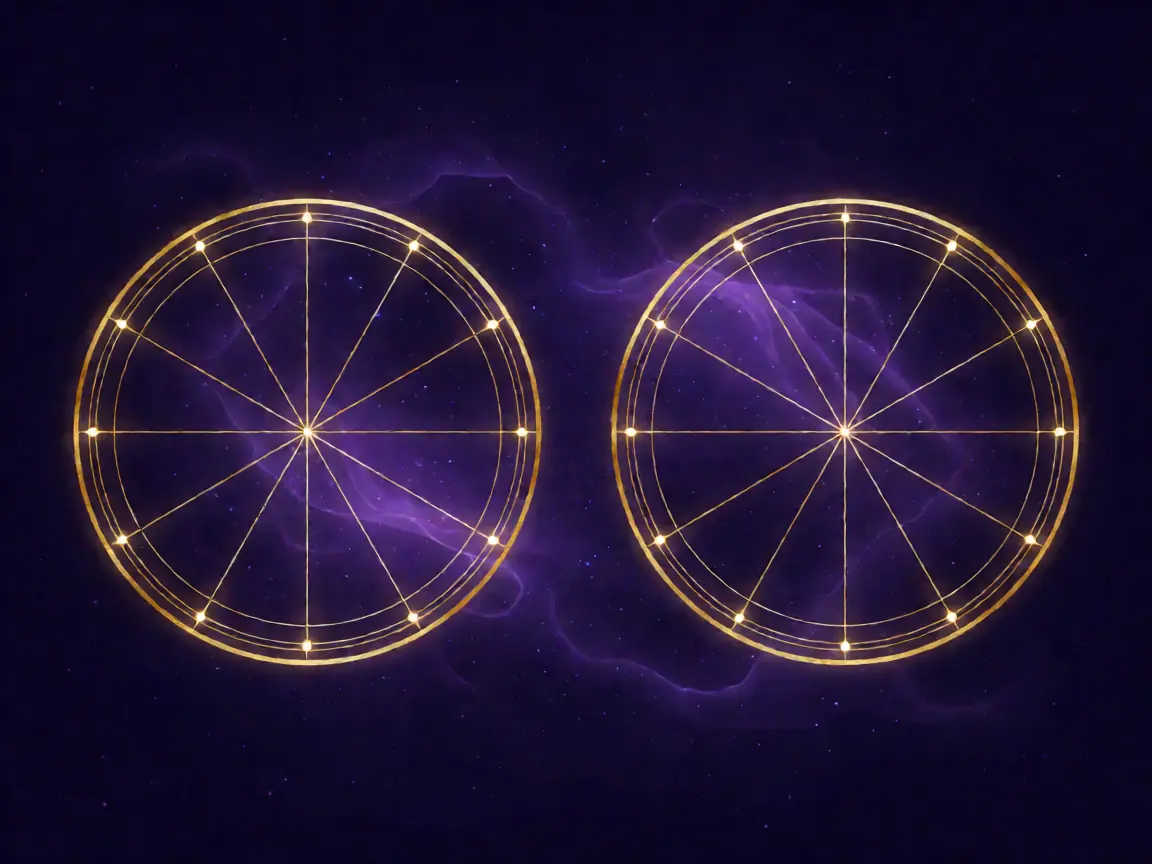
An astrology compatibility birth chart is a two-person reading that measures the angular distance between one person's planets and another's, then groups those distances into aspects. Where a sun sign comparison reads two signs, a compatibility birth chart reads two full wheels: ten planets each, the degree of each planet inside its sign, and the contacts that form between the two sets. The geometry is the part that carries information, and it is the part you can read yourself with a notebook and an ephemeris.
Two Wheels, Two Methods
The older method is overlay, which astrologers call synastry. You lay one chart on top of the other and read the contacts between them. It has been in use since at least the first and second centuries CE, when Dorotheus and Ptolemy were writing (Wikipedia). The planetary layer of that method has its own treatment in my guide to synastry, so this piece stays with the mechanics.
The composite chart arrived in the twentieth century with no classical precedent. It is a midpoint construction in which each planet sits exactly halfway between the two people's versions of that planet. John Townley introduced it in his 1973 book The Composite Chart, and Robert Hand made it canonical two years later with Planets in Composite (The Astrology Podcast). Townley called it a mathematical construct of mutual midpoints, answering to no actual moment or place.
The two methods answer different questions. Overlay tells you how each person experiences the other. The composite tells you what the pair behaves like as a unit, including patterns that neither person carries alone. This article stays with the overlay, because that is the version you can build by hand.
The Geometry Comes First
Everything in a compatibility reading rests on one fact. The zodiac is a circle of 360 degrees, divided into twelve signs of 30 degrees each.
That makes the arithmetic easy. Count the signs between any two placements and multiply by 30 to get the angular distance between them. Same sign, roughly zero degrees, and the pair is in conjunction. Two signs apart gives 60 degrees, the sextile. Three signs apart gives 90, the square. Four gives 120, the trine. Six signs apart gives 180, the opposition.
Five of those angles are old enough to have names attached to a person. Ptolemy used them in the Tetrabiblos in the second century CE, which is why they are still called the Ptolemaic aspects. Conjunction, sextile, square, trine, opposition. The rest are later additions with smaller effects.
Then there is the orb, which is the margin by which two planets miss the exact angle and still count. Most modern Western astrologers allow six to eight degrees for the major aspects, and wider for a conjunction or for anything involving the Sun and Moon. The closer the contact, the louder it speaks. A Moon-Saturn conjunction with an orb of two degrees will shape a relationship more than six loose contacts scattered across the wheel.
Hellenistic and medieval astrologers drew aspects by sign rather than by degree, which is why two placements in signs of the right relationship count as connected even when the degrees sit far apart. Most modern readers work by degree and use sign distance as a first filter.
What Each Angle Does to a Couple
Conjunction, 0 degrees. Two functions fuse. This is the aspect of the blank spot, the place where a couple cannot see what they are doing because both of them are inside it. I once watched a pair finish each other's sentences for ten minutes and then, separately, both describe the same argument they had never had. Nothing had been brought out where either of them could look at it.
Sextile and trine, 60 and 120 degrees. Flow, and the trap inside flow. A trine usually sits inside a single element, and the element pairings have their own treatment in my guide to astrology compatibility signs. Jung noted in Psychological Types that the dominant function shapes consciousness while its opposite gets pushed into the unconscious (Wikipedia). A couple whose charts agree everywhere has very little pressure to develop the functions they left in reserve. Their strengths get stronger. The undeveloped parts stay undeveloped, and nobody notices for years, because nothing hurts yet.
Square, 90 degrees. Friction, and the most useful aspect in the chart. Squares are where projection lands, which makes them uncomfortable and worth reading closely. Her Mercury squares his Saturn and every conversation turns into a hearing. Two functions that need each other are meeting without a translator, and the irritation marks the spot where translation has to be built.
Opposition, 180 degrees. Polarity. Jung used the yin-yang symbol to describe it, writing that a pair without its partner is like yin without yang, and he placed the anima and animus at the far end of that axis. An opposition is where you hand the other pole of yourself to someone else and ask them to carry it. This is the aspect that produces the feeling of having known a stranger for years. It is also the aspect that produces the argument three years in, when the projection thins out and the actual person is standing there.
Jung kept one distinction worth carrying into this section. The encounter with the shadow is the apprentice work of a life, he wrote, while the encounter with the anima or animus is the masterpiece. In chart terms, the squares are the apprentice work and the oppositions are the masterpiece. One asks you to own what you have denied. The other asks you to love a person who is not your fantasy.
What the Chart Needs From Each Person
Two dates, two times, two birthplaces. The date alone pins the Sun, Mercury, Venus and Mars, since none of them moves far enough in a day to change sign without a time. The time is what makes the Moon and the Ascendant usable, and the Ascendant is what puts houses on the wheel. Houses are the only way an overlay can show one person's planet landing in the other's fourth house or seventh house, which is where a fair amount of the emotional charge in a reading comes from.
When one birth time is missing, the reading narrows rather than collapses. Date-level compatibility has its own method and its own limits, and I laid those out in what two birthdays reveal.
Reading a Compatibility Chart by Hand
You need both birthdays, both birth times, and the signs and degrees of six placements per person: Sun, Moon, Mercury, Venus, Mars, Saturn.
1. Write both sets of placements down, sign plus degree, in two columns.
A pair I read in June came in with a single contact worth mentioning, her Saturn within three degrees of his Moon. She described him, without prompting, as the person who slows her down. He described her as the only person who had ever made him finish anything. Same contact, two accounts, both accurate. Saturn on the Moon brings weight to attachment and asks both people to build something with it. She had been reading the weight. He had been reading the structure.
Where the Chart Stops
Back to the ninety-one percent. A compatibility score is a chart with the geometry hidden, which means you cannot see what it measured or where it drew the line. The overlay I have been describing shows you what it measured and where the line falls. It marks where the two of you will have to work, and the doing stays with you.
I asked the woman with the screenshot what she had wanted from the number. She said she wanted permission, one way or the other, to stop trying. That is not something a chart can issue. What it can do is put the conversation on the table with a name attached, and give two people a place to start talking about the thing they had both been walking around.
This article is offered for spiritual guidance and entertainment purposes only. It is not a substitute for medical, legal, or financial advice.
Discover your cosmic blueprint
Cast your natal chart and explore the symbolic patterns that shape your personality and life journey.
Get Your Free Natal ChartFree · No sign-up needed
Frequently Asked Questions
What is an astrology compatibility birth chart?▼
What is the difference between synastry and a composite chart?▼
Which aspects matter most in a compatibility chart?▼
Can I read a compatibility chart without software?▼
Does a square or opposition mean we are incompatible?▼
Recommended Reading
Astrology
Astrology Compatibility by Date of Birth: What Two Birthdays Reveal
Astrology
Astrology Compatibility Signs: What the Four Elements Reveal About Attraction
Astrology
Leo Zodiac Sign Meaning: The Lion, the Sun, and the Shadow of the Golden Mask
Astrology
Weekly Zodiac & Horoscope Forecast September 21 - September 27, 2026