Venus Sign Meaning in Astrology: The Anima Archetype and Your Soul's Way of Loving
Discover your cosmic blueprint
Cast your natal chart and explore the symbolic patterns that shape your personality and life journey.
Get Your Free Natal ChartFree · No sign-up needed
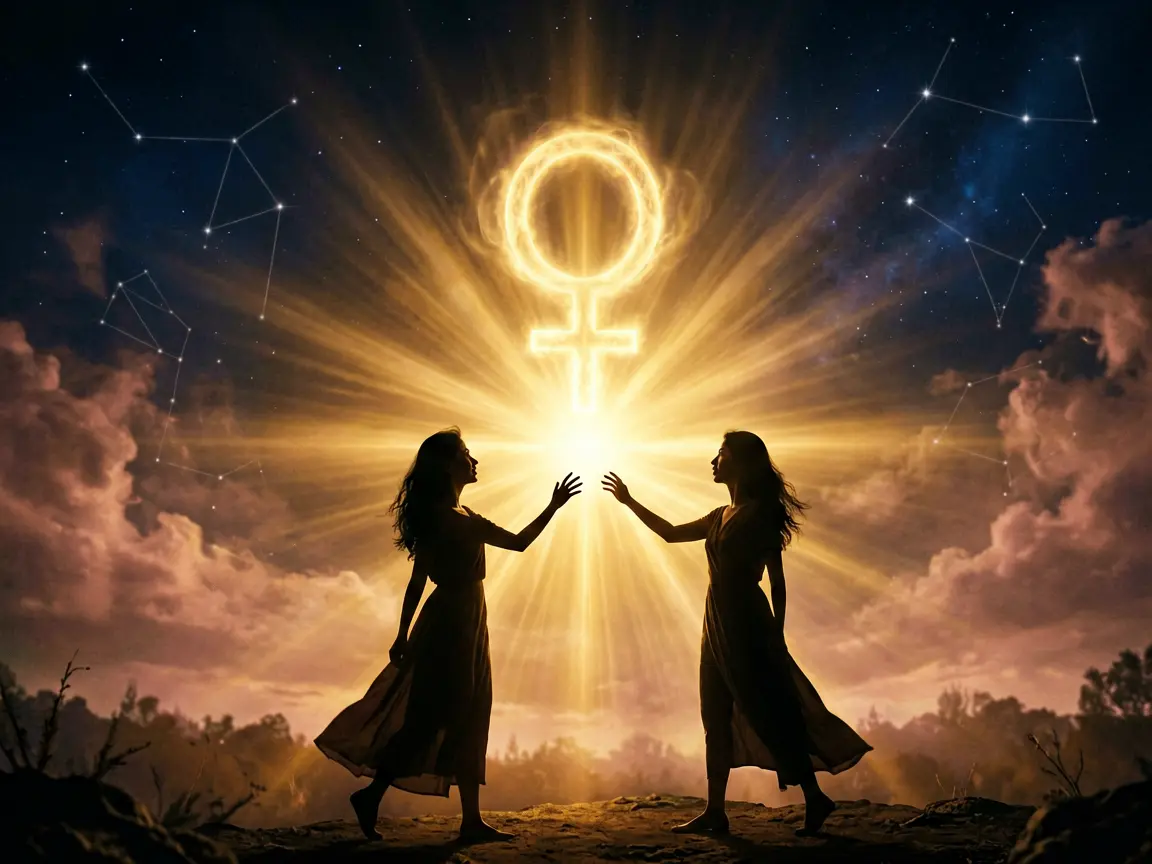
Jung wrote that the meeting of two personalities is like the contact of two chemical substances. If there is any reaction, both are transformed.
You have probably read a description of your Venus sign before. "Venus in Aries means you are bold in love. Venus in Taurus means you are sensual and loyal." Those descriptions are true as far as they go. But they treat Venus as a personality trait. They miss what it actually is: a portal into the deepest relational patterns of your psyche.
From a Jungian perspective, Venus corresponds to something far more profound than love and beauty. It maps the archetypal image of the Anima. For those with a predominantly masculine ego structure, Venus carries the face of the inner feminine. For those with a predominantly feminine structure, it carries the Animus. Your Venus sign reveals the template your unconscious uses when it reaches toward another person. It maps the quality of your Eros, the principle of relatedness and psychological bonding that Jung placed at the center of individuation.
Venus as the Anima Archetype
Jung described the Anima as the inner feminine image every man carries in his unconscious. It is a personified archetype, a living symbol of Eros, feeling, mood, receptivity, and relatedness, not a literal woman or a stereotype. The Anima mediates between the ego and the deeper layers of the unconscious. She appears in dreams, fantasies, and projections. She is the face you fall in love with before you have ever spoken a word.
In a womans chart, Venus operates differently. It can express as the Animus, the inner masculine. Or it can represent her own relationship to the feminine principle, her embodied sense of worth, pleasure, and self-value. Either way, Venus is the planet of projected love. It shows us what we unconsciously seek in another because it is the part of ourselves we have not yet fully claimed.
Think of it this way. Your Sun sign is your conscious identity. Your Moon sign is your emotional shadow. Your Venus sign is the bridge between them. It is the quality of relatedness that allows the ego to meet the unconscious and begin the lifelong conversation Jung called individuation.
Venus by Element: The Four Qualities of Eros
Start with the element. It reveals the fundamental quality of your relational energy, the texture of your Eros.
Venus in Fire Signs (Aries, Leo, Sagittarius): Your Eros is spontaneous, enthusiastic, and direct. You fall in love with the spark of possibility. The danger is that you may confuse the thrill of the chase with genuine intimacy. Your shadow work is to stay present after the initial ignition. Can you sustain relatedness when the fire settles into a steady glow?
Venus in Earth Signs (Taurus, Virgo, Capricorn): Your Eros is patient, sensory, and loyal. You build love the way you build a life, one brick at a time. The shadow here is possessiveness or a tendency to reduce love to practicality. Your growth edge is to risk the unpredictable. Let love be a little unstable if that means it can also be alive.
Venus in Air Signs (Gemini, Libra, Aquarius): Your Eros is intellectual, curious, and conversational. You are drawn to the meeting of minds before the meeting of bodies. The shadow is detachment. You may analyze love rather than feel it. Your invitation is to descend from the realm of ideas into the messy, embodied reality of connection.
Venus in Water Signs (Cancer, Scorpio, Pisces): Your Eros is emotional, intuitive, and oceanic. You love with your entire feeling body. The shadow is enmeshment. You may lose yourself in the other, mistaking merger for intimacy. Your work is to develop a strong enough container that you can feel deeply without drowning.
The Venus Shadow: What You Project, You Must Integrate
One of Jung's most powerful insights was that everything we find irresistibly attractive in another person is a projection of an unowned part of ourselves. If you are drawn to someone with an intense, magnetic presence, that intensity lives somewhere in your own psyche, probably in your shadow, waiting to be claimed.
This is where Venus becomes a tool for serious psychological work. When you notice a pattern in your romantic history, the same type of person, the same disappointment, the same longing, your Venus sign is the key to decoding it.
Try this: look up your Venus sign and its element. Then ask yourself three questions. What kind of love did I witness growing up? What kind of love did I learn to expect? And what kind of love am I afraid to ask for?
The third question carries the most weight. The love you are afraid to ask for is usually the love your Venus truly needs. The safe patterns you repeat are your egos compromise. The love you dare not name is your souls desire.
Venus in the Houses: Where Your Relational Drama Unfolds
The sign of your Venus tells you how you love. The house tells you where that love plays out. This is where Venus becomes exquisitely specific.
Venus in the 1st house means your relational identity is tied to your self-presentation. You project your Anima or Animus through your very presence. Venus in the 4th house means your love patterns are deeply entangled with your family of origin and your inner sense of home. Venus in the 7th house places relationship center stage. You learn who you are through the mirror of the other. Venus in the 10th house means your public life and your values are inseparable. Your career may be an expression of your Eros.
Each house placement adds a layer of psychological specificity to the elemental quality of your Venus. If you have Venus in Libra in the 4th house, you may need intellectual harmony in your domestic life. If you have Venus in Capricorn in the 7th house, you may seek a relationship that feels like a shared life project, structured, patient, and built to last.
A Venus in the 5th house speaks to a creative, playful approach to romance. You fall in love through shared joy and self-expression. Your Anima or Animus projection often appears through artistic collaboration or the theater of courtship. Venus in the 12th house is perhaps the most psychologically complex placement. Your relational patterns are deeply submerged in the unconscious. You may be drawn to hidden, unavailable, or spiritually idealized partners. Not because you are broken. Your psyche is using love as a pathway to the numinous, to the mystery that lies beyond the ego. The house of your Venus is the stage on which your inner drama of relatedness unfolds. Knowing that stage transforms casual self-knowledge into genuine psychological insight.
Venus and Individuation: From Projection to Integration
The goal of the Jungian path is to withdraw projection, to reclaim the parts of ourselves we have been giving away to others. Venus is arguably the most powerful planet for this work because romantic projection is the most emotionally charged projection of all.
When you meet someone and feel an overwhelming sense of recognition, a sense of "this is the one," what you are most likely experiencing is a powerful Anima or Animus projection. That person is carrying the image of your unconscious ideal. And that is beautiful. It is the psyche reaching toward wholeness. But it is also dangerous if you mistake the projection for the person.
The mature approach to Venus is to appreciate the projection, learn from it, and then gradually withdraw it. Let the other person be a person, flawed, real, separate. And let the qualities you saw in them become qualities you cultivate in yourself.
Transforming romance from a compulsion into a conscious choice is the work. A compulsive attraction is a symptom of an unexamined inner life. A conscious love is a sign that individuation is underway.
Frequently Asked Questions
Is my Venus sign more important than my Sun or Moon sign for relationships?
Not more important, but differently important. Your Sun sign shows your core ego identity. Your Moon sign reveals your emotional needs and shadow patterns. Your Venus sign reveals how you relate, the quality of your Eros. A complete psychological picture requires all three. Think of them as the trinity of your relational self: the who (Sun), the what (Moon), and the how (Venus).
Can two people with incompatible Venus signs have a healthy relationship?
Yes, if both are doing their psychological work. A Venus sign only describes your default relational pattern, not your destiny. The most magnetic connections are often between people with challenging Venus aspects, because those aspects activate growth. The real question is whether both people are willing to do the shadow work their Venus differences reveal.
Why do I keep attracting the same Venus type even though it never works?
This is the repetition compulsion, a core Jungian concept. You are unconsciously drawn to a certain Venus energy because it represents an unintegrated part of your psyche. The pattern will repeat until you stop projecting and start integrating.
How does Venus retrograde affect the psychology of love?
A Venus retrograde period is the psyche's invitation to review your relationship patterns. It pulls the projection inward. What you formerly sought in others, you are now asked to find in yourself. It can feel lonely or frustrating, but psychologically it is one of the most fertile times for genuine relational growth. Use it for inner work, not for making relationship decisions.
Is Venus the same as the Anima for women?
Not exactly. For a woman, Venus can represent her relationship to the feminine principle itself, her sense of self-worth, pleasure, and embodied value. The Animus archetype (the inner masculine) may be more strongly correlated with Mars or Saturn in a womans chart. But these are maps, not walls. Every psyche contains both masculine and feminine energies, and Venus participates in that dance regardless of gender.
Discover your cosmic blueprint
Cast your natal chart and explore the symbolic patterns that shape your personality and life journey.
Get Your Free Natal ChartFree · No sign-up needed
Recommended Reading
Astrology
Weekly Zodiac & Horoscope Forecast October 19 - 25, 2026: Mercury Retrograde Begins as Venus Meets the Sun
Astrology
Weekly Zodiac & Horoscope Forecast October 12 - 18, 2026: Pluto Turns Direct
Astrology
Weekly Zodiac & Horoscope Forecast October 5 - 11, 2026: The Libra New Moon
Astrology
Weekly Zodiac & Horoscope Forecast September 28 - October 4, 2026