Tarot Spreads for Self-Inquiry: 6 Layouts That Ask Better Questions
What does your next card say?
Draw from the 78 cards and let Luna guide you through love, career and your inner journey.
Draw Your Free Tarot CardFree · No sign-up needed
Tarot Spreads for Self-Inquiry: 6 Layouts That Ask Better Questions
A client came to me two years into reading tarot with one complaint. Every reading sounded like the same reading. She asked about her job, her mother, a new man she had met, and the cards kept telling one story about leaving something behind and starting over. She was convinced the deck was stuck.
The deck was fine. The spread was the problem. She used the same three positions, past, present, future, for every question, and the layout forced every part of her life into the grammar of a timeline. Questions about her mother turned into questions about her past. Questions about a man turned into questions about where it was heading. Nothing escaped the shape she dealt it into.
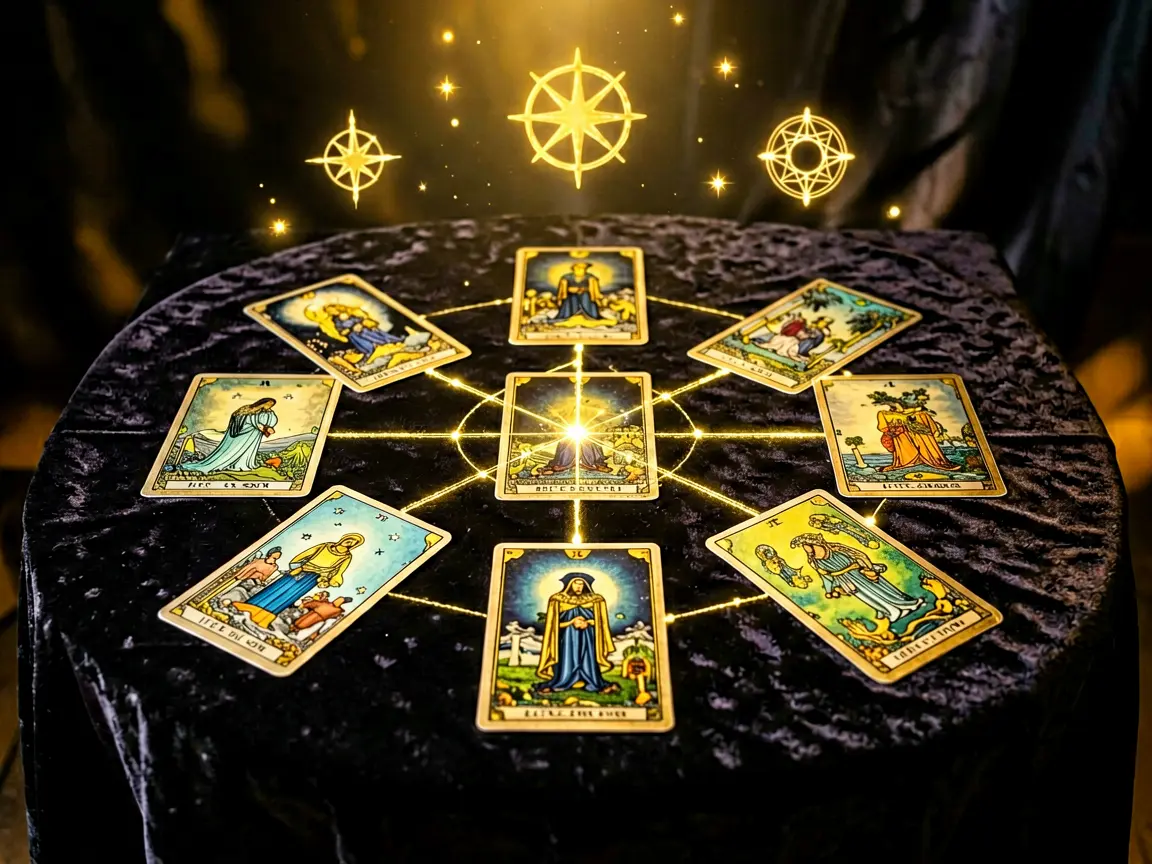
A tarot spread is a fixed layout of card positions, each with its own assigned meaning, that gives a reading its structure by turning one broad question into several specific ones the cards can answer. The layout decides who gets to speak.
Why the Layout Matters
Tarot cards are images, and an image will answer almost any question you put to it. Ask the Three of Swords about your career and it will talk about the ache of leaving a team. Ask it about your health and it will talk about what you will not let yourself feel. The real instrument is the question. A spread just asks several of them at once.
This is where Jungian psychology enters. In Psychological Types (1921), Carl Jung described four functions of consciousness, thinking, feeling, sensation, and intuition, and argued that the dominant function shapes how a person meets the world while its opposite gets pushed down into the unconscious. Psychological Types makes the full argument. A thinker treats feeling as noise. A feeler suspects the intellect. Nobody uses all four equally, and the neglected functions are the ones that run you from below.
Watch what that does to a spread. Ask the same three questions and you consult the same function. The layout is a chair you keep offering to one guest. People who live in their heads favor spreads about decisions and outcomes, which deepens the imbalance. A spread can force a meeting with the function you usually ignore, if you choose the positions on purpose.
The Six Spreads
The layouts below move from simplest to most demanding, and each suits a different layer of the psyche.
The One-Card Draw
One card, no positions, one question: what does today need me to see. I recommend it to every new reader and still use it myself most mornings. The card is not a weather report. It is a nomination. The deck offers one image out of seventy-eight, and the work is noticing why it landed on you today.
A nurse pulled a card every morning for a year before her shift. It was the only quiet minute she got. By the third month she stopped looking up meanings and started writing one line about the card in a pocket notebook. She told me later the notebook was the reading. The card was just the excuse to look at her own day before it happened to her.
The Three-Card Momentum Spread
Three cards laid left to right: what is carrying over, what stands right now, what is forming. I use this when a client is mid-transition and the familiar timeline tempts them to treat the third card as a verdict. I changed the names on purpose. "Future" sounds like news. "What is forming" is a question about ingredients, and ingredients can be rearranged.
Most people want to skip the middle card, because it shows the situation as it stands, without the story. When a client flinches at card two, that is the reading. The card declined to repeat the comfortable version.
The Shadow Cross
Four cards: what I show, what I hide, what I avoid, what I need. I designed this spread for clients who say they are fine and mean it, then surprise themselves crying on a Tuesday afternoon.
Jung called the encounter with the shadow the apprentice piece of psychological development, the first real work of individuation. The shadow is everything you decided was unacceptable in yourself and stopped looking at. What I hide and what I avoid are two doors into the same room. The hiding card shows the trait you keep polished. The avoiding card shows the one you will not admit exists.
A client insisted for months that she did not get angry. In the Shadow Cross, the hiding position kept landing on Swords, and she read them as other people's arguments. When she finally asked the card what she herself was wielding, she sat with the answer for a long minute. She had outsourced her anger to every man she dated and then resented them for carrying it. The spread did not give her the anger. It gave her back the title.
The Four Functions Spread
Five cards: the situation, then one card for what your thinking says, one for what your feeling says, one for what your body reports, one for what your intuition murmurs. I reach for it when a client is strong in one function and starving the rest.
An engineer came to me convinced that Cups cards were decorative. He wanted Swords and Pentacles. The Four Functions spread dealt him the Two of Cups in the feeling position and he stared at it like a summons. His body card was the Five of Pentacles, which he read as a cold draft, and that was the sentence that broke the reading open. He had run on thinking so long that his body filed its complaints as a minor injury. The spread gave his neglected functions a scheduled meeting.
Jung's point in describing the four functions was integration, not classification. The goal is to know which chair you always sit in and to spend time in the others on purpose. Active imagination, the method Jung developed for dialoguing with inner images, works the same way. A spread is active imagination with a floor plan.
The Decision Spread
Three cards for a real choice: what you want, what it costs, what you are leaving out. The third position earns its keep. People rarely omit the price from their own math. They omit it because they have decided someone else will pay it.
I read it for a client weighing two job offers, one safe and one alive. The want card was the Sun. The cost card was the Hermit. The leaving-out card came up the Hanged Man twice, and he laughed the second time, because he knew what it meant. Himself. He had built the decision around what his partner and his parents would think, and the spread kept asking where he was in the math.
The Celtic Cross
Ten cards in two shapes: the situation, the forces pressing on it, the hidden foundation, and the direction of travel. The Celtic Cross is the most taught spread in the world, and it earns that reputation. I reach for it when a question has circled for months and needs every layer on the table at once.
For the ten positions mapped one by one, I wrote a full guide to the Celtic Cross. The layout descends from the Hermetic Order of the Golden Dawn, the occult society founded in London in 1888, and A.E. Waite published the ten-position form in The Pictorial Key to the Tarot in 1910, one year after Pamela Colman Smith drew the Rider-Waite-Smith deck that still shapes how the cards look. Tarot has older roots in fifteenth century playing cards, but the spreads we use are a modern language.
Choosing a Spread by Question, Not by Habit
The rule I give students is simple. Write the question first. Then pick the spread that can hear it.
A question about the shape of a whole situation wants the Celtic Cross. A question about your own blind spots wants the Shadow Cross. A question that begins with "should I" needs rewriting before it needs a spread. The one-card draw can hold any question, which is why it stays useful. The moment a reading feels repetitive, suspect the layout before you suspect the deck.
A Shadow Work Exercise
Deal the Shadow Cross tonight and journal on each position before you read any card meanings. Then write the answer to one more question, which position did you want to skip. The position you rush past is the function you starve, and the spread dealt it to you on purpose.
Deal the cards. Let each position ask its question. See which one you flinch at.
This article is offered for spiritual guidance and entertainment purposes only. It is not a substitute for medical, legal, or financial advice.
What does your next card say?
Draw from the 78 cards and let Luna guide you through love, career and your inner journey.
Draw Your Free Tarot CardFree · No sign-up needed
Frequently Asked Questions
What is a tarot spread?▼
How many cards should a beginner tarot spread use?▼
Do I need to memorize card meanings before using a spread?▼
What is the best tarot spread for shadow work?▼
Recommended Reading
Tarot
Tarot Horoscope September 2026: Your Sign's Card of the Month & What to Do About It
Tarot
Tarot Horoscope October 2026: Your Sign's Card of the Month & What to Do About It
Tarot
Tarot for Beginners: A Jungian Guide to Learning the Cards
Tarot
Daily Tarot: How a One-Card Draw Becomes a Mirror Practice