Tarot for Beginners: A Jungian Guide to Learning the Cards
What does your next card say?
Draw from the 78 cards and let Luna guide you through love, career and your inner journey.
Draw Your Free Tarot CardFree · No sign-up needed
Tarot for Beginners: A Jungian Guide to Learning the Cards
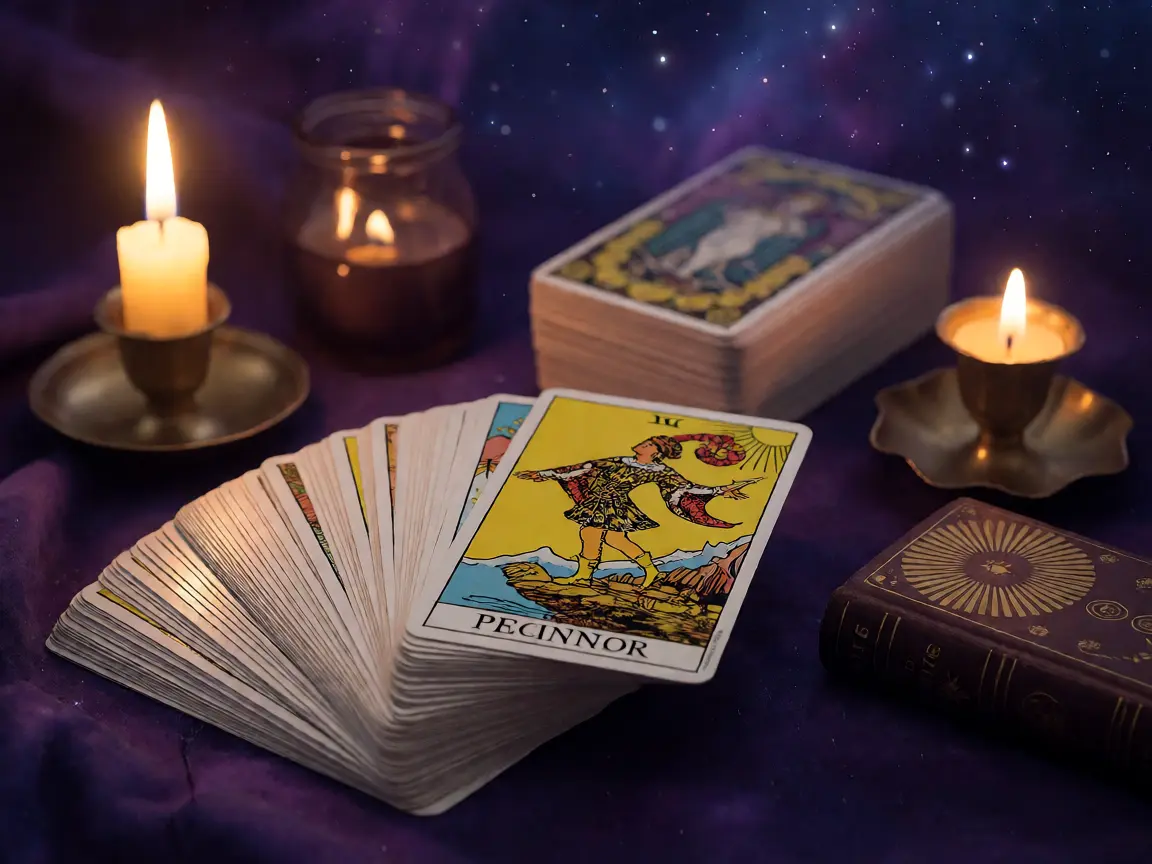
The first time a friend opened the deck I gave her, she fanned the cards across the table and went quiet. Seventy-eight pictures. She said it looked like a language she would never learn, then closed the box and slid it back to me.
I have watched that exact pause happen a hundred times. Another client bought a Rider-Waite deck, read one chapter of a guidebook, and kept the deck in a drawer for a year because the book made her feel behind before she started. She told me the cards felt like a test she had to pass to earn the right to touch them. That feeling, not the cards, is what most beginners are really up against.
A tarot deck is a set of seventy-eight illustrated cards, divided into the twenty-two Major Arcana and the fifty-six Minor Arcana, that works less like a prediction device and more like a mirror held up to the unconscious. Nobody needs to master seventy-eight separate meanings to begin. The deck has an internal architecture, and once you see it, most of the memorizing disappears.
One story and four rooms
The Major Arcana run from the Fool, numbered zero, to the World, numbered twenty-one. They form a single sequence with a plot. Jung described archetypes as the inherited patterns of the collective unconscious, and the Major Arcana are a gallery of exactly those figures: the Magician, the Empress, the Hermit, the Tower. When one of these shows up in a reading, something large is moving.
The fifty-six Minor Arcana describe smaller weather. Forty numbered cards run from Ace to Ten across four suits, and sixteen court cards (Page, Knight, Queen, King) complete them. The suits are the four rooms of ordinary life: Cups for feeling and relationship, Wands for will and creative fire, Swords for thought and conflict, Pentacles for body, money, and home. A court card can stand for a person in your life or a role you are currently playing.
That is the whole architecture. One story upstairs, four rooms downstairs.
The majors are a map of individuation
The best way to learn the deck is to read the twenty-two majors as a single story, because Jungians would recognize that story immediately. It is the individuation process, the lifelong work of becoming the person you actually are rather than the person you learned to perform. Jung wrote in Two Essays on Analytical Psychology that the aim of individuation is to strip away the false wrappings of the persona, the social mask we wear, and meet what sits underneath.
The Fool steps off the cliff with no plan. That is the start of every real change. The Magician is conscious will. The Empress and Emperor are the capacities to nourish and to hold structure. The Tower is the collapse of a building that was never load-bearing, painful and freeing at once. Death is the end of one way of living so another can begin. Reading the sequence in order, you are watching one psyche move from innocence through crisis to wholeness, and your own life keeps supplying examples.
So when a beginner pulls a major and asks what it means, I do not hand them a paragraph. I ask which stage of that story they are standing in this month. They usually know within seconds.
Learning without memorizing
Most beginner guides are organized like dictionaries, which teaches you to translate card by card. Translation is slow and it never quite works, because the same card means something different in March and in September. The image is constant. Your life is not.
Try this instead. Any card, any suit, ask three questions: What is happening in this picture? What is looking at me? What do I feel before I name it? The third question matters most. The body reacts to the image before the mind explains it away, and that reaction is the actual content of the reading. Check the guidebook last, after you have your own sentence, and you will find the book suddenly makes sense in a way it never did when you read it first.
This is close to what Jung called active imagination, the practice of letting an inner image speak instead of talking over it. A tarot reading is active imagination with a physical prop. The card is not a code to be cracked. It is a figure you sit down with and question, the way you would question a dream that keeps returning.
Choosing your first deck
Get the deck whose pictures you can live with, because you will look at them every day. The Rider-Waite-Smith deck, illustrated by Pamela Colman Smith in 1909, is the standard recommendation because its images set the vocabulary that most English-language tarot writing assumes. If you already feel drawn to another deck, follow that pull. The connection matters more than the pedigree.
Two practical filters. First, check that the scenes show actual scenes, people doing things, since a deck full of vague symbols is hard to read before you know the tradition. Second, do not buy a deck because a photo looked beautiful online. Hold the cards, or at least watch a full flip-through, because you are choosing a daily companion, not a poster.
What you are doing when you read
New readers usually assume the deck is looking at them. It is the other way around. When a card produces a strong reaction, disgust, longing, dread, that reaction is your own material surfacing. The cards that bother you are the ones doing the work, which is why the frightening majors scare beginners more than they should. The Tower tends to show up when a structure in your life is already cracking and a part of you knows it. Death usually appears at endings you have been avoiding, and the fear of loss is often the fear of letting the ending land.
Most of the change I see in clients comes from a single turn. They stop asking what will happen and start asking what they are refusing to see. A woman once came to me certain the cards would settle whether she should leave her marriage. Within three sessions she was asking why she needed a deck to make that decision for her, and that question was worth more than any card she pulled. Her readings changed after that, because she stopped bringing the deck a demand and started bringing it attention. The cards finally had room to show her something she did not already know.
What the first month feels like
Expect clumsy readings. Expect to pull a card, feel nothing, and assume you are doing it wrong. Expect the urge to shuffle until a better card appears, and resist it, since the card that disappoints you is usually the one carrying the message.
For the first weeks, one card a day is enough, with no question attached if you have none. Let the image sit with you while you make coffee. Notice where your eyes go first and whether the feeling is warm or cold. Write one line, nothing more. The daily draw fails when it becomes homework, and it works when it becomes company.
Nobody reads fluently in a month. The goal of the first month is not proficiency. It is the slow discovery that the mirror does not lie, does not flatter, and does not bite, and that you can look into it without being destroyed. That discovery is what every later reading builds on.
A shadow work exercise for your first week
Go through the twenty-two Major Arcana and find the one that unsettles you most. Not the one you dislike in an intellectual way. The one that makes your stomach tighten.
Pull that card and set it in front of you. Ask it three questions: What do you want? What do I refuse to see in you? Where have I met you this month? Write whatever arrives without editing, even if it seems absurd or unfair. The card is asking you to host a part of yourself you have been boarding out, and the first meeting is usually awkward.
Keep that page. In six months, pull the same card and ask the same three questions. You will see the shift on paper, and it will be clearer than any interpretation anyone ever gave you.
This article is offered for spiritual guidance and entertainment purposes only. It is not a substitute for medical, legal, or financial advice.
What does your next card say?
Draw from the 78 cards and let Luna guide you through love, career and your inner journey.
Draw Your Free Tarot CardFree · No sign-up needed
Frequently Asked Questions
How many cards are in a tarot deck?▼
Which tarot deck should a beginner buy?▼
Do I need to memorize all the card meanings?▼
How long does it take to learn tarot?▼
Is tarot dangerous for beginners?▼
Recommended Reading
Tarot
Tarot Horoscope September 2026: Your Sign's Card of the Month & What to Do About It
Tarot
Tarot Horoscope October 2026: Your Sign's Card of the Month & What to Do About It
Tarot
Daily Tarot: How a One-Card Draw Becomes a Mirror Practice
Tarot
Tarot Journaling: How to Keep a Deck Journal for Shadow Work and Self-Inquiry