
Tarot Journaling: How to Keep a Deck Journal for Shadow Work and Self-Inquiry
What does your next card say?
Draw from the 78 cards and let Luna guide you through love, career and your inner journey.
Draw Your Free Tarot CardFree · No sign-up needed
Tarot Journaling: How to Keep a Deck Journal for Shadow Work and Self-Inquiry
A client once asked me, after a heavy reading, whether I could tell her again what the Ten of Swords had meant. She had felt something shift at the table. By the time she reached her car, it was already dissolving. I hear this constantly. The cards speak clearly to the present moment, and then nothing holds that moment still long enough for the person to work with it.
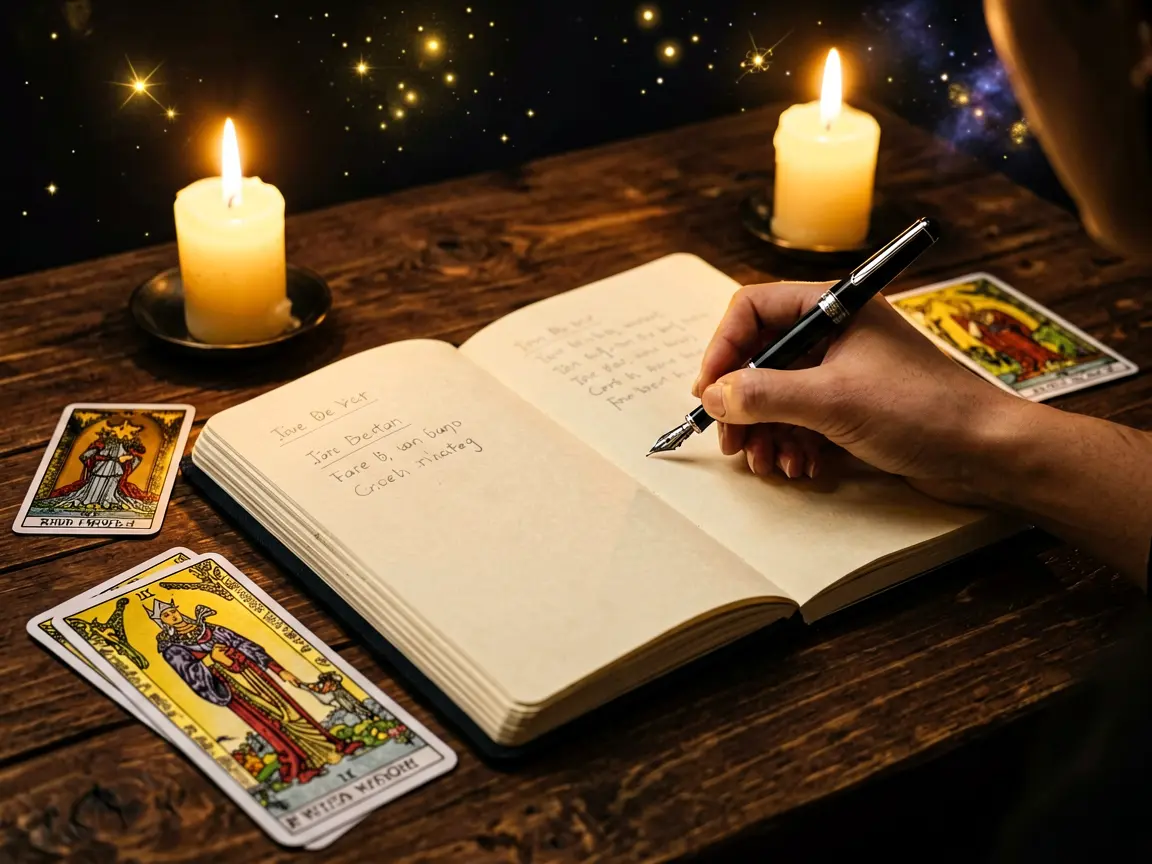
Tarot journaling is a reflective writing practice that records each reading, the question behind it, the cards you drew, and your own reactions, so that meanings can surface over time instead of evaporating the moment the deck goes back in its box. It holds the reading still. The reading opens a conversation, and the journal lets it continue.
The psychologist Carl Jung kept the most famous journal of inner work in the modern era. From 1914 to 1930 he filled the Red Book, or Liber Novus, with his visions, dialogues, and paintings from what he called the confrontation with the unconscious. It was published only in 2009, and it shows a man writing his way through material that his conscious mind could not yet explain. Jung called the method active imagination: you let an image rise, then you enter into dialogue with it instead of explaining it away. A tarot journal is active imagination with training wheels. The deck hands you the image, and the page gives you somewhere to meet it.
Why a reading fades
Your memory is not a recording device. It is an editor with a strong opinion about what you should keep. Within hours of a draw, the unconscious reshapes what happened, softening the edges of the card that stung and amplifying the one that flattered you. Jung described this in terms of the persona, the mask you wear for the world. The persona wants a tidy story. The shadow, the part of you that carries everything the persona rejects, wants to be heard, and it rarely respects the tidy version.
Writing fixes the problem at the source. The moment you put your reaction on paper, you have a snapshot taken before the editing started. A year later you can open the entry and see exactly what you felt on that Tuesday, not what your memory agreed to preserve.
What to record
I suggest five elements per entry, and they take less than ten minutes once you build the habit.
First, the date. This matters more than it sounds, because the whole power of a journal is looking back and noticing that the same card appears every October, or that a particular suit shows up whenever you are fighting a particular fight.
Second, the question in your own words. Write it as you actually asked it, not as you wish you had. "Should I quit my job" tells you more about your state of mind than "What do I need to know about my career path" ever will.
Third, the cards in order. A list is enough. You do not need to describe the artwork in detail, though you can if an image grabbed you.
Fourth, your first feeling before you looked up any meaning. This is the gold. Write the body reaction first: the tight chest, the sudden tiredness, the urge to laugh. The mind lies fluently. The body rarely bothers.
Fifth, the card you most wanted to resist. If you drew a card and felt the urge to shuffle it back into the deck, that card is your teacher. Jung wrote in Mysterium Coniunctionis that the encounter with the shadow begins with a standstill, a dead balance that hampers moral decisions, and that genuine courage is required in that time of descent. The card you resist is the shortest route to that standstill, which is why so many of us avoid it without knowing we are doing it.
Reading the journal back
A journal becomes useful the second time you read it. Once a month, take twenty minutes to page through what you wrote. You are looking for three things.
Recurring cards. A card that appears three times in a month is not a coincidence, it is a message with a return address. Ask what in your life keeps producing the same symbol.
Recurring moods. Look at your fourth element, the first feelings, without the card names. You may discover that every hard week began with the same dull dread, regardless of which deck or spread you used.
Recurring resistance. Note which cards you keep resisting. Over a year, this list becomes a portrait of your shadow that no personality test could draw. The Devil appears whenever you refuse to name a desire. The Hermit appears whenever you are avoiding solitude. Your resistances are a map, and the journal is the legend.
A shadow work exercise to start today
If you have never journaled with tarot, begin with one card and one question: "What am I not letting myself see?"
Draw the card. Before you open any book or app, write for three minutes without stopping. Do not edit, do not censor, do not aim for good sentences. Let the writing be messy. The shadow hides behind polished grammar, and free writing starves it of that cover.
Then answer two questions in writing. What does this card show about what I avoid? What would it cost me to stop avoiding it? Sit with the second one. The cost is usually the reason the pattern has survived, and naming it is the first step toward a real choice.
Keep the entry. Do not reread it for a month. When you finally do, you will see how far the conversation has moved, and you will understand why the cards are best understood as a mirror rather than a message service. The mirror does not change. Your willingness to look does, and the journal is the record of that change.
A template for your first entry
The question I asked: The cards I drew: My first feeling, before meanings: The card I wanted to resist: What I will not let myself see right now:
Copy this into any notebook and you have a working tarot journal. It does not require a beautiful deck, special pens, or an hour of free time. It requires honesty and a willingness to return to the same pages next month.
In my years reading for clients, the ones who grew fastest were never the ones with the most accurate predictions. They were the ones who wrote the readings down and came back with pages of their own questions. The cards opened the door. The journal is where they walked through it, and what they found on the other side belonged to them in a way no reading ever could.
This article is offered for spiritual guidance and entertainment purposes only. It is not a substitute for medical, legal, or financial advice.
What does your next card say?
Draw from the 78 cards and let Luna guide you through love, career and your inner journey.
Draw Your Free Tarot CardFree · No sign-up needed
Frequently Asked Questions
What is tarot journaling?▼
What should I write in a tarot journal?▼
How is tarot journaling different from regular journaling?▼
How often should I journal with my tarot cards?▼
Do I need to know the card meanings to keep a tarot journal?▼
Recommended Reading
Tarot
Tarot Horoscope September 2026: Your Sign's Card of the Month & What to Do About It
Tarot
Tarot Horoscope October 2026: Your Sign's Card of the Month & What to Do About It
Tarot
Tarot for Beginners: A Jungian Guide to Learning the Cards
Tarot
Daily Tarot: How a One-Card Draw Becomes a Mirror Practice