The Celtic Cross Tarot Spread: A Jungian Guide to the 10 Card Positions
What does your next card say?
Draw from the 78 cards and let Luna guide you through love, career and your inner journey.
Draw Your Free Tarot CardFree · No sign-up needed
The Celtic Cross Tarot Spread: A Jungian Guide to the 10 Card Positions
A client of mine refused to look at the second card of the Celtic Cross. She had been reading with the spread for a year and she loved it, except for that one position. The crossing card. Every time it landed face up she flipped it back over, fast, the way you slam a drawer shut. I asked her what she thought it meant. She said it was the obstacle. She had spent a year reading it as the thing standing in her way, and she was tired of bad news.
I know that tiredness. In my twelve years of reading the cards, the crossing position has delivered more honest information than any other card on the table, and most of that honesty is uncomfortable.
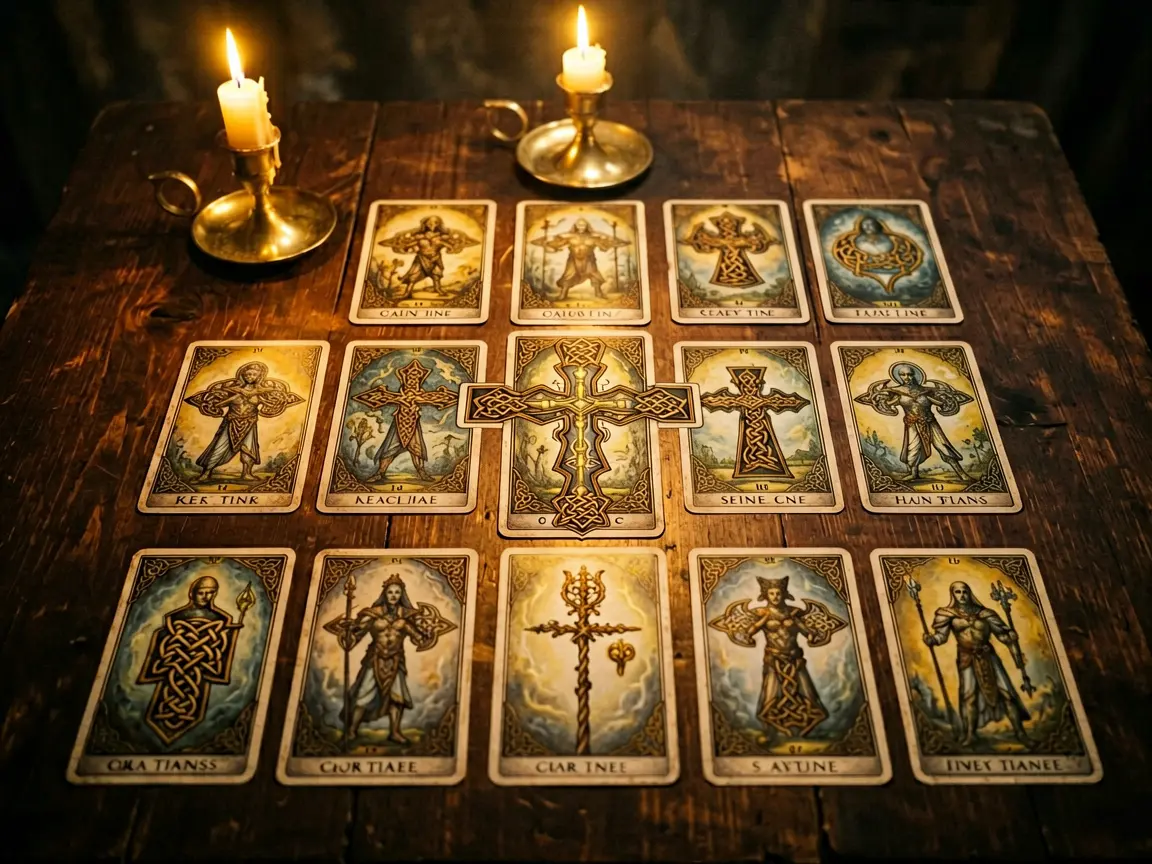
The Celtic Cross is a ten-card tarot spread that reads a single question through two stacked shapes, a cross of six cards and a staff of four, mapping the visible situation, the hidden foundation, the past, the near future, and the direction of change in one layout. It is the most widely taught tarot spread in the Western world, and it is younger than most people assume.
The layout descends from the Hermetic Order of the Golden Dawn, the secret society founded in London in 1888 that reshaped Western ritual magic and tarot. A.E. Waite, a Golden Dawn member, published the ten-position form in The Pictorial Key to the Tarot in 1910, a year after the deck he designed with Pamela Colman Smith appeared in 1909. The images on that deck, the Rider-Waite-Smith, are the ones most readers still see when they picture the cards. Waite's original method opened with a significator card chosen to stand for the questioner. Most modern readers skip it and deal the ten cards directly.
Jung would have recognized the shape immediately. The cross inside an open field is a mandala structure, and he collected mandalas for decades, describing them as representations of the self, images of wholeness that surface in dreams and in art across cultures. The Wikipedia entry on mandalas gathers the evidence. The Celtic Cross is a mandala of the present moment. The six cards that form the cross describe the field of the question. The four cards stacked below it describe where that field is moving. Together they make one picture of a psyche in motion, with the questioner at the center.
The Cross: Cards One Through Six
Card one, the cover. The situation made visible. This is the energy filling the room right now, the question as it actually stands, not the story you tell about it. In a reading about a job, this card shows the real state of the work.
Card two, the crossing. The force pressing on the situation. In my experience this is the card people resist, because it often carries the shadow, the trait, fear, or habit they left out of their own account of the problem. Jung wrote in Psychological Types (1921) that the dominant function characterizes consciousness while its opposite is repressed into the unconscious, and the crossing card has a knack for being that repressed opposite. The client who slammed the drawer shut was seeing her own avoidance, not an obstacle. When this card lands hard, ask what in you it is naming.
Card three, the crown. The aim, the best the situation could become. It is also the persona, the polished version of the outcome you are presenting to yourself. A crown card that feels too clean deserves suspicion. Ideals that cost nothing are usually masks.
Card four, the root. The ground the situation stands on. This card is usually unconscious. The assumptions you stopped noticing, the conditioning you absorbed without thinking, the inheritance you carry like furniture you never chose. Jung called this layer the personal unconscious, and the root card is its front door.
Card five, the past. The momentum already spent that still pushes the present. This is not your biography. It is the specific stretch behind the question, the weeks or months that produced this moment.
Card six, the future. The near direction of travel if nothing changes. Readers argue about how fixed this card is. I read it as tendency, not destiny. It shows the road the current energies are building, and roads get walked differently.
The Staff: Cards Seven Through Ten
Card seven, the self. Your own position inside the question. The same situation reads differently from fear than from curiosity, and this card names which one you are standing in.
Card eight, the house. The environment, the people around the question. It is also a projection screen. Jung observed that people see in others what they refuse to see in themselves, a mechanism he called projection, and the house card gives it a face. A manager once drew the Empress here and swore the card meant her colleague. The colleague was warm, generative, impossible to resent, which was exactly the point. The manager had never claimed her own abundance, and the irritation was homesickness for it.
Card nine, hopes and fears. The doubled card. A hope and a fear are often the same thing seen from two sides, and this position holds both. The person hoping for commitment is fearing it in the same breath. When this card lands, name the hope first, then the fear, and notice how close the two sentences are.
Card ten, the outcome. The result the layout points toward, and the least fixed card in the spread, because it is built from everything above it. Change the foundation, the trajectory changes with it. The card describes where the story goes if you keep telling it the way you have been.
How to Read It Without Drowning
Shuffle with the question in mind, lay the ten cards, and read them in pairs first. One with two, three with four, five with six, seven with eight, nine with ten. The pairs mirror the structure of the psyche: surface and depth, aim and ground, past and pull, self and other, want and fear. Then read the staff as an arc, seven through ten, as the story of where you stand and where you are heading.
Then the part most people skip. Write the answer to one question: which card did you hope would appear? The card you hoped for is the persona talking. The one you dreaded is the shadow, and it is the card the spread was really for. Sit with the dread. Ask the crossing card what it is protecting you from seeing. That is the method in full: let the layout show you what you already knew and had agreed to look away from.
Why does the shape hold together at all? Jung called the meaningful collision of inner image and outer event synchronicity, and he devoted a 1952 essay to it, arguing that such coincidences are acausal connections between psyche and world. The Wikipedia entry on synchronicity lays out the argument. A card draw is a small synchronicity. The odds of any single card landing are one in seventy-eight, and the one that lands is the one you need. The unconscious arranges the meeting. The spread gives it a table.
Ten cards, one question, one picture of a psyche in motion. The spread has been laid this way since 1910, and the readers who get the most from it treat card ten as a direction, then go do something about the cards underneath it.
This article is offered for spiritual guidance and entertainment purposes only. It is not a substitute for medical, legal, or financial advice.
What does your next card say?
Draw from the 78 cards and let Luna guide you through love, career and your inner journey.
Draw Your Free Tarot CardFree · No sign-up needed
Frequently Asked Questions
What does each position in the Celtic Cross mean?▼
Why is it called the Celtic Cross if it is not Celtic?▼
Is the Celtic Cross spread good for beginners?▼
Does the outcome card predict the future?▼
Can I use the Celtic Cross for love questions?▼
Recommended Reading
Tarot
Tarot Horoscope September 2026: Your Sign's Card of the Month & What to Do About It
Tarot
Tarot Horoscope October 2026: Your Sign's Card of the Month & What to Do About It
Tarot
Tarot for Beginners: A Jungian Guide to Learning the Cards
Tarot
Daily Tarot: How a One-Card Draw Becomes a Mirror Practice