Asteroids in the Natal Chart: Ceres, Pallas, Juno, and Vesta as Goddess Archetypes
Discover your cosmic blueprint
Cast your natal chart and explore the symbolic patterns that shape your personality and life journey.
Get Your Free Natal ChartFree · No sign-up needed
The first chart I read with asteroids in it belonged to a woman I will call Mara. Her planets sat exactly where the textbooks said a whole person should sit. Sun in Libra, Moon in Cancer, Venus rising. Still, when we finished, she said the reading felt like a list of ingredients with no recipe.
She had a Ceres in hard aspect to that Moon, and I had no vocabulary for it, so I skipped it the way you skip a footnote you assume is decoration. Mara left polite and unread. It took me two more years of the same blank look before I opened the drawer marked minor planets and actually looked inside.
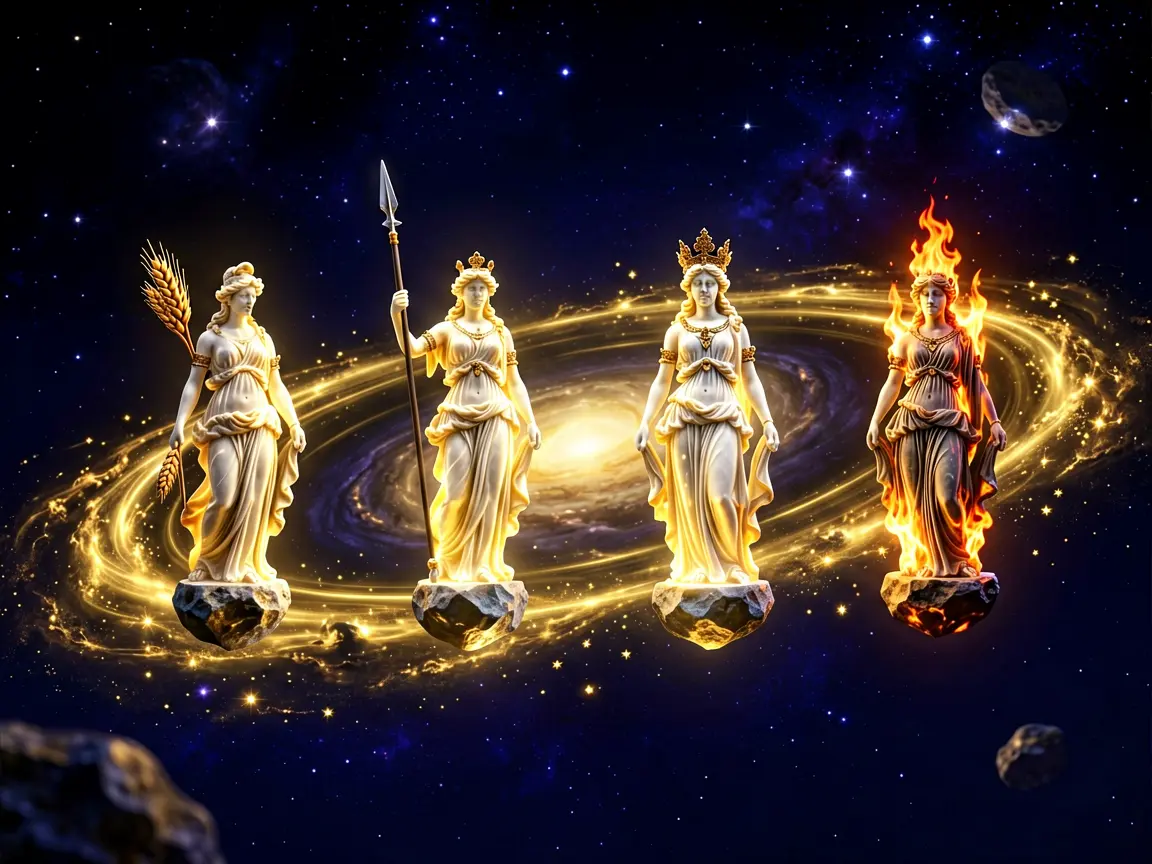
Asteroids in the natal chart are a group of four large bodies from the main asteroid belt, Ceres, Pallas, Juno, and Vesta, plotted beside the planets and read as archetypal figures for the parts of life the planetary lineup leaves unnamed. All four orbit between Mars and Jupiter. All four carry the name of a goddess, and in a reading each behaves like one: a fixed way of being that a person either lives out or wrestles with.
Why the Sky Needed Four More Gods
The four were found in a nine-year burst of sky-gazing. Giuseppe Piazzi spotted Ceres from Palermo on January 1, 1801, the first night of the new century Ceres. Heinrich Olbers found Pallas in 1802 and Vesta in 1807. Karl Harding found Juno in 1804. Within decades the belt was crowded with hundreds more rocks, the newcomers received numbers instead of names, and astrology, which had never quite adopted the first four, forgot them for a century and a half.
What brought them back was not astronomy. It was a new way of reading old myths. Jung cleared the path in 1941, when he and the classical scholar Karl Kerényi published Essays on a Science of Mythology. Jung's contribution, an essay on the Kore figure, treated Demeter and her daughter Persephone as one psyche in two seasons: the maiden above ground in spring, the queen of the underworld for the rest of the year Persephone. Jean Shinoda Bolen reached the same well from the other side in 1984 with Goddesses in Everywoman, which gave each Olympian goddess a working psychology Goddesses in Everywoman. Put the two streams together and you get a method: place the goddess in the chart, then ask what that fixed way of being is doing in your particular sky.
Ceres: The Mother Who Keeps the Seasons
Ceres is the Roman name for Demeter, the grain goddess whose grief made winter. When her daughter was taken to the underworld, she let the fields die until a bargain returned the girl for half of every year. In a chart, Ceres shows how you nourish people and what you do when someone you love is missing from the table. It is the placement I now check first for caretakers, for people who were parented by their parents' moods, and for grief that never received a funeral.
Mara's Ceres squared her Moon, and her whole story snapped into focus once I had the word for it. She fed everyone. She had been feeding everyone since age nine, when her mother's depression moved in and someone had to keep the household warm. Ceres said it with more force than any planet in her chart. If yours is loud, the question is usually not whether you give enough. It is whether you have ever been fed, and by whom, and what would happen to your sense of purpose if you stopped being the only adult in the room.
Pallas: The Mind That Sees the Pattern
Pallas carries the name of Athena, who was born armed from the head of Zeus. The myth says the smith god split the skull and out stepped the strategist in full armor, adult and ready. Pallas in the chart shows your signature way of thinking: pattern recognition, design, the craft that turns raw facts into a move. Athena was the goddess of weavers and generals, and her asteroid tends to describe people who see the shape of a problem before anyone has finished stating it.
The shadow side is the mind used as armor. Bolen called Athena the father's daughter, the woman raised to be the son her father wanted, competent in every arena and illiterate in her own needs. A prominent Pallas can show brilliance that wins every argument and starves every relationship, because the person mistakes understanding for intimacy. The working question: do you use your mind to open situations or to stay safe inside them?
Juno: The Contract Inside the Marriage
Juno is Hera, sister and wife of Zeus, queen of the gods, and the patron of marriage as an institution rather than as a feeling. In a chart she describes committed partnership: the kind of bond you can tolerate, the equality you require, the betrayal you will not absorb twice. Venus tells you what attracts you. Juno tells you what you signed up for, or what you keep signing up for.
Jung wrote that meeting the shadow is the apprentice piece of development, while meeting the anima, the inner opposite you keep projecting onto partners, is the masterpiece. Juno marks where that apprenticeship happens through another person. Her shadow shows up as the scorekeeper: the spouse who tracks who gave more, who apologized first, whose career bent. A clean Juno in a chart usually describes someone who can state a boundary in a relationship without needing the other person to fail.
Vesta: The Fire You Do Not Let Go Out
Vesta is Hestia, the eldest and youngest of her siblings, first to be swallowed by her father and last to return. She never married, never joined the quarrels on Olympus, and kept the hearth fire instead. Her priestesses, the Vestals, tended the public flame of Rome, and legend held that the city would fall if it went out. In a chart Vesta shows what you consecrate yourself to: the work, person, or inner room where nothing may interrupt you.
A strong Vesta reads as self-possession. People with her prominent can work alone for years and call it rest. The shadow is devotion as a hiding place, the monastery built to avoid the world, the sixty-hour weeks that keep a marriage or a grief at a safe distance. Vesta asks the hardest question of the four: what are you saving your life for, and is anyone allowed to touch the fire?
How to Read Yours
Pull your chart with the extended objects setting turned on, or use Cafe Astrology's tables for the four signs. Read sign first, then house, then the aspects to your Sun, Moon, and angles. Ignore the numbered asteroids. The belt holds more than a million known rocks and the list tempts you to chase them, but the four named goddesses carry the archetypal weight. Vesta is worth a side note: it is the only one of the four bright enough to have been seen with the naked eye from a dark sky, though nobody knew it was there until Olbers found it in 1807 Vesta.
If you already work with the deeper minor bodies, these four sit in the same family as Lilith and the dark feminine. In fifteen years of practice I have seen the goddess asteroids explain more blank looks than any transit. A client with an unaspected Sun can still feel read to the bone by a Ceres in the fourth house.
For the shadow work, pick the one you flinch at, the goddess whose paragraph made you look away. Write her name at the top of a page, then answer three questions. Where did I learn this role? Where is it still saving me? What would I have to grieve to set it down?
Mara called me two years later, after her mother died, to say she had finally stopped feeding people who had not asked to be fed. No asteroid predicted that. What Ceres did was name the plate she had carried since she was nine, and a thing with a name can be set down.
This article is offered for spiritual guidance and entertainment purposes only. It is not a substitute for medical, legal, or financial advice.
Discover your cosmic blueprint
Cast your natal chart and explore the symbolic patterns that shape your personality and life journey.
Get Your Free Natal ChartFree · No sign-up needed
Frequently Asked Questions
What are the four major asteroids in astrology?▼
Do asteroids matter in a natal chart reading?▼
How do I find my asteroids in my birth chart?▼
Is Ceres a planet or an asteroid?▼
Why are the major asteroids named after goddesses?▼
Recommended Reading
Astrology
Weekly Zodiac & Horoscope Forecast October 19 - 25, 2026: Mercury Retrograde Begins as Venus Meets the Sun
Astrology
Weekly Zodiac & Horoscope Forecast October 12 - 18, 2026: Pluto Turns Direct
Astrology
Weekly Zodiac & Horoscope Forecast October 5 - 11, 2026: The Libra New Moon
Astrology
Weekly Zodiac & Horoscope Forecast September 28 - October 4, 2026