
How to Cleanse and Charge a Tarot Deck: A Ritual Reset for Tired Readings
What does your next card say?
Draw from the 78 cards and let Luna guide you through love, career and your inner journey.
Draw Your Free Tarot CardFree · No sign-up needed
How to Cleanse and Charge a Tarot Deck: A Ritual Reset for Tired Readings
A client came to me with a deck she described as tired. She had read for herself for three years, every morning without fail, and in the second year the readings started repeating. Same cards. Same story. She worked through the full internet list of fixes: moonlight on the windowsill, sage smoke, a night buried in salt. Each one held for about a week, and then the dullness came back. She asked whether her deck needed a deeper clean.
I asked her what she had been asking the deck. She went quiet. For eighteen months she had been asking whether she should leave her job, in roughly forty phrasings. The deck was not tired. It had been answering one question with one answer, and she kept hoping a cleanse would change the verdict.
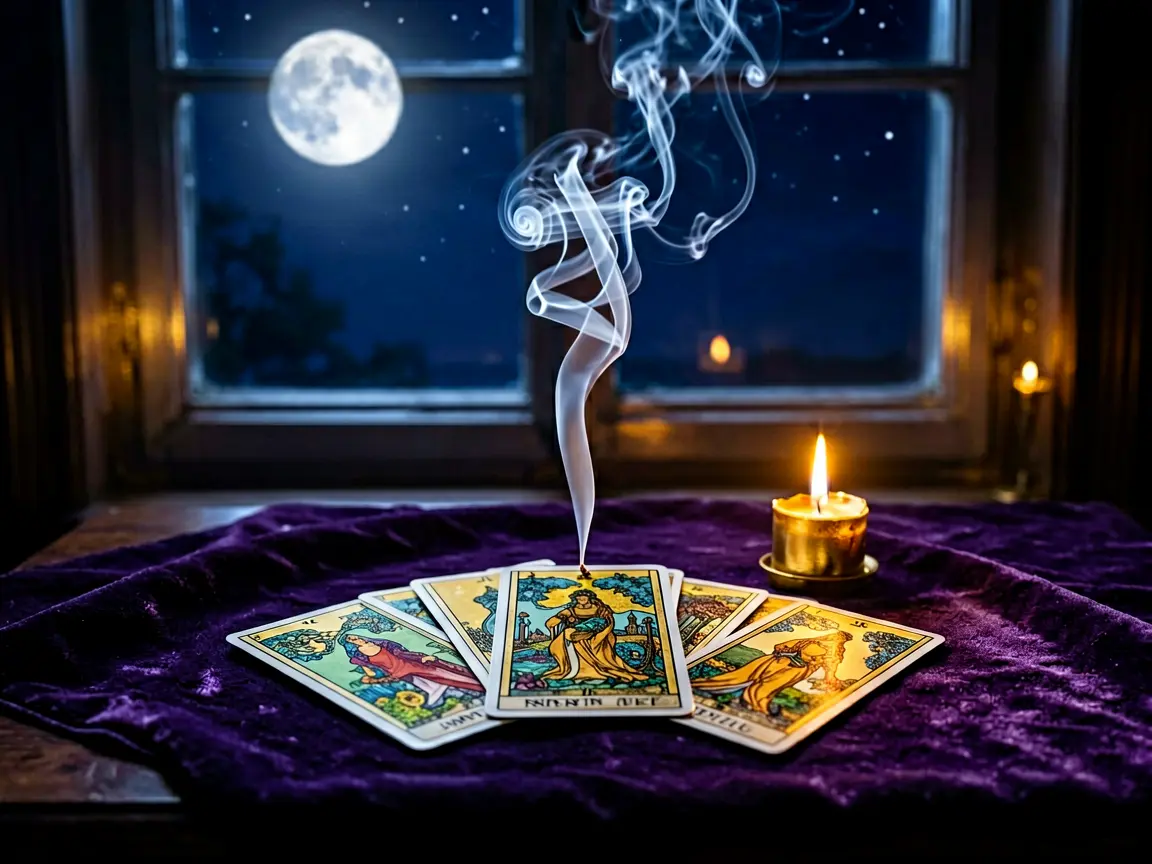
Cleansing a tarot deck is a deliberate ritual that resets the symbolic space between readings, clearing the residue of old questions so the next draw can start fresh. Charging a tarot deck is the companion practice of setting a conscious intention for the readings that follow. Cleansing empties the cup, and charging decides what gets poured in.
What Collects on a Deck
Cards are printed paper and ink. They do not absorb moods, and they cannot carry a stranger's energy across town. What carries over is the loop between the images and your attention. A reading is a collaboration, and attention forms habits. Ask one question long enough and the cards keep meeting it in the same room. That is what a heavy deck feels like. It is repetition you can touch.
Jung's model of psychic energy explains the mechanism better than any crystal. He identified the libido with psychic energy in general and argued that this energy expresses itself only through symbols, in the account of his work gathered under libido. Tarot cards are symbols in exactly that sense. They give desire and worry a shape to move through. A deck used constantly becomes the symbol of the same desire, because you keep feeding it the same question, and the cleanse interrupts that feed.
Rituals for purifying divination tools are old, and smoke, salt, and water show up in cleansing customs across many cultures. Jungian psychology offers a clean account of why the habit survives. A ritual draws a boundary between before and after, and a boundary is the one thing a stuck loop lacks. The cards get moved through smoke or set under moonlight either way. The real work happens in the person holding them, marking the last reading as finished so the next one can begin. That is also why the spread you choose matters. A deck dealt into the same layout for every question will keep answering in the same grammar no matter how often you cleanse it.
The Vessel
Jung's interest in alchemy began with a Chinese text. Richard Wilhelm sent him a translation of The Secret of the Golden Flower, a manual of inner alchemy, in the late 1920s, and the encounter turned Jung toward alchemical studies for the rest of his working life. He published Psychology and Alchemy in 1944. Carl Jung gives the chronology. What he found in the old manuscripts was the vessel, the sealed container where base materials were supposed to transform into gold. He read the vessel as a symbol of the psyche: a contained space where opposing parts could meet and change without either side getting lost.
A tarot deck is a vessel in that sense. It holds your projections long enough for you to look at them, which is what a reading is for. The cleanse is the practice of emptying the vessel on purpose, instead of letting it fill by accident with whatever the last session left behind.
Four Resets That Work
You need no tools for any of this, but each common method has a reason it works, and knowing the reason makes it easier to pick one that fits your life.
The shuffle reset. Long, slow shuffling is a cleanse by itself. Most of us shuffle just enough to deal. Shuffle for three full minutes and the reading has nowhere to go but the present. Say the boundary out loud: this reading is over, this one begins. Speech is part of the mechanism, because naming the boundary commits the part of you that still argues with the last reading.
Smoke. Sage, incense, cedar, whatever you can get. The smoke matters less than the pace. Smoke cannot be hurried, so the ritual forces you to stand with the deck for minutes instead of seconds, passing card after card through it. The smell also anchors. After a few cleanses the scent alone tells your nervous system that reading time has started.
Moonlight. The moon runs a 29.5-day cycle, which makes it the only common method that schedules itself. New moon for charging, full moon for clearing is the folk rule, and the psychology underneath it is sound. The ritual returns monthly, so the deck gets reviewed monthly. Most stale decks are simply decks that went a year without being handled as objects instead of tools.
Sound. A bell or a singing bowl closes a reading the way a bell closes a meditation period in many contemplative traditions. One note, held until it fades, and the session is done. Sound is the fastest boundary I know. It takes three seconds and leaves nothing behind to manage.
A crystal or a stone on top of the deck works as a reminder object. You see it when you unwrap the deck and remember the intention you set beneath it. That is the whole job. If it reminds you, keep it. If it does not, the deck will not mind.
Charging the Deck
Cleansing without charging leaves the deck clean and aimless. Charging is the act of naming what the next run of readings will serve.
I charge my own deck at the new moon. I write one question on a slip of paper, fold it, and tuck it under the cards. The rule I give clients is simple: charge the deck with the question you would be embarrassed to say out loud. That question is usually the real one. "Will he text me back" keeps the deck busy. "What am I asking him to save me from" gives it something to work with.
The client with the tired deck did exactly this. She kept the moonlight and the sage because she liked them, and she added one more step: a slip of paper under the deck that read, what am I protecting by staying. Within a month the readings started surprising her again. The deck had not changed, and neither had her job, at first. Only the question she brought to the cards was new.
A Shadow Work Exercise
Try this tonight. Write down the last three questions you asked the deck, then read them as if a friend had written them. What is the same request hiding in all three? That request is the loop.
Cleanse the deck with any method above. Then charge it with the question underneath the request, the one your three questions were circling. Give the deck a month with the new question and notice which cards start showing up.
This article is offered for spiritual guidance and entertainment purposes only. It is not a substitute for medical, legal, or financial advice.
What does your next card say?
Draw from the 78 cards and let Luna guide you through love, career and your inner journey.
Draw Your Free Tarot CardFree · No sign-up needed
Frequently Asked Questions
How often should I cleanse and charge my tarot deck?▼
Do I need sage, crystals, or moonlight to cleanse a tarot deck?▼
Can cleansing a tarot deck change your readings?▼
What is the best way to charge a tarot deck for a specific question?▼
Recommended Reading
Tarot
Tarot Horoscope September 2026: Your Sign's Card of the Month & What to Do About It
Tarot
Tarot Horoscope October 2026: Your Sign's Card of the Month & What to Do About It
Tarot
Tarot for Beginners: A Jungian Guide to Learning the Cards
Tarot
Daily Tarot: How a One-Card Draw Becomes a Mirror Practice