Free Birth Chart: Your Archetypal Map of the Psyche — A Jungian Guide to Interpreting Your Astrological Blueprint
Discover your cosmic blueprint
Cast your natal chart and explore the symbolic patterns that shape your personality and life journey.
Get Your Free Natal ChartFree · No sign-up needed
A free birth chart is a map of the exact positions of the Sun, Moon, and planets across the zodiac signs and houses at the moment you were born. Read through a Jungian lens, it becomes something more: an archetypal portrait of your psyche, revealing patterns and potentials for self-inquiry rather than fixed predictions.
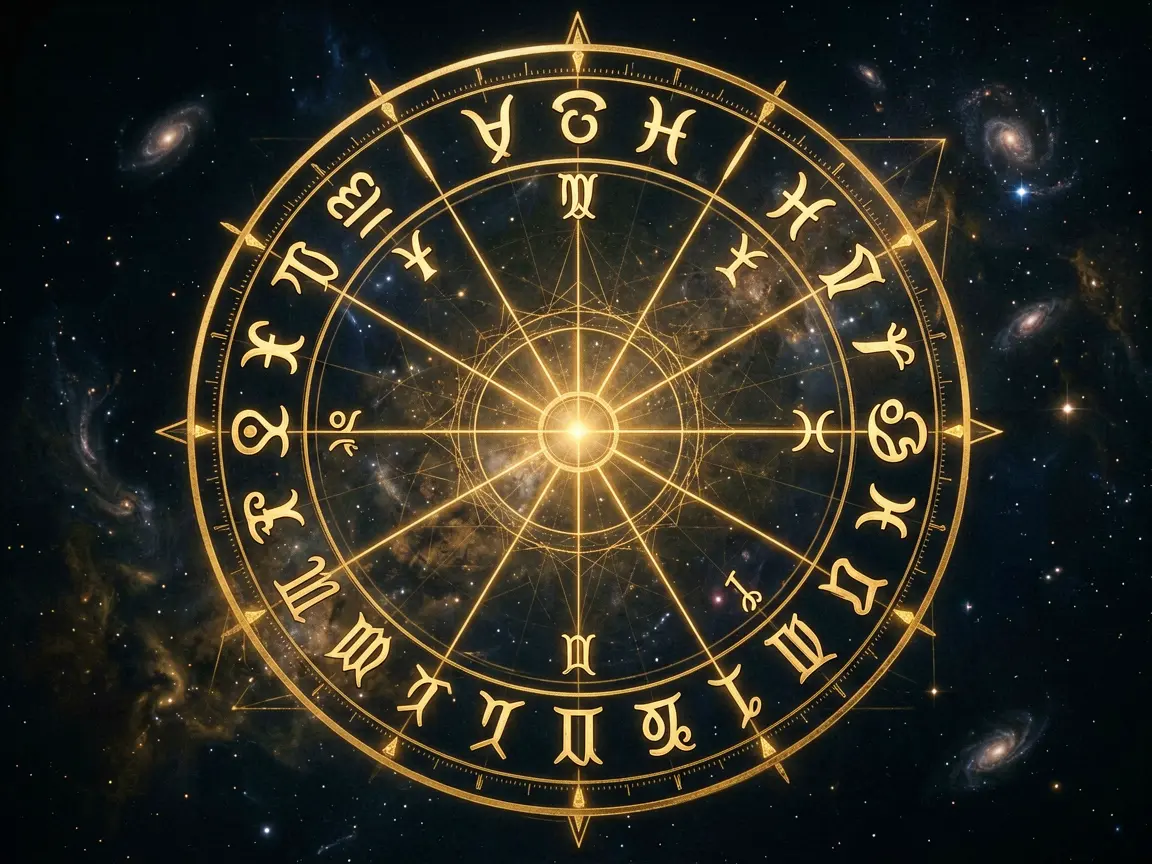
The internet is flooded with offers for a free birth chart. Enter your date, time, and place of birth and within seconds a rendered wheel appears: planets scattered across twelve houses, aspect lines crisscrossing like a subway map of the soul. Most people glance at it, read a few automated paragraphs about their Sun sign, and close the tab. The "blueprint of their destiny" didn't deliver anything they didn't already know.
A birth chart was never a fortune. It never handed you a script. Through Carl Jung's analytical psychology, a free birth chart becomes an archetypal map of your psyche. It shows you the recurring patterns, the unconscious pulls, the tensions between who you think you are and who you are becoming.
Here is how to get a meaningful free birth chart and how to read it as a tool for psychological self-inquiry.
Where to Get a Free Birth Chart That Actually Works
For a chart that serves psychological exploration, you need accurate planetary positions, a readable wheel, and enough detail to work with. Astro.com offers extensive data and detailed charts. Astro-Seek.com has a clean interface good for beginners. Cafe Astrology provides interpretive text that leans psychological. Each lets you generate a full natal chart with planets in signs and houses, aspects, and often the asteroid nodes. Input your birth date, exact time, and location. The time matters because the rising sign changes approximately every two hours.
Once you have your chart, ignore text that says "you are destined to" or "this predicts that." You are holding a photograph of the sky at your first breath. In that photograph, Jung would say, lies a synchronistic snapshot of the archetypal energies your psyche brought into this lifetime.
The Psychological Framework: Why a Birth Chart Matters to the Psyche
Jung spent decades exploring the symbolic systems of astrology, alchemy, and Eastern philosophy. He treated them as maps of the collective unconscious, the inherited layer of the psyche that speaks in universal symbols rather than personal memories.
From this perspective, a birth chart maps the archetypal themes your life is organized around. The planets are symbolic representations of fundamental psychological forces: the Sun as the conscious ego and life purpose, the Moon as the emotional body and instinctual memory, Mercury as the organizing mind, Venus as the capacity for love and value, Mars as the drive and assertion, Jupiter as the search for meaning, Saturn as the encounter with limitation and structure. The outer planets -- Uranus, Neptune, Pluto -- carry transpersonal currents that shape generations and erupt into individual lives as crises, inspirations, and transformations.
When Jung wrote in 1954 that "astrology represents the summation of all the psychological knowledge of antiquity," he named something crucial. The planets and their configurations name the archetypal patterns your psyche is living through. A free birth chart gives you the vocabulary for that dialogue.
How to Read Your Free Birth Chart as Self-Inquiry
Step One: Start with the Angles
Before you dive into what each planet means, look at the four angles: the Ascendant, Descendant, Midheaven, and Imum Coeli. They form the cross-shaped axis of your psyche's orientation to the world. The Ascendant is your Persona, the mask you wear in social life. The Descendant carries the shadow of that mask, the qualities you project onto others. The Midheaven points toward your vocational calling as a direction of becoming. The IC is your roots, your private self, the foundation of your inner world.
Ask yourself: What sign is on my Ascendant? Do I recognize this as the face I show the world? What qualities do I habitually seek in others that might be disowned parts of myself?
Step Two: Read the Sun and Moon as Ego and Shadow
The Sun represents the archetype of the Self as Jung understood it. Its sign and house show where your conscious energy naturally flows. The Moon reveals the territory of your emotional shadow: the unconscious habits, instinctual reactions, and hidden vulnerabilities your ego was built to protect.
If your Sun is in practical Capricorn but your Moon is in sensitive Cancer, that tension drives your individuation. The conscious ego and the emotional shadow are in dialogue. The chart gives you a language for that conversation.
Step Three: Hard Aspects as Growth Edges
Squares and oppositions show where the psyche is actively trying to grow. A square between Venus and Saturn means your capacity for intimacy meets an encounter with limitation, responsibility, and fear. The work is to integrate the tension: to learn to love with both the heart and the boundary.
Jung wrote that "the meeting of two personalities is like the contact of two chemical substances: if there is any reaction, both are transformed." The same holds for the planets in your chart. Where they clash, they ask you to become more than you currently are.
Step Four: Houses as the Arenas of Life
The twelve houses are the theaters where the planetary archetypes play out. A planet in the 4th house activates themes of home, ancestry, and the inner child. A planet in the 10th house activates public life, career, and contribution. The 4th house is the symbolic territory of your psychological foundation. The 10th house is your encounter with the collective and your felt sense of purpose.
A house with several planets concentrates the psyche's work. An empty house means your conscious attention is not required there in the same way. The houses, like the psyche itself, are not equally active at every stage of life. Some come alive later. Others fade as you integrate their lessons.
Step Five: Aspects as the Grammar of the Chart
If planets are the nouns and signs are the adjectives, aspects are the verbs. They describe how the planetary energies interact. A trine at 120 degrees indicates a natural flow between two planets. You barely have to try. But ease has its own shadow. A chart heavy with trines can indicate a person who coasts, who never develops the resilience that friction demands.
Squares at 90 degrees and oppositions at 180 degrees create conscious tension. They are the places where you feel stuck, where the same pattern repeats until you finally face it. A square between Mars and Pluto means your assertion meets transformation as a recurring challenge. If you stay conscious in that territory, you develop a depth of strength a frictionless chart never forges.
Look at the overall distribution of aspects in your free birth chart. Do you have mostly flowing aspects or mostly challenging ones? Neither is superior. Each is a different psychological landscape with its own developmental path.
A Journaling Exercise for Your Birth Chart
Take your free birth chart and pick one planet. Write down its sign, house, and any aspects it makes. Spend ten minutes journaling with these prompts:
This is active imagination, Jung's method of dialoguing with the unconscious. The chart is simply the language for the conversation.
Frequently Asked Questions
What is a birth chart in astrology? A birth chart is a symbolic map of the positions of the planets, Sun, and Moon at the exact moment of your birth, organized by zodiac signs and astrological houses. In Jungian psychology, it represents the archetypal blueprint of your psyche.
Where can I get a free birth chart? Reliable free birth chart calculators are available at Astro.com, Astro-Seek.com, and Cafe Astrology. For accurate results, you need your birth date, exact time, and location.
Is a birth chart the same as a natal chart? Yes. "Birth chart" and "natal chart" are interchangeable terms. Both refer to the same astrological map of planetary positions at the moment of birth.
How do I read my birth chart psychologically? Start with the four angles (Ascendant, Descendant, Midheaven, IC) to understand your persona, projections, calling, and roots. Then explore the Sun and Moon as your conscious ego and emotional shadow, followed by hard aspects as growth edges.
Can astrology really help with self-discovery? Carl Jung treated astrology as a map of the collective unconscious, a symbolic language for understanding archetypal patterns. When used as a tool for self-inquiry rather than prediction, it can illuminate recurring psychological themes and support the individuation process.
Discover your cosmic blueprint
Cast your natal chart and explore the symbolic patterns that shape your personality and life journey.
Get Your Free Natal ChartFree · No sign-up needed
Frequently Asked Questions
What is a free birth chart?▼
Is a birth chart reading fortune-telling?▼
How do I get a free birth chart?▼
What is the most important part of a birth chart?▼
Recommended Reading
Astrology
Weekly Zodiac & Horoscope Forecast October 19 - 25, 2026: Mercury Retrograde Begins as Venus Meets the Sun
Astrology
Weekly Zodiac & Horoscope Forecast October 12 - 18, 2026: Pluto Turns Direct
Astrology
Weekly Zodiac & Horoscope Forecast October 5 - 11, 2026: The Libra New Moon
Astrology
Weekly Zodiac & Horoscope Forecast September 28 - October 4, 2026