Astrology vs Astronomy: What's the Difference? A Jungian Psychologist's Answer
Discover your cosmic blueprint
Cast your natal chart and explore the symbolic patterns that shape your personality and life journey.
Get Your Free Natal ChartFree · No sign-up needed
Every few months a client sits across from me and asks the same question, usually with an apology already in their voice. "I know it's not scientific, but I looked at my birth chart and it scared me a little." They want permission to take the chart seriously. I tell them the science question is the wrong door. Walk around it and come in.
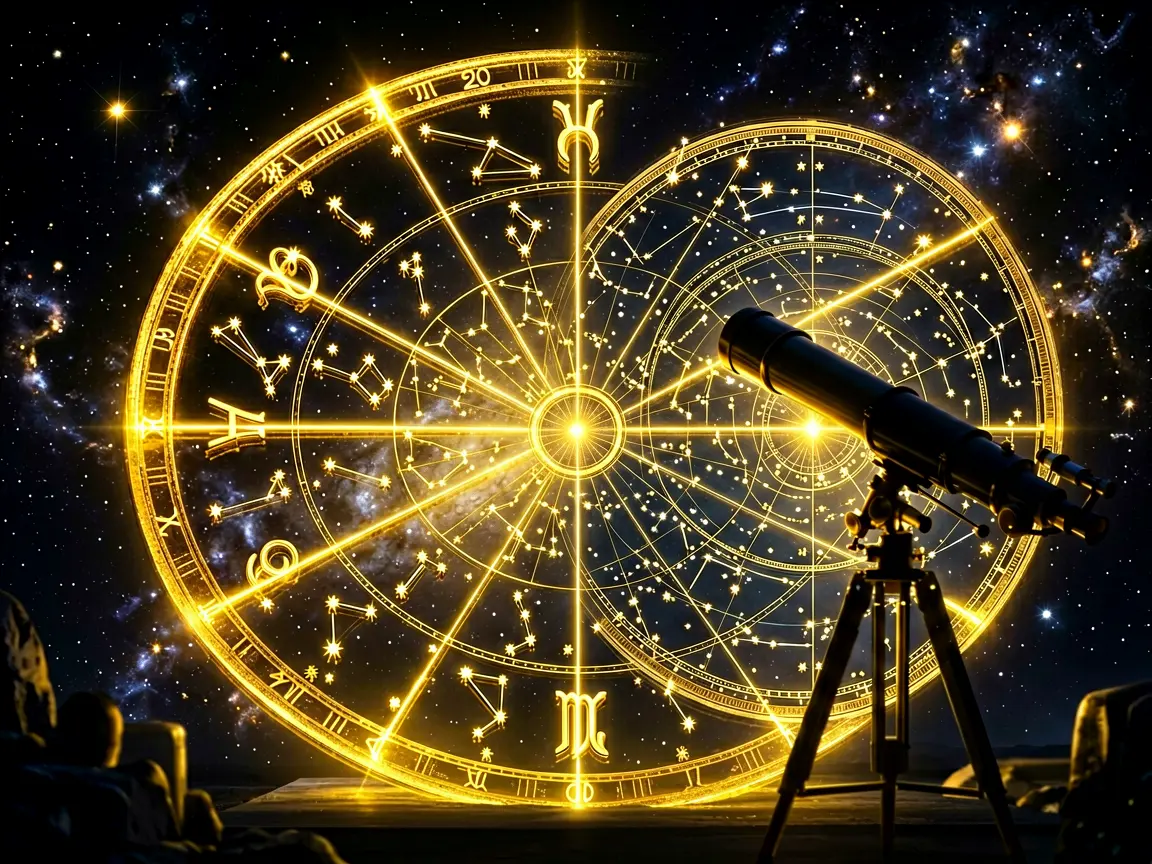
Astrology is a symbolic system of self-inquiry that reads planetary positions and cycles as mirrors of psychological patterns, while astronomy is the empirical science that measures the physical positions, motions, and properties of celestial objects. The two look at the same sky and answer different questions. Astronomy tells you what things are. Astrology tells you what they mean to the psyche.
Two Disciplines, One Ancestor
For most of recorded history there was no split to argue about. The Babylonians tracked the planets and read omens in them with the same breath. Tycho Brahe (1546-1601), the finest naked-eye observer who ever lived, cast horoscopes for the Danish court between observations. Johannes Kepler (1571-1630) discovered the laws of planetary motion and published astrological calendars to pay the bills. He called astrology a foolish little daughter while noting that astronomy could not do without her. The two fields were one family, and everyone knew it.
The divorce came with Newton. Once gravity could predict a comet's return, astronomy had something astrology never claimed: mechanical, testable causation. By the eighteenth century the split was complete, and the word astrology began its slide toward the fortune-teller corner. The history is documented in detail in the Wikipedia article on astrology and astronomy.
What Astronomy Measures
Astronomy is physics pointed at the sky. It measures distance, mass, temperature, orbit, and light. When you read that Saturn's rings are mostly water ice, or that Jupiter's Great Red Spot is a storm wider than Earth, you are holding facts any observer with the right instrument can verify. That is the strength of astronomy, and it is genuinely impressive.
Here is the part people forget. Those facts carry no meaning about you. Jupiter's position at the moment of your birth is a real, measurable thing. Whether it means anything is not an astronomical question. It cannot be, because the instruments do not measure meaning. Nothing in a telescope tells you what a planet signifies.
What Astrology Does
Astrology works in a different register. It treats the planets as archetypes, figures of the psyche that reappear across cultures and centuries. Saturn is the builder and the boundary maker. Venus draws you toward beauty and connection. Mars is the assertor, the drive that takes up space. Jung would have recognized these figures at once. They behave exactly like the archetypes of the collective unconscious he spent forty years mapping.
An astrologer reads a chart the way a depth psychologist reads a dream. The Sun sign names the organizing principle of your consciousness, and the Moon sign holds the emotional pattern you absorbed before you had words for it. Saturn's house shows where you meet resistance, and usually where you are being asked to build. None of this predicts an event. It describes a symbolic structure, and the structure is you.
What Jung Found
Jung took astrology seriously his whole career, which is more than most of his followers can say. In a 1911 letter to Sigmund Freud he wrote that "we shall one day discover in astrology a good deal of knowledge that has been intuitively anticipated." He cast horoscopes and studied the charts of his patients. In 1952 he published "Synchronicity: An Acausal Connecting Principle," an essay built around a statistical experiment on 483 marriage horoscopes.
The experiment matters because it is honest about its own ambiguity. Jung looked for planetary aspects that appeared more often in married couples' charts than chance would predict. The first batch showed an intriguing excess. The follow-up batches did not confirm it. Where a skeptic sees a failed hypothesis, Jung saw evidence for his real argument: astrology does not run on mechanical cause. It runs on meaningful coincidence, and he gave that phenomenon the name synchronicity.
The Real Difference: Cause and Meaning
The whole difference comes down to one word. Astronomy trades in causes. Astrology trades in meaning.
Both kinds of knowledge are real, and neither replaces the other. A causal explanation tells you how something happens. A meaning-based one tells you what it asks of you. When your Saturn return arrives around age twenty-nine, astronomy has nothing to say about it. The planet is simply completing its orbit. But the psyche does something remarkable at that age. It audits the life it has built and demands a reckoning. The two events line up with no causal link between them, and that alignment is exactly what Jung named synchronicity. It is why astrology survives every debunking.
Most arguments between skeptics and believers are arguments at cross purposes. The skeptic shows astrology is not physics, and the believer hears the word useless. The believer insists the planets push events around, and the skeptic hears superstition. Each is accurately describing the other's weaker claim. Drop both claims and the ground clears. Astrology does not need to be physics to be true to the psyche.
Reading Your Chart Without the Science Debate
In my practice I have watched people waste years trying to make their chart scientifically respectable. It never works, and it is never needed. Use astronomy when you want facts about the sky: when a planet is visible, what a conjunction looks like, what is up there. Use astrology when you want to know yourself: what patterns keep repeating, what your shadow protects, what the current cycle asks you to grow into.
Try this exercise. Take one planet, any planet, and find it in your chart. For a week, do not ask what it predicts. Ask where that energy shows up as a pattern. If you chose Saturn, notice every place you meet resistance and ask what structure is trying to be built there. If you chose Venus, notice what you are drawn to and what you refuse to let yourself want. The pattern is the message. That is self-inquiry, and it is the whole point of a chart.
This article is offered for spiritual guidance and entertainment purposes only. It is not a substitute for medical, legal, or financial advice.
Discover your cosmic blueprint
Cast your natal chart and explore the symbolic patterns that shape your personality and life journey.
Get Your Free Natal ChartFree · No sign-up needed
Frequently Asked Questions
Is astrology a science?▼
What is the difference between astrology and astronomy?▼
Did Carl Jung believe in astrology?▼
Can I use astrology if I do not believe in it?▼
Recommended Reading
Astrology
Weekly Zodiac & Horoscope Forecast October 12 - 18, 2026: Pluto Turns Direct
Astrology
Weekly Zodiac & Horoscope Forecast October 5 - 11, 2026: The Libra New Moon
Astrology
Weekly Zodiac & Horoscope Forecast September 28 - October 4, 2026
Astrology
Astrology Compatibility Birth Chart: How to Read Two Charts Side by Side