The Tower Tarot Card Meaning: The Archetype of Collapse
What does your next card say?
Draw from the 78 cards and let Luna guide you through love, career and your inner journey.
Draw Your Free Tarot CardFree · No sign-up needed
The Tower Tarot Card Meaning: The Archetype of Collapse
Every few months someone pulls the Tower and says the same thing. "Of course." One client, a designer in her forties, had spent the morning in a meeting where her studio was bought out and her project was killed. She drew the Tower that evening, in a reading meant to be about something else entirely. She looked at the falling figures and laughed. Not a bitter laugh. A relieved one. She told me she had known the studio was hollow for two years and had only been waiting for someone else to say it out loud.
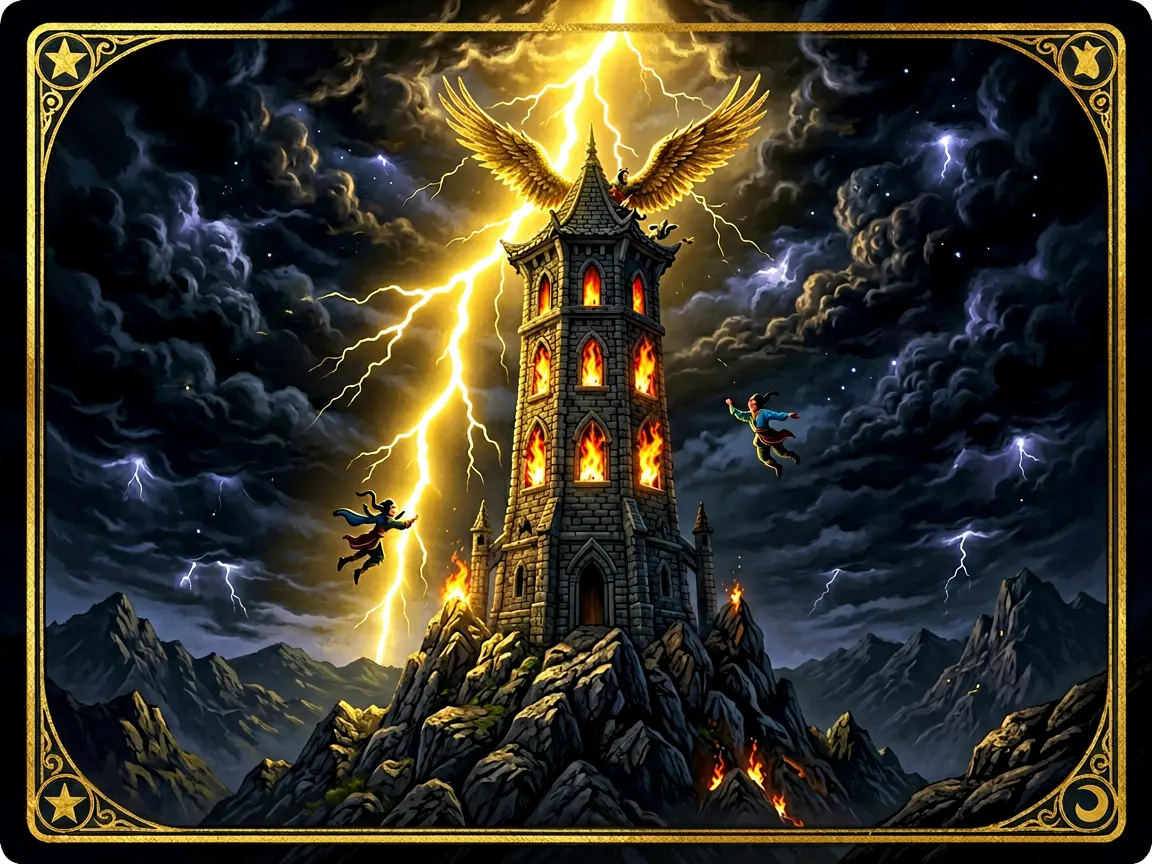
The Tower is a Major Arcana tarot card that shows a stone keep struck by lightning on a rocky peak, with a crown knocked from its roof and two figures falling into the dark. It is card XVI of the twenty-two Major Arcana, and in a reading it stands for sudden collapse, forced revelation, and the end of structures that were never as solid as they looked. In fifteen years of reading cards I have watched people fear this card more than any other except Death. I have also watched it become, months later, the one they thank.
The Image as a Map of the Psyche
The Rider-Waite-Smith deck, published in 1909 with art by Pamela Colman Smith, draws the scene without mercy. A tower perches on a bare peak. Lightning splits the sky from a mouth-like opening in the clouds and strikes the roof dead center. The crown that sat on the roof flies off in pieces. Two figures plunge from the windows, arms out, and flames lick from a third. The background is night. Nothing on the card is being repaired.
Arthur Edward Waite, who wrote the deck's guidebook, called the Tower the ruin of the House of Falsehood. Older decks named it differently. The Marseille tarot calls card XVI La Maison Dieu, the House of God, and the scene has been tied to the Tower of Babel since the biblical story in Genesis 11:1-9, where a city that tried to reach heaven was scattered and its language confused. Esoteric tradition links the card to the planet Mars and to the Hebrew letter peh, which means mouth. The mouth in the clouds is not decoration. Something is being said.
What Falls Is Always Hollow
The Tower rarely destroys anything that was sound. Lightning finds the crack that was already there. The crown flies off because it was decoration, not structure, and the figures fall because the floors beneath them gave way.
Jungian psychology reads this precisely. Carl Jung wrote that the aim of individuation, the lifelong work of becoming yourself, is "nothing less than to divest the self of the false wrappings of the persona" (see Individuation). The persona is the face you wear for the world: the title, the marriage that looks right from outside, the career you chose because it impressed someone. None of it is fake exactly. It is built from the outside in. When the Tower appears, something built from the outside in has been struck.
A structure like that fails in one of two ways. It decays slowly, the way a floor rots, and no one notices until a foot goes through. Or it holds perfectly until the first real weight lands on it. I have read for people whose lives looked enviable on paper and who privately described themselves as tenants in their own bodies. The Tower is the eviction notice. It is also, usually, the first honest thing that has happened to them in years.
The crown matters. Nothing holds up a building from its roof, and the crown is the part of the self-image that had to be knocked off before anything underneath could be seen: the achievement that was doing the work of identity. Jung's own life carries a famous version of this moment. After his break with Sigmund Freud in 1913, the career he had built went into free fall and he spent years in deliberate confrontation with his own unconscious, recording the visions and fantasies that later became the Red Book. The psychology he is known for came out of that fall. In his late work Mysterium Coniunctionis (1963) he wrote of transformation in alchemical terms: "Every descent is followed by an ascent" (see Mysterium Coniunctionis).
What the Lightning Reveals
Babel is a story about a single shared delusion: that a structure can reach heaven. The lightning does not punish. It shows the ceiling. What looked like an unbroken ascent to meaning turns out to have been bricks and pride, and the moment it is lit up everyone can finally see what they were standing on. Carl Jung named this kind of moment with his theory of synchronicity, the meaningful coincidence he developed in his 1952 essay, using the I Ching as his example of an acausal connecting principle (see Synchronicity). The Tower shows up the same week a real collapse happens because the psyche knows what the ego refuses to: a structure has already failed. The reading is not the collapse arriving. The reading is the collapse being admitted.
What It Asks of You in a Reading
When the Tower appears, I ask one question: what has been pretending to hold? The destruction is usually underway by the time the card shows up. The card's job is to name it. In a spread, watch what surrounds it. Cards that read harsh the week before tend to read like plain language after the Tower appears. A client drew it with the Star beside it and told me the fall had already happened. She was not asking whether. She was deciding what to rebuild.
Reversed: When the Collapse Is Postponed
Reversed, the Tower shows the same lightning and the same cracked walls, with one difference: the moment has been put off. I see it in people who know a relationship is dead and are negotiating its occupancy terms. Others paper over a failing business with fresh strategy documents. The walls do not stop being hollow because you stop looking at them.
The other face is subtler. Some people, having survived one Tower, decide that any change is the Tower and spend their lives bracing. The card reversed then means the fear of collapse has become its own prison, and a prison is a structure that will also eventually be struck.
In Love: The Fall of the Image
Love readings are where the Tower earned its reputation. It can mark the end of a relationship. More often it marks the end of a relationship image. The person you were with was partly real and partly projection, and the projection is what falls. In Jungian terms, falling in love runs through the anima and animus, the inner images of the other that we carry before we meet anyone (see Anima and animus). The Tower in a love reading is the moment the projection breaks and you meet the actual person standing where the image used to be. That meeting is the beginning of real love, or the honest end of it. Either way, the false version was the thing that had to go.
A client once told me, after a Tower year that took her marriage and her business, that she had stopped being afraid of the card. What she said next I have never forgotten: the falling was the first thing in her life that had ever been truthful.
The Practice
Here is the exercise I give clients when the Tower appears, and the one I use myself. Take a piece of paper. Draw a simple tower. At the top, write the things you believe would fall apart if you stopped maintaining them: the job title, the friendship, the image, the routine. That is your crown. At the bottom, write what is actually holding the tower up: the skill, the bond, the truth, the need. Then look at the gap. The crown list is almost always longer than the foundation list, and that gap is the strike point.
After that, journal on one question: where have I been paying rent on a building I do not own?
The designer who drew the Tower the night her studio was bought out rebuilt in eighteen months. She works for herself now, in a smaller room, on work she chooses. When she tells the story she says the buyout was the best thing that ever happened to her, and I believe her, because I have heard the same sentence from enough people who survived their Tower. The card does not predict the fall. The fall was already in the foundations, and the card is what it looks like when the truth finally reaches the surface.
This article is offered for spiritual guidance and entertainment purposes only. It is not a substitute for medical, legal, or financial advice.
What does your next card say?
Draw from the 78 cards and let Luna guide you through love, career and your inner journey.
Draw Your Free Tarot CardFree · No sign-up needed
Frequently Asked Questions
What does the Tower tarot card mean in a reading?▼
Is the Tower tarot card always bad?▼
What does the Tower reversed mean?▼
Is the Tower a yes or no card?▼
What does the Tower mean in love readings?▼
Recommended Reading
Tarot
Tarot Horoscope September 2026: Your Sign's Card of the Month & What to Do About It
Tarot
Tarot Horoscope October 2026: Your Sign's Card of the Month & What to Do About It
Tarot
Tarot for Beginners: A Jungian Guide to Learning the Cards
Tarot
Daily Tarot: How a One-Card Draw Becomes a Mirror Practice