Tarot vs Oracle Cards: Which Deck Speaks Your Unconscious? A Jungian Guide
What does your next card say?
Draw from the 78 cards and let Luna guide you through love, career and your inner journey.
Draw Your Free Tarot CardFree · No sign-up needed
Tarot and oracle cards are two symbolic languages for reading the psyche. Tarot is a fixed system of seventy-eight cards built on universal archetypes; oracle decks are free-form worlds each creator designs from scratch. In Jungian terms, tarot reads like grammar, structured and collective, while oracle reads like poetry, personal and immediate.
Carl Jung called it synchronicity: the meaningful coincidence between an inner state and an outer event. A woman came to me last spring with a new deck in her lap and a worried question. She had bought it on impulse, drawn to the gold foil and the painted moons, then discovered it was an oracle deck rather than a tarot deck. "Did I get the wrong one?" she asked. I told her what I will tell you. There is no wrong deck. There is only the question of which language your unconscious is currently speaking.
In my eight years of reading cards, trained first in the Marseille tradition and then in a Jungian study group that met every other Tuesday, this is the question I hear more than any other. People assume tarot and oracle are two brands of the same product, one fancier than the other. The real difference runs deeper. It is the difference between grammar and poetry, between a map and a weather report, between the collective unconscious and the dream that visited you last night. Both are tools of self-inquiry. Both can carry you deep into shadow work. But they work on you differently, and knowing how will change the way you use them.
Tarot: The Grammar of the Soul
The tarot is a fixed system. Seventy-eight cards, no more, no less. Twenty-two Major Arcana and fifty-six Minor Arcana, the latter divided into four suits that map onto the classical elements. Jung recognized the Major Arcana as a near-perfect inventory of archetypes, the universal images of the collective unconscious. The Fool, the Magician, the Empress, the Tower. Each card names a force that lives in every human psyche, whether or not you have met it yet.
The Minor Arcana works one level down. Where the Majors name the great archetypal themes of a life, the Minors describe the everyday theater those themes play out in. The suit of cups is your emotional life, swords your thinking, wands your drive, pentacles your body and your work. Court cards are the personae you slip into and the people who shape you. When a client asks why their reading feels repetitive, I often point here. The Majors set the stage, and the Minors show them the same scene from four directions until they finally see it.
A tarot reading works like a sentence. The cards are the words, the spread is the grammar, and each position tells you how to read the word that sits in it. The past, the present, the hidden influence. Meaning comes from the interplay. When I lay out a spread for a client, I am asking that structure to show me how the pieces of their situation fit together. Prediction has nothing to do with it. The pattern itself does the revealing.
The tarot's power comes directly from its structure. It rewards patience, and that patience is a form of psychological training. You start to think in archetypes. You notice the Fool's energy in your own life, the moment you leapt without a net. You recognize the Tower when a belief you built your identity on starts to crack. The cards give you a vocabulary for the inner life, and vocabulary changes what you can perceive.
Oracle: The Poetry of the Moment
Oracle decks are a different species. There is no standard structure, no fixed number of cards, no shared symbolism. Each deck is a self-contained world. Some speak in animals, some in goddesses, some in trees, some in abstract watercolors carrying a single word like "release" or "gather." The deck's creator built a symbolic language from scratch, and your job is simply to enter it.
If tarot is grammar, oracle is poetry. Poetry does not need syntax to move you. A single image can do more work than a paragraph. I have watched clients go still over one oracle card, a painting of a fox in the snow, while a full tarot spread left them puzzled. The image spoke before the intellect could get in the way.
Psychologically, oracle cards stay closer to the personal unconscious. They behave like dreams: dense, personal, sometimes strange, always addressed directly to you. Tarot hands you the archetypal architecture of a situation. Oracle hands you the weather of the present moment. One tells you what kind of building you are standing in. The other tells you what the air feels like right now.
How to Choose, From Years at the Table
When clients ask which one to buy, I ask a question back. What kind of inner work are you trying to do? If you want to understand the shape of a situation, the forces at play, the arc of a decision, start with tarot. Its structure will hold you steady while you learn to read your own patterns. If you want to open a door into reflection, to sit with an image and let it work on you, start with oracle. Its freedom is a kindness to beginners who might feel intimidated by a system.
I also tell them this. You will probably end up with both. Most readers I know, myself included, use them together. A common rhythm is tarot for the map and oracle for the voice. I lay out a spread, read the architecture, then pull a single oracle card to close the reading. That last card is often the one the client remembers. It is the image that follows them out the door.
One more thing I have learned over the years. The deck you resist is usually the deck you need. I have a client who refuses to work with the Devil card, and another who hides her oracle deck because it keeps showing her the same raven. That resistance is an announcement. It is the shadow introducing itself. Jung said that until you make the unconscious conscious, it will direct your life, and you will call it fate. The cards are one way to make it conscious. The deck you avoid is pointing at the part of yourself you have been unwilling to meet.
A Shadow Work Exercise With Both Decks
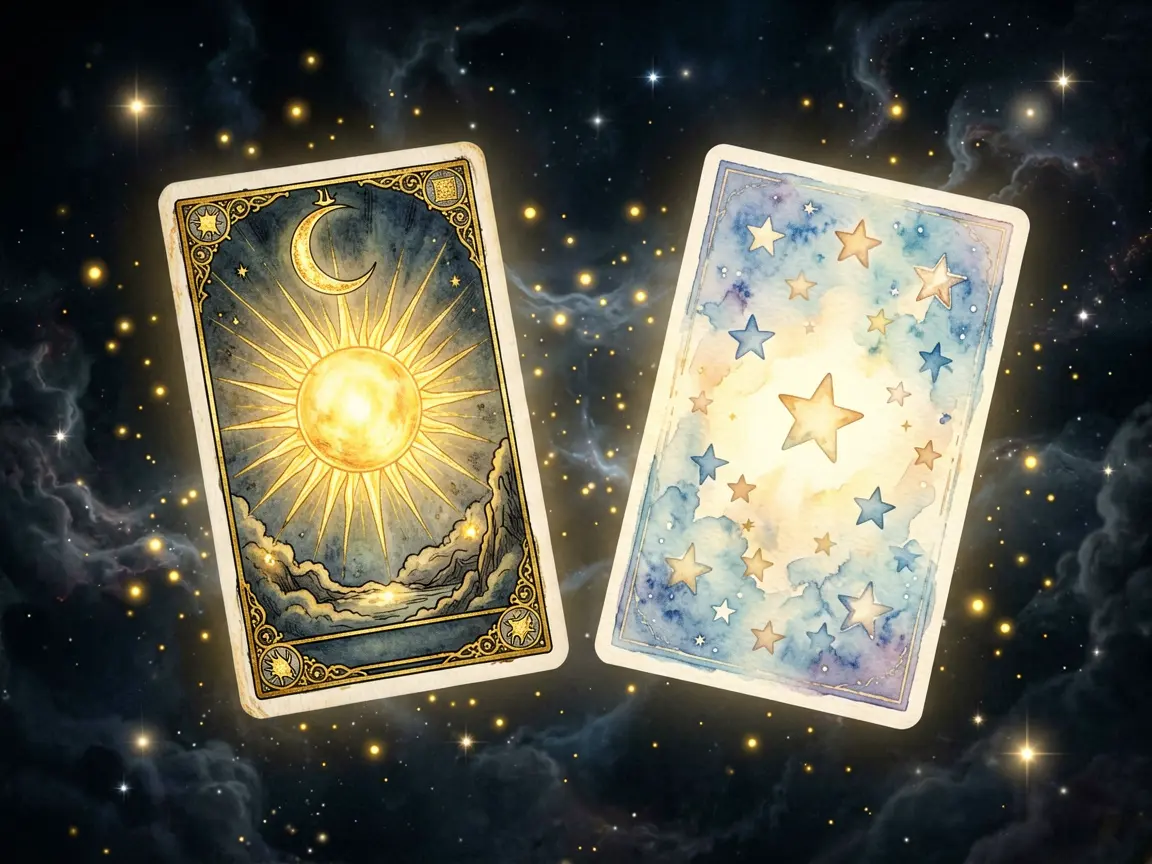
Here is a practice I give to clients. It needs one tarot card and one oracle card, or a single deck and a journal if that is all you have. Pull one card from each without asking a question. Lay them side by side. Write down what the tarot card names as the archetypal theme of your current chapter. Then write down what the oracle card shows you as the felt texture of that chapter. The tarot card might be the Hermit. The oracle card might be a lantern in fog. Same message, two dialects. Notice which one moved you more, then ask yourself why. The answer tells you which language your unconscious prefers, and that knowledge is worth more than any deck.
Which Deck Is Better? The Wrong Question
Whether you choose the structured grammar of tarot or the open poetry of oracle, the real instrument is always the same. You. The cards are a mirror, and a mirror neither lies nor decides. What it reflects back is a psyche in motion, asking to be seen. The question was never which deck is better. It is which one you will actually sit with, week after week, in the honest company of your own inner life.
Disclaimer: The content on this page is for spiritual guidance and entertainment purposes only, and is not a substitute for medical, legal, or financial advice.
What does your next card say?
Draw from the 78 cards and let Luna guide you through love, career and your inner journey.
Draw Your Free Tarot CardFree · No sign-up needed
Frequently Asked Questions
What is the difference between tarot and oracle cards?▼
Are oracle cards easier for beginners than tarot?▼
Can you use tarot and oracle cards together?▼
Do oracle cards predict the future?▼
How many cards are in an oracle deck?▼
Recommended Reading
Tarot
Tarot Horoscope September 2026: Your Sign's Card of the Month & What to Do About It
Tarot
Tarot Horoscope October 2026: Your Sign's Card of the Month & What to Do About It
Tarot
Tarot for Beginners: A Jungian Guide to Learning the Cards
Tarot
Daily Tarot: How a One-Card Draw Becomes a Mirror Practice