Tarot Reading: A Jungian Guide to What It Is and How It Works
What does your next card say?
Draw from the 78 cards and let Luna guide you through love, career and your inner journey.
Draw Your Free Tarot CardFree · No sign-up needed
The first client I ever read for wanted a date. She had come through a painful breakup six months earlier, and she asked the cards one question: when would she be ready to love again. I dealt three cards and we sat with them for an hour. We never got a date. We got something better, the pattern she kept running that made every new person feel like the last one.
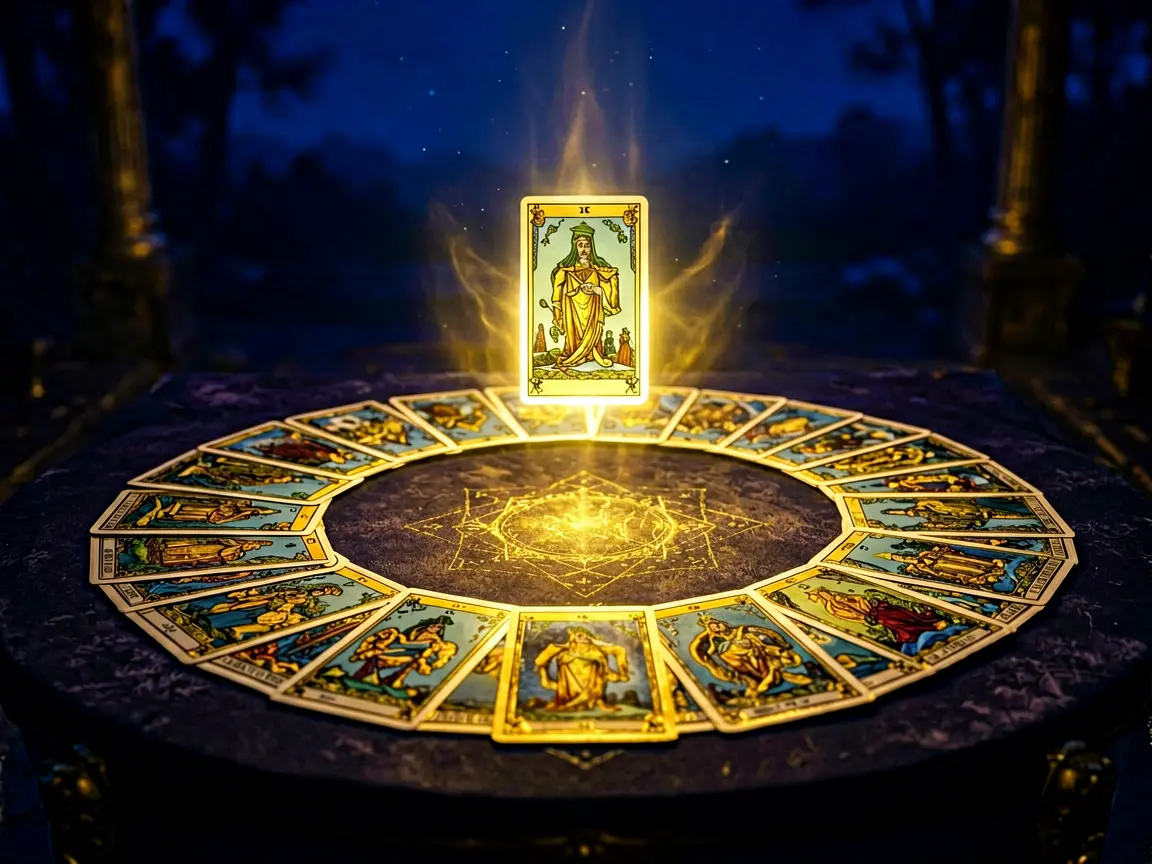
A tarot reading is a structured session in which a question is turned into a spread of cards and read as images, using the deck's 78 cards as a symbolic vocabulary for what the questioner carries beneath awareness. The cards are the language the reading happens in. The reading itself is the conversation between the images and the person looking at them.
The Deck Is a Map of the Psyche
A tarot deck holds 22 Major Arcana cards and 56 Minor Arcana cards in four suits. The Majors are a sequence of archetypal figures: the Fool, the Magician, the Empress, Death, the Star. Pamela Colman Smith drew the most famous version of them in 1909 for the Rider-Waite-Smith deck, and her images set the standard that modern decks still react to. She was an artist, a stage designer, and a member of the Hermetic Order of the Golden Dawn, and she packed her cards with so much symbolic detail that readers can spend years still finding new layers. Tarot traces its playing-card roots to fifteenth-century Europe, but the deck as we use it today is essentially her invention in pictures.
Read psychologically, the 22 Majors tell one story, the individuation journey. The Fool starts the walk. The World finishes it. Every card between is a stage that every psyche passes through, whether it reads tarot or not. Carl Jung described this territory better than any tarot author has. In Psychological Types (1921) he wrote that the dominant function characterizes consciousness while its opposite is repressed and characterizes the unconscious. Carl Jung was writing about personality types. The tarot says the same thing with pictures. The cards you keep pulling are the functions you keep repressing.
The 56 Minor Arcana cards work differently. The four suits map to the four functions of consciousness Jung described in the same book: Wands are intuition, Cups are feeling, Swords are thinking, Pentacles are sensation. The numbers in each suit walk through stages, from the raw impulse of the Ace to the settled outcome of the Ten. When a reading turns up mostly Cups, you know where the energy is flowing. When a client refuses the Swords, you know what she is avoiding.
Why Symbols Work
Jung rebuilt the old idea of libido into something larger, psychic energy in general, of which sexual desire is only one expression, and he insisted that this energy expresses itself only through symbols. Libido lays out the argument. The tarot is a set of symbols built for exactly this job. A card is a container, not a traffic sign with one fixed meaning. Your energy flows into the image, and the meaning that comes back is the shape of what you carry.
This is why the same card says different things to different people, and different things to the same person on different days. The card is stable. What you bring to it changes. In my practice I tell clients that the deck is the least interesting part of the room. The interesting part is what they flinch at.
Jung took symbolic systems seriously enough to write the foreword to Richard Wilhelm's German translation of the I Ching, calling the book 'one long admonition to careful scrutiny of one's own character, attitude, and motives.' I Ching He said the same thing about every oracle he worked with, tarot included. The question a reading answers is always the same one: what are you avoiding.
What a Session Actually Does
A reading has three beats: the question, the spread, the noticing. Most of the work happens in the third.
The question matters because it sets the frame. "Will I get the job" produces a different reading than "what is my hand in this interview". The first makes you a passenger. The second puts you in the room. I rephrase almost every question a client brings, because the rephrasing is usually the reading.
The spread gives the question a shape. One card for a single issue, three for a situation, ten for a full picture. Position meanings are scaffolding. They keep the images from blurring into one another, and they give the mind somewhere to start.
The noticing is where the work lives. I watch which card a client reaches for and which one she avoids. I listen for the sentence she interrupts. A client once asked me to flip the Death card face down because it unsettled her, and we spent the session on why a card about endings was the one she could not look at. She was planning to quit her job the next week. The card had not told her anything. It had held up a mirror she had been walking past.
Jung called the deliberate act of entering an image and asking it why it appeared active imagination, the method he developed and recorded in the Red Book. Active imagination is the closest ancestor of a tarot reading. The deck is the door. The rest is the same practice: hold the image, let it speak, answer honestly.
Reading for Yourself
You do not need a reader. Start with one card a day. Pull it in the morning, carry the image with you, and notice what it keeps pointing at during the day. When you want more, use three positions: what is carrying over, what stands right now, what is forming. Write the three cards down and answer one question about each: why did you show up.
The temptation is to look up meanings. Resist it for the first month. The dictionary meaning of the Three of Swords is useful eventually. Your first answer to "why did you show up" is worth more, because it is the one your unconscious wrote.
A Practice: Interview the Card You Avoid
Here is the exercise I give clients. Shuffle and deal one card. If it makes you uncomfortable, keep it. If it delights you, put it back and deal again. Then journal on three questions. What in this image do I recognize. What in this image do I refuse. What would change if I stopped refusing it.
A client who pulled the Hermit kept saying she hated the card, the lonely old man with the lantern. By the third question she was crying. She had spent two years building a life that never required her to be alone with herself, and the Hermit was the first image in years that had asked her to try. Synchronicity is the name Jung gave to meaningful coincidence, moments when an outer event and an inner state line up without a cause. A card like that feels like a coincidence of timing only. You shuffled. You drew. You flinched. The meaning was already yours before the card fell.
Deal a card tonight. Ask it why it showed up. See what you flinch at.
This article is offered for spiritual guidance and entertainment purposes only. It is not a substitute for medical, legal, or financial advice.
What does your next card say?
Draw from the 78 cards and let Luna guide you through love, career and your inner journey.
Draw Your Free Tarot CardFree · No sign-up needed
Frequently Asked Questions
What is a tarot reading?▼
Can a tarot reading predict the future?▼
How do I do a tarot reading for myself?▼
Do you need psychic ability to read tarot cards?▼
Recommended Reading
Tarot
Tarot Horoscope September 2026: Your Sign's Card of the Month & What to Do About It
Tarot
Tarot Horoscope October 2026: Your Sign's Card of the Month & What to Do About It
Tarot
Tarot for Beginners: A Jungian Guide to Learning the Cards
Tarot
Daily Tarot: How a One-Card Draw Becomes a Mirror Practice