Minor Arcana Four Suits Explained: Wands, Cups, Swords, and Pentacles as Jungian Functions
What does your next card say?
Draw from the 78 cards and let Luna guide you through love, career and your inner journey.
Draw Your Free Tarot CardFree · No sign-up needed
A client once pushed the Ten of Swords back across the table. "Give me one of the real ones," she said. She meant the Major Arcana, the cards with names and faces. I understood the feeling. The Ten of Swords shows a man facedown on a beach with ten blades in his back. It looks like a very bad Tuesday. But that is the subject. The Minor Arcana is the part of the deck that does not dress life up as destiny, because it is too busy living it.
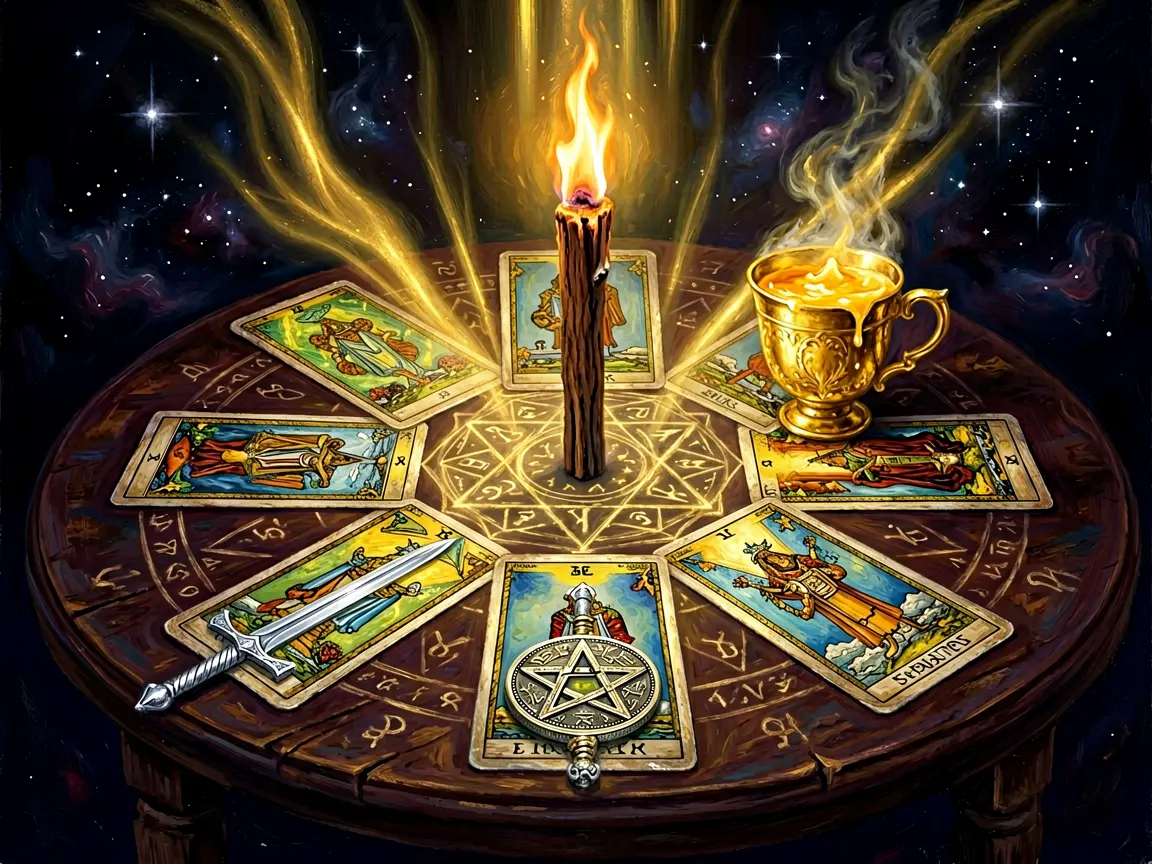
The Minor Arcana is the 56-card half of a tarot deck, divided into four suits of fourteen cards each: Wands, Cups, Swords, and Pentacles. Each suit carries one of the four classical elements, and each element carries one of the four psychological functions that Carl Jung described in his 1921 book Psychological Types: thinking, feeling, sensation, and intuition. Learn the suits and you learn the deck's vocabulary for ordinary life.
I have read cards for fifteen years, and this correspondence is why the deck keeps its teeth. Jung argued that every person takes in the world through four channels. Thinking judges by logic. Feeling judges by value, by like and dislike. Sensation reports what the body and the senses register. Intuition reads the pattern beneath the surface. He called thinking and feeling the rational functions, sensation and intuition the perceiving ones. Most of us favor one channel and let the others fade into the background. Jung wrote that the dominant function "characterizes consciousness, while its opposite is repressed and characterizes the unconscious" (Psychological Types, 1921). The suit you read most naturally and the suit you avoid are the same sentence.
The Four Suits as the Four Functions
The mapping is old and standard in Jungian tarot work. Wands is fire and intuition. Cups is water and feeling. Swords is air and thinking. Pentacles is earth and sensation. The four suits descend from late medieval European card decks, and the Visconti-Sforza tarot of the 1450s already carries them in recognizable form. The images most readers know come from the Rider-Waite-Smith deck of 1909, drawn by Pamela Colman Smith. Each suit holds fourteen cards: an ace, nine numbered cards, and four court cards, the page, knight, queen, and king, which stage the function at different levels of maturity.
Wands: Intuition and Fire
Wands is the suit of fire and intuition. In readings I think of it as the ignition switch. Wands cards show up when a project is about to begin, when a plan catches light, when someone finally acts on the idea they have been carrying. The Ace of Wands is the spark itself, a hand offering a flowering staff out of a cloud. By the Ten, the fire has done its full work, whether that means a heavy burden carried home or a field burned clean for planting.
The shadow of Wands is the flame that does not stay. The clients who pull Wands over and over are the ones who start beautifully. They begin books, courses, businesses, relationships, all with real conviction. And somewhere around eighty percent done, the fire moves on. The intuition is so strong that finishing, which is a feeling-function and sensation-function task, feels like a betrayal of the vision. If you keep pulling Wands and keep abandoning projects, the card is naming the function you have not developed: the one that can sit with a thing until it is done.
Cups: Feeling and Water
Cups is water and feeling, the suit of love, mood, memory, and the inner weather. Where Wands asks what you want to make, Cups asks what you feel about it. The suit runs from the Ace of Cups, a hand offering a chalice that overflows, to the Ten of Cups, the little family under the rainbow that everyone mocks and everyone quietly wants. In between sit the Two of Cups and the choice to meet someone halfway, the Five of Cups and the spilled wine you keep staring at, the Eight and the slow walk away from a situation you have outgrown.
The shadow of Cups is drowning. The feeling function, left unexamined, takes over the whole psyche. Clients with heavy Cups energy often cannot say what they want without first asking what everyone else wants. Their anger comes out as tears, silence, or excessive sweetness. Jung treated the inner feminine of a man, the anima, as the hardest integration of all, the "masterpiece" that follows the shadow's "apprentice-piece." The Cups shadow is the part of you that is afraid of being disliked, and the cards keep handing it to you until you stop negotiating with it.
Swords: Thinking and Air
Swords is air and thinking, the suit of the mind and its weapons. These are the cards of language, argument, decision, and the clean cut. The suit moves from the Ace of Swords, a blade held upright through a crown, to the Ten, the man on the beach. Swords cards appear when a situation needs clarity or something has to be said out loud.
The shadow of Swords is the mind that wins and wins. I have sat with brilliant clients whose readings were wall to wall Swords and whose relationships were empty rooms. They could dismantle any argument in seconds and could not say what they felt to save their lives. The thinking function, cut loose from feeling and sensation, becomes ideology. It protects the person from the messy, unprovable parts of being alive. The Ten of Swords is the thought that ran its course and left its owner flat on the ground.
Pentacles: Sensation and Earth
Pentacles is earth and sensation, the suit of the body, money, craft, home, and the work of the hands. The pentacle itself is a coin. The suit runs from the Ace, a hand offering a single gold disc, to the Ten, the family, the garden, the archway of abundance. These cards show up for salaries, rent, health, the meal on the table, the thing you built with your own hands.
The shadow of Pentacles is comfort that hardens into inertia. The sensation function loves what is solid, and that love can curdle into materialism, overwork, or the quiet terror of changing anything that works. I have read for people who pulled Pentacles for months and never touched a single situation the cards described. The suit was showing them the life they had built, and they could not feel it because they had stopped listening to their bodies years ago. One of them finally drew the Three of Pentacles, the card of craft and collaboration, and went back to the workshop he had closed for ten years.
Finding Your Shadow Suit
The simplest way to find your shadow suit is to watch which one you flinch at. In a reading, which suit makes you look away? Which one do you skip when you flip through the deck? Most people have a suit they secretly consider boring, childish, too soft, or too harsh. That dismissal is the function being repressed. A thinker calls Cups sentimental. A feeler calls Swords cold. A sensation type calls Wands flaky. An intuitive calls Pentacles dull. Every one of those insults is the psyche describing its own blind spot.
Jung's own framing is more generous than most shadow work makes it sound. The repressed function is not a defect waiting to be fixed. It is the undeveloped half of a pair, and it holds exactly the energy the dominant function cannot supply. The person who lives entirely in thinking is already drowning in it. The feeling function needs to come in from the cold.
The Shadow Suit Week
Here is the exercise I give clients, and it costs seven minutes a day. Pull one card each morning from your shadow suit. Do not open a book. Look at the image and write one line about where that function showed up in your day yesterday. If your shadow suit is Cups, the hunt is for one moment of genuine feeling you allowed yourself to have yesterday. On day seven, lay the seven cards out in a row and read them like a single sentence. The sentence is almost always the thing you have been avoiding saying out loud.
I have seen this small practice do more than any spread I have ever given a client. The client who pushed the Ten of Swords away did the week. Six months later she told me the card had become her alarm clock. The thought that had been running her life, seen from above at last, was small. She had not needed the card to change. She had needed to stop flinching from it.
Learn which function you live in, find the suit you avoid, and give the avoided one seven days.
This article is offered for spiritual guidance and entertainment purposes only. It is not a substitute for medical, legal, or financial advice.
What does your next card say?
Draw from the 78 cards and let Luna guide you through love, career and your inner journey.
Draw Your Free Tarot CardFree · No sign-up needed
Frequently Asked Questions
What does the minor arcana represent in tarot?▼
How do the four suits map to Jung's psychological functions?▼
Which element is each tarot suit?▼
Why do I keep drawing the same suit?▼
Is the minor arcana less important than the major arcana?▼
Recommended Reading
Tarot
Tarot Horoscope September 2026: Your Sign's Card of the Month & What to Do About It
Tarot
Tarot Horoscope October 2026: Your Sign's Card of the Month & What to Do About It
Tarot
Tarot for Beginners: A Jungian Guide to Learning the Cards
Tarot
Daily Tarot: How a One-Card Draw Becomes a Mirror Practice