Love Tarot Reading: The Mirror of Anima and Animus
What does your next card say?
Draw from the 78 cards and let Luna guide you through love, career and your inner journey.
Draw Your Free Tarot CardFree · No sign-up needed
Love Tarot Reading: The Mirror of Anima and Animus
Every few months someone books a love reading and opens with the same sentence: will he commit, is she the one. A client in her late thirties once sat down with a three-card spread and that exact question. The cards came up the Lovers, the Two of Cups, and the Devil. She wanted to know what they said about her boyfriend. I told her they said nothing about him at all. She was furious for about ten minutes. Then she told me she had broken off two engagements in the previous decade, each one weeks before the wedding. The Devil was not hiding in his apartment. It was hiding in her refusal to be chosen.
A love tarot reading is a tarot spread, usually three to ten cards, that maps the emotional field between you and another person. Its true subject is the projection you carry: the inner image of the other that you formed before you ever met them. In fifteen years of reading cards I have learned that the cards never report on what your partner feels. They show what you are ready to see, afraid to see, and currently unable to see in yourself. That shift of attention is the whole art.
Falling in Love With an Image
Jung called the inner images we carry of the other sex the anima and the animus. The anima is the feminine image inside a man, the animus the masculine image inside a woman, and both are built long before any real person walks in. In his late work he described the encounter with the shadow as the apprentice-piece of development and the encounter with the anima as the masterpiece (see Anima and animus). Falling in love runs through those images. You meet the image first and the person second.
Every love reading I have ever given has been, at some level, about that gap. A client whose father left when she was six kept choosing men who were already half gone. Another, a man who learned early that anger was shameful, kept finding partners who could not say what they felt. The cards named the pattern in ten minutes. It had taken the relationships years to do the same.
The Lovers Is a Card About Choice
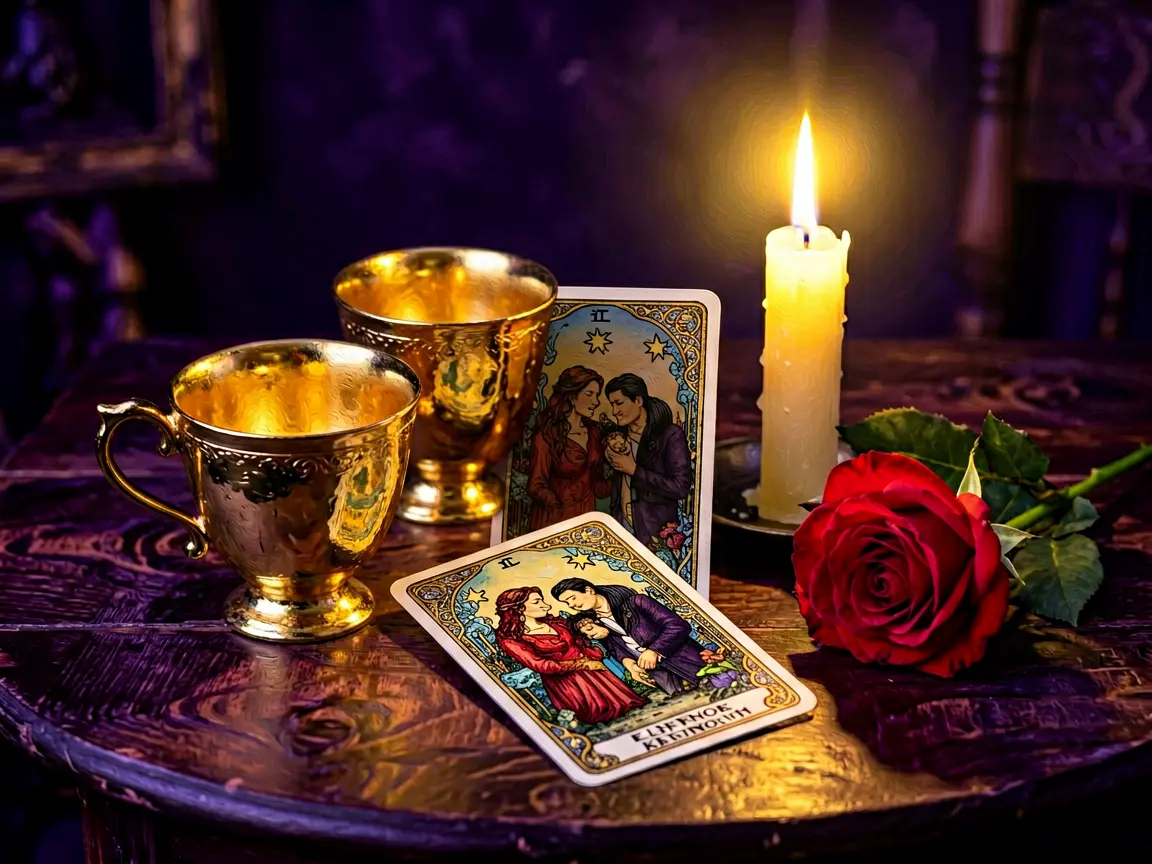
The Lovers, card VI of the Major Arcana, is the card everyone hopes for in a love spread and the one most often misread. In the Rider-Waite-Smith deck, published in 1909 with art by Pamela Colman Smith, it shows Adam and Eve in the Garden of Eden beneath a winged figure that most guides name Raphael, the angel of healing. The older Marseille tradition calls the card L'Amoureux, the Lover, and draws a man caught between two women. Both images describe the same moment: a choice between two versions of life.
A serpent coils in the tree behind Eve. The mountain behind the man rises toward a crown of light. In a love reading the Lovers rarely means the relationship itself. It means the person you are deciding to be inside it. The card asks which version you will bring to the table, and the answer is the only honest thing a love reading can hand you.
The Cups and Your Capacity to Receive
The Cups suit governs emotion, relationship, and imagination. When cup cards appear in a love position, most people ask what the other person feels. I ask what you are ready to receive. The Ace of Cups is the classic example. It shows a hand offering a golden cup, and beginners often read it as a promise that love is coming. In practice it is an offer you can refuse: the question the card carries is whether you can accept tenderness without checking it for a price tag.
Jung argued that psychic energy expresses itself only through symbols, which is why desire keeps arriving in the imagery of cups, keys, and crossed swords instead of plain speech (see Libido). A cup card in a love spread is your desire taking a shape you can look at. Ask what it points at in you.
The Shadow You Bring to Every Relationship
The person who irritates you most in a relationship is usually carrying something you have disowned. Jung called this the shadow: the qualities you rejected early and pushed out of sight. An angry partner holds the anger you were punished for showing. A needy one carries the need you learned to call weakness. Love gives you a front-row seat at your own shadow show, whether you came for the entertainment or not.
Jung's model of psychological types makes the same point from the other direction. The function you repress, he wrote, is the one that sinks into the unconscious (see Psychological Types). Thinking types marry feeling types because the missing function is the most attractive thing in the room. The attraction is real. So is the irritation that follows, when the partner keeps being the thing you refuse to be. A love reading that names that swap does more than flatter. It gives the pattern a name.
Why a Love Reading Feels Eerily Accurate
People come back from a good love reading saying it was scary. I understand why. The cards seem to know things. Jung gave this a name in 1952: synchronicity, the meaningful coincidence that connects an inner state with an outer event without a causal chain (see Synchronicity). You draw the Lovers the week a decision you have been avoiding surfaces. You pull the Three of Swords the day a wound you thought was healed reopens.
None of that is a prediction. It is a recognition. The psyche knows its own material, and the cards give that knowledge a shape at the exact moment it can be seen. The accuracy is your own attention finally arriving.
The Practice: A Three-Card Love Spread
The spread I give clients who want a love reading worth keeping is deliberately small. Three cards, three questions: what I bring, what I project, what I am not ready to see. Lay them left to right. Read the first card as your actual contribution to the relationship, the second as the image you have been pouring over the other person, and the third as the part of yourself the reading is asking you to meet.
Then journal on one question and sit with it a full week: who have I been falling in love with, and what did I need them to be? The answers usually land somewhere uncomfortable, which is how you know they are yours.
The client with the two broken engagements did not marry the man she was reading about. Not then. She spent a year in therapy instead, and told me the Devil in that three-card spread was the first honest thing anyone had said to her about love in years. Two years later she married him, on her own timeline, with her own feet under the table. She likes to say the cards got it right after all, just about a different question than the one she asked.
This article is offered for spiritual guidance and entertainment purposes only. It is not a substitute for medical, legal, or financial advice.
What does your next card say?
Draw from the 78 cards and let Luna guide you through love, career and your inner journey.
Draw Your Free Tarot CardFree · No sign-up needed
Frequently Asked Questions
What is a love tarot reading?▼
Can tarot tell me if he or she is the one?▼
What does the Lovers card mean in a love reading?▼
What is the best spread for a love reading?▼
Why do love readings feel so accurate?▼
Recommended Reading
Tarot
Tarot Horoscope September 2026: Your Sign's Card of the Month & What to Do About It
Tarot
Tarot Horoscope October 2026: Your Sign's Card of the Month & What to Do About It
Tarot
Tarot for Beginners: A Jungian Guide to Learning the Cards
Tarot
Daily Tarot: How a One-Card Draw Becomes a Mirror Practice