The High Priestess Tarot Card Meaning: The Archetype of the Unconscious
What does your next card say?
Draw from the 78 cards and let Luna guide you through love, career and your inner journey.
Draw Your Free Tarot CardFree · No sign-up needed
The High Priestess Tarot Card Meaning: The Archetype of the Unconscious
Every few months a client pulls the High Priestess before we have even named the question. One woman came to me about a promotion she had been offered and had quietly been dreading. She shuffled, cut the deck, and the card fell face up. She stared at it, then at me. "I knew that was coming," she said. Not as prediction. As recognition.
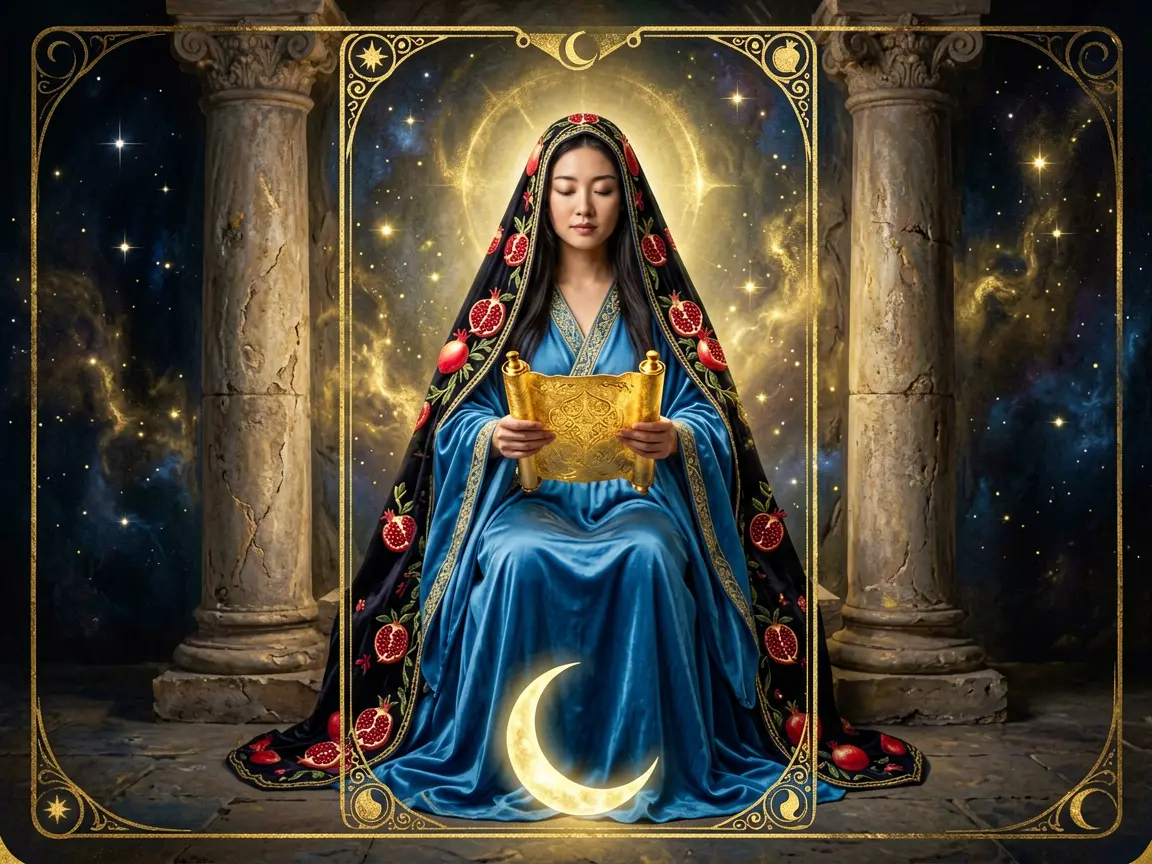
The High Priestess is a Major Arcana tarot card that shows a woman seated between two pillars at the threshold of a temple, holding a scroll of hidden knowledge. In a reading she stands for intuition, the unconscious mind, and the things you already know but have not let yourself say out loud. She is card II of the Major Arcana, and in the Rider-Waite-Smith deck, first published in 1909 with art by Pamela Colman Smith, she sits in full stillness while every detail around her carries meaning. In fifteen years of reading cards, I have learned to stop talking when she appears.
The Image as a Map of the Psyche
Every detail on this card is worth taking literally. The pillars behind her are inscribed J and B, short for Jachin and Boaz, the two columns that stood at the portico of Solomon's Temple (1 Kings 7:21). Between them hangs a veil embroidered with pomegranates. She holds a scroll marked TORA, a crescent moon rests at her feet, and her crown rises in three tiers. In the Marseille deck she is called La Papesse, the Popess, a name bound up with the legend of Pope Joan, the woman who, according to the old story, reigned briefly as pope in the ninth century.
I read these details the way I read a dream. The pillars frame the card like a doorway, and they are opposites: Jachin, the pillar of establishment, and Boaz, the pillar of strength. A threshold needs both. The veil means the doorway leads somewhere. Pomegranates have carried underworld symbolism since the myth of Persephone, who ate six seeds and was bound to return to the dead for part of every year. The scroll is knowledge. The moon is what light does when the sun is gone. Nothing here is decoration. It is a diagram of the psyche.
The Unconscious, Personified
Jungian psychology gives this card its deepest frame. Carl Jung wrote in Psychological Types (1921) that "the dominant function characterizes consciousness, while its opposite is repressed and characterizes the unconscious." If you are a thinking type, your feeling life runs below the threshold. If you are an extravert, your inner world goes underground. What you push out of awareness does not vanish. It collects.
The High Priestess is what that collected content looks like when it takes human form. She is the unconscious as a figure, and she is also the classic image of the anima, the inner feminine presence that Jung called the masterpiece of development, the encounter that follows the apprentice work of meeting your shadow (see Anima and animus). For a man she often appears in dreams as an unknown woman with something to tell him. For anyone, she is the part of the psyche that knows before the ego has caught up.
This is why the card shows up at the exact moment a client has been ignoring their own knowing. The promotion client had spent three weeks making lists. Pros in one column, cons in the other. She had asked everyone's opinion except her own. What she had not done was sit with the plain fact that her body tightened every time she thought about the new role. The High Priestess does not argue. She holds the scroll.
What She Asks of You in a Reading
The High Priestess rarely hands you a new fact. She asks a question instead: what do you already know, and what is it costing you to pretend otherwise? When she appears, I ask clients to notice their first reaction before they reach for logic. That first reaction is the message.
The knowing she points to surfaces in three places. Dreams, which Freud called the royal road to the unconscious. Synchronicities, the meaningful coincidences that Jung explored in his 1952 essay, where he used the I Ching as his example of an acausal connecting principle (see Synchronicity). And the body, which registers what the ego edits out. Carl Jung built much of his later work on the claim that these signals carry meaning. They are the psyche speaking in its own language, which is symbolism.
In a spread, watch what sits on either side of her. The card before her is the thing you have been able to say. The card after her is what opens once you admit the rest. A client drew her with the Hermit on the left and the Star on the right, and she told me later that the reading described her year before she had lived it. The High Priestess had not predicted anything. She had named the door the client had been circling.
Reversed: When the Threshold Stays Closed
When the High Priestess appears reversed, I see two patterns in the people I read for. The first is mystification: a client treats her as permission to stop thinking, reading every coincidence as a cosmic instruction and every mood as a prophecy. The second is the opposite: a client has sealed the door so tightly that they announce their feelings and intuitions are unreliable, and they want me to tell them what to do instead.
Both are the same evasion wearing different coats. The card reversed asks for discrimination, the skill of telling the signal from the noise, and it asks you to own the knowing rather than worship it or bury it.
The Practice
Here is the exercise I give clients, and the one I do myself when she shows up in a spread. For one week, keep a small notebook by your bed. Each morning, before you check your phone, write the first thing that comes to mind about a question you are holding. No editing. At the end of the week, read the pages once and underline every line that turned out to be true. Most people find they knew the answer on day one and spent six days negotiating with it.
The client with the promotion took the job. Eight months later she told me the card had been right about the part she had kept off the lists: she had known it from the start, and she had wanted to say no. The High Priestess never argues. She waits for you to unroll the scroll.
This article is offered for spiritual guidance and entertainment purposes only. It is not a substitute for medical, legal, or financial advice.
What does your next card say?
Draw from the 78 cards and let Luna guide you through love, career and your inner journey.
Draw Your Free Tarot CardFree · No sign-up needed
Frequently Asked Questions
What does the High Priestess tarot card mean in a reading?▼
Is the High Priestess a yes or no card?▼
What does the High Priestess reversed mean?▼
What is the difference between the High Priestess and the Empress?▼
What does the scroll in the High Priestess card say?▼
Recommended Reading
Tarot
Tarot Horoscope September 2026: Your Sign's Card of the Month & What to Do About It
Tarot
Tarot Horoscope October 2026: Your Sign's Card of the Month & What to Do About It
Tarot
Tarot for Beginners: A Jungian Guide to Learning the Cards
Tarot
Daily Tarot: How a One-Card Draw Becomes a Mirror Practice