The Ten Gods of BaZi: The Archetypal Cast of Your Psyche's Inner Drama
Curious what YOUR chart reveals?
Cast your free BaZi chart and see your Day Master, elemental balance and life patterns through a Jungian lens.
Get Your Free BaZi ChartFree · No sign-up needed
The Ten Gods (Shi Shen) are ten archetypal forces in BaZi, formed by the relationship between your Day Master and every other element in your birth chart. Each one acts as an inner character: a nurturer, a rebel, a steward, a judge. Together they map the unconscious patterns that shape your personality, career, and relationships.
(55 words)
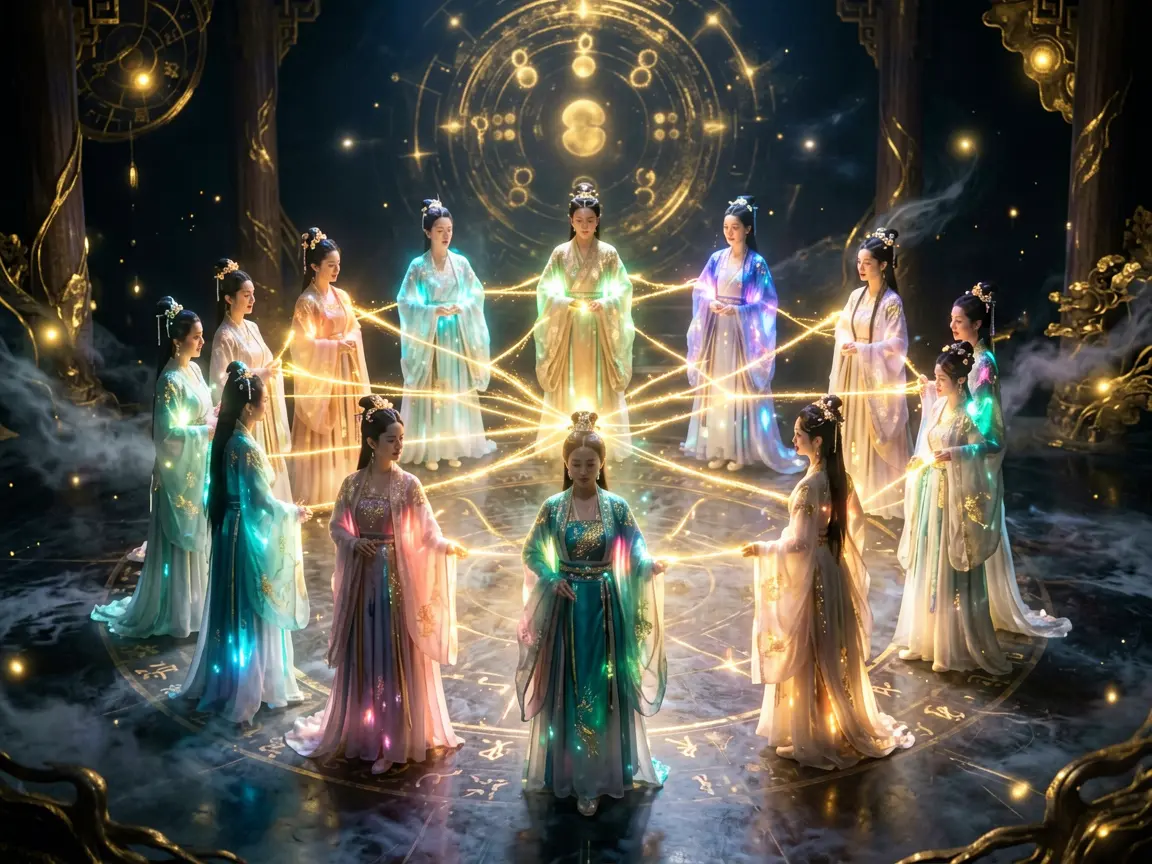
The French philosopher Jean-Paul Sartre once said, "Hell is other people." A Jungian might push back. Hell is also the people you carry inside you. The voices, the critics, the nurturers, the rebels. The invisible entourage that populates your inner world and pulls your strings without you ever knowing they're there.
In BaZi these inner characters have names. The Ten Gods (Shi Shen) are ten archetypal relational forces born from the interaction between the Five Elements in your natal chart. They map the unconscious relational patterns, personality dynamics, and shadow projections that shape your life from the inside out.
What Are the Ten Gods?
Every Element in your chart has a relationship to every other Element. Five fundamental dynamics hold them together: creating, draining, controlling, being controlled, and resonating as equals. Each dynamic carries a positive and a shadow expression. That gives us ten archetypal figures.
Think of them as the permanent cast of characters in the theater of your psyche. The Major Arcana maps the archetypal journey of the self in Tarot. The Ten Gods map the archetypal relationship patterns of the self in BaZi. They reveal who you are already being. Who you are unconsciously recruiting others to be.
The Five Relational Dynamics
Each dynamic describes a psychological relationship between two parts of your psyche.
Self (Bi Jian / Rob Wealth). The Element that matches your Day Master. When it appears as a peer, it is your inner sibling. Your capacity for camaraderie, competition, and the kind of mirroring that either strengthens or drains you.
Output (Shi Shen / Shang Guan). The Element you create. Your inner artist, inventor, and performer. The part of you that must bring something new into the world. Its shadow is restlessness, reckless expression, and creative burnout.
Resource (Zheng Yin / Pian Yin). The Element that creates you. Your inner parent, teacher, and voice of received wisdom. Healthy resource nourishes. Excessive resource traps you in the safety of borrowed knowledge.
Wealth (Zheng Cai / Pian Cai). The Element you control. Your inner steward. Your relationship with resources, material security, and the practical management of life. Its shadow is possessiveness. When absent, chronic financial disorganization.
Authority (Zheng Guan / Qi Sha). The Element that controls you. Your inner judge, your conscience, your capacity to meet external expectations. Authority gives structure. Too much becomes the inner critic that never sleeps.
Each of these five dynamics has a positive (Zheng) and a shadow (Pian) expression. That brings the total to ten archetypal figures.
The Ten Archetypal Characters
Every Day Master type generates a unique configuration of these ten characters. But the archetypal meaning of each is universal.
1. Zheng Yin (正印) -- The Wise Guardian. The part of you that receives and protects. Represents formal education, maternal nurturing, tradition, and inherited wisdom. Psychologically, it is your superego's healthy function. The internalized voice of care and guidance. When out of balance, it becomes intellectual laziness. Relying on credentials rather than lived experience.
2. Pian Yin (偏印) -- The Shadow Sage. Unconventional wisdom, occult knowledge, spiritual intuition. This is the side of you that learns through the back door. Through dreams, symbolism, sudden flashes of insight. Its shadow is withdrawal, paranoia, and a reluctance to engage with ordinary life.
3. Zheng Guan (正官) -- The Lawgiver. Structure, integrity, respect for order. The part of you that keeps promises, follows through, and honors commitments. Its healthy form is self-discipline. Its shadow is rigidity, guilt, and fear of disappointing authority.
4. Qi Sha (七杀) -- The Warrior. Challenge, ambition, martial discipline. The part of you that rises to meet difficulty. It gives you the spine to face opposition. When untamed, it becomes aggression, risk addiction, a compulsive need to dominate every situation.
5. Zheng Cai (正财) -- The Steward. Steady income, material stability, grounded practicality. This archetype manages the household of the psyche. Paying bills, saving for the future, maintaining physical comfort. Its shadow is greed and the fear of not having enough.
6. Pian Cai (偏财) -- The Adventurer. Speculative wealth, unexpected gains, charisma in financial matters. Psychologically it represents your relationship with risk, spontaneity, and the willingness to receive abundance. Its shadow is recklessness and get-rich-quick thinking.
7. Shi Shen (食神) -- The Artisan. Creative output, pleasure, generosity of spirit. The part of you that cooks a good meal, tells a good story, and enjoys life's simple joys. Its shadow is indulgence, escapism, using pleasure to avoid feeling.
8. Shang Guan (伤官) -- The Revolutionary. Brilliant, iconoclastic, emotionally intense. The part of you that tears down old structures to build something new. Artists, inventors, rebels all draw from Shang Guan. Its shadow is arrogance, emotional volatility, a tendency to destroy relationships with sharp words.
9. Bi Jian (比肩) -- The Mirror. Siblings, peers, equals. Your capacity for friendship, cooperation, and healthy competition. It reflects back who you are. When strong, you attract allies. When weak or afflicted, you struggle with comparison and rivalry.
10. Jie Cai (劫财) -- The Rival. Sibling rivalry, competition, the part of you that fights for resources. Its healthy form is ambition and teamwork. Its shadow is envy, betrayal, the constant feeling that someone is taking what is yours.
Reading the Stage: Practical Application
Start by identifying your Day Master. The Heaven Stem of your Day Pillar. This is the central character of your inner drama. Every other God in your chart relates to this Day Master as one of the ten archetypes above.
Ask yourself three questions.
Which Gods appear in your chart's four pillars? The ones present at birth are the most active characters in your psyche. Someone with strong Zheng Guan (Lawgiver) may feel an intense internal pressure to be responsible. Someone with multiple Shang Guan (Revolutionary) may chronically rebel against any structure. Including the ones they need.
Which Gods are missing? Absence speaks as loudly as presence. A chart with no Zheng Yin (Wise Guardian) may point to someone who had to parent themselves from a young age. The missing archetypes are the roles you may struggle to embody without conscious effort.
Which Gods appear in your Luck Cycles? As you move through the ten-year Luck Pillars, different archetypes activate. A Luck Cycle of Pian Cai (Adventurer) may bring years of entrepreneurial risk-taking. A cycle of Qi Sha (Warrior) may bring intense challenges. And the inner strength to meet them.
Shadow Work with the Ten Gods
The most powerful psychological use of the Ten Gods is shadow integration. Each archetype has a light and dark expression. The ones that trigger you in others are almost always the ones you have not integrated in yourself.
Journaling prompt. Look at the Ten Gods list above. Which three do you find yourself criticizing most in other people? The boss who is too controlling (Qi Sha shadow). The friend who spends recklessly (Pian Cai shadow). The parent who smothers with care (Zheng Yin shadow).
Now find that same God in your own chart. If it is present, ask: where have I embodied its shadow without realizing it? If it is absent, ask: where am I projecting onto others the very quality I cannot yet hold in myself?
This practice reclaims the exiled parts of your psyche. The characters you sent offstage so long ago that you forgot they were yours.
The Individuation Path
A complete BaZi chart contains all ten archetypes in some configuration. Some strong, some weak, some hidden, some blazing. The path of individuation, in BaZi terms, is the journey of integrating them all without being possessed by any single one.
The Lawgiver learns when to break the rules. The Revolutionary learns when to build. The Adventurer learns when to stay. The Wise Guardian learns when to let her children walk into the dark alone.
None of this is prediction. It's practice. And the Ten Gods are the cast of characters you get to work with for the rest of your life.
Frequently Asked Questions
What are the Ten Gods in BaZi? The Ten Gods (Shi Shen) are ten archetypal relational forces derived from the interactions between the Five Elements in a BaZi chart. They represent the psychological dynamics of self, resource, output, wealth, and authority in their positive and shadow expressions.
How do I find my Ten Gods? Calculate your BaZi chart using an online calculator or consult a professional reader. Each of the four pillars contains a Heavenly Stem and an Earthly Branch. The relationship between each stem and your Day Master determines which of the Ten Gods is present.
What is the Day Master in BaZi? The Day Master is the Heavenly Stem of the Day Pillar in your BaZi chart. It represents the central archetype of your personality. Analogous to the Sun sign in Western astrology. All Ten Gods are determined by their relationship to this central stem.
Can the Ten Gods predict my future? No. The Ten Gods describe archetypal themes and psychological dynamics active in your life at any given time. Like the positions of the Major Arcana in a Tarot spread, they reveal what is already moving in your psyche.
What is the difference between Zheng and Pian expressions of the same God? Zheng (正) expressions are the orthodox, stable, and socially aligned forms of each archetype. Pian (偏) expressions are the unorthodox, lateral, and less conventional forms. Both are necessary. The Zheng forms provide structure and consistency. The Pian forms provide flexibility and innovation. A healthy psyche needs both.
Curious what YOUR chart reveals?
Cast your free BaZi chart and see your Day Master, elemental balance and life patterns through a Jungian lens.
Get Your Free BaZi ChartFree · No sign-up needed