BaZi Five Elements Meaning: The Five Energy Archetypes Inside Your Chart
Curious what YOUR chart reveals?
Cast your free BaZi chart and see your Day Master, elemental balance and life patterns through a Jungian lens.
Get Your Free BaZi ChartFree · No sign-up needed
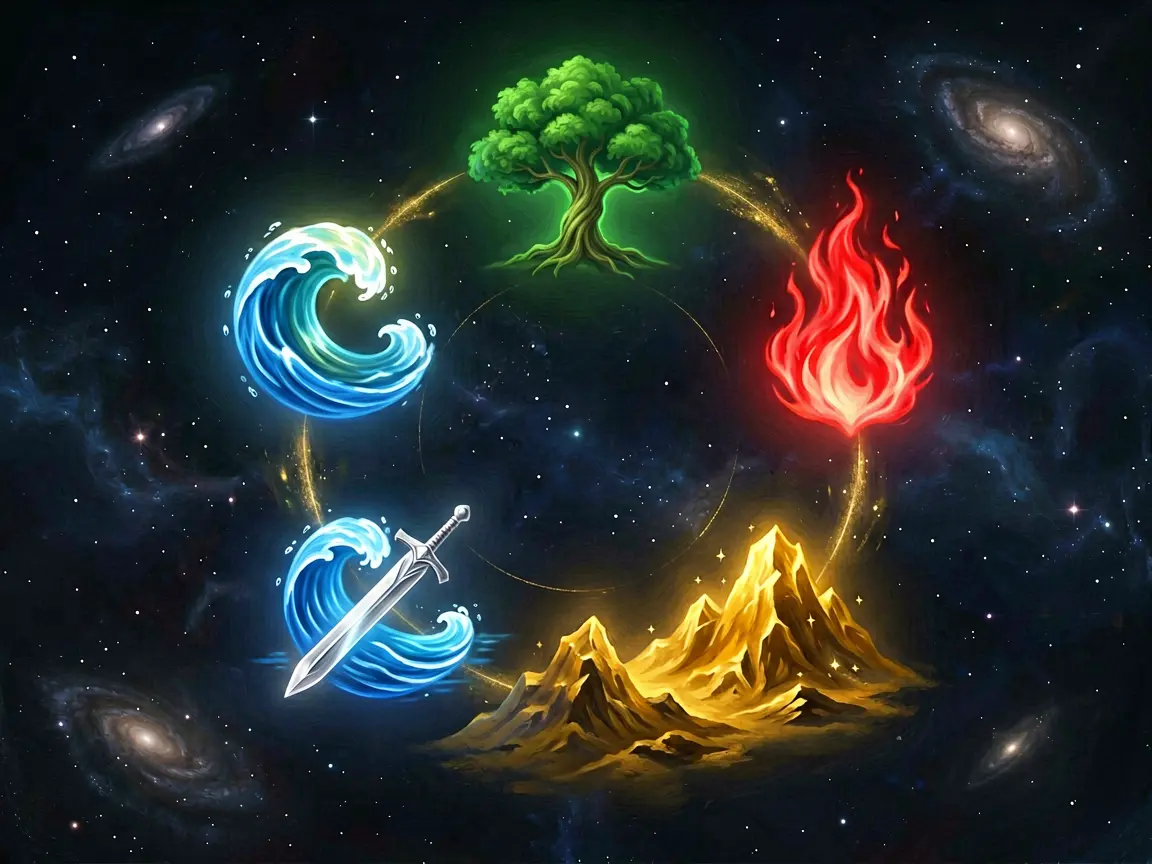
"The BaZi five elements are Wood, Fire, Earth, Metal, and Water, the five phases of energy known as Wu Xing (五行). Every Heavenly Stem and Earthly Branch in a Four Pillars chart carries one element, so each chart holds all five at once, moving together like a weather system of gifts and shadows."
BaZi Five Elements: The Five Energy Archetypes Inside Your Chart
A client came to me holding a printout of her chart and asked the question I hear most: "Which element am I?" She wanted one word. Fire, maybe, or Metal, something she could wear like a zodiac sign. I asked her to look again. The chart in her hands did not contain one element. It contained all five.
That is the part most introductions to BaZi skip. The five elements are not a menu you order a personality from. They are a weather system running through every pillar of your chart, and the real reading lives in how the five of them move together inside you.
BaZi five elements is a system of Chinese metaphysics, known in Chinese as Wu Xing (五行), that assigns every Heavenly Stem and Earthly Branch to one of five phases of energy, Wood, Fire, Earth, Metal, and Water, and uses their generating and controlling cycles to describe how a person's psychic energy flows through life. The doctrine was systematized in the Warring States period, around the 3rd century BCE, by thinkers such as Zou Yan, and BaZi inherited it wholesale. Wuxing is a good place to start reading about its history.
The Five Archetypes
In my practice I treat the five elements the way Jung treated the archetypes: as inherited patterns of energy that shape how we perceive and act. Each one carries a gift, a traditional image, and a shadow pole. The shadow is the part the gift represses, and it always comes due.
Wood: Expansion
Wood is spring, the push of new growth. Its traditional images are the tall tree and the vine, the pioneer and the weaver. Wood people begin things, carry projects, and believe in possibility. The shadow of Wood is structure. A Wood-dominant client will describe a dozen open projects and zero finished ones. The tall tree refuses to prune itself, and growth becomes an avoidance of completion. The remedy I offer is simple: pruning is how the tree becomes a beam.
Fire: Radiance
Fire is summer, the peak of visibility. The sun and the lamp in the window are its images. Fire people light rooms, speak in public, and make things happen through sheer warmth. The shadow of Fire is self-containment. Fire represses the quiet holding that Earth and Water carry, and it pays for that repression every night. I have watched Fire clients give everything to a stage and collapse the moment the lights go down. The flame that warms everyone else burns its own fuel first.
Earth: Grounding
Earth is the pivot of the year, the season of harvest and holding. Its images are the mountain and the field. Earth people are the ones marriages and teams lean on: steady, loyal, unshakeable. The shadow of Earth is change. Earth represses the letting-go that Wood and Metal demand, so the mountain holds the ground even when the ground itself is shifting. The Earth client I think of most stayed in a failing partnership for two years because leaving felt like betrayal. Her loyalty was real. It was also a wall.
Metal: Structure
Metal is autumn, contraction, refinement. The axe and the polished jewel are its images. Metal people bring order, precision, and clean boundaries, and they are usually right about the details everyone else missed. The shadow of Metal is warmth. Metal represses the connective, feeling pole of the cycle, the tenderness that Wood and Fire carry. The axe is magnificent. The axe is also lonely.
Water: Depth
Water is winter, the reservoir of the year. The ocean and the rain on still water are its images. Water people read rooms like novels, hold the history of a family or a company in their heads, and think in layers. The shadow of Water is momentum. Water represses the forward push that Wood and Fire carry, and so the deep thinker stalls inside the decision. A Gui Water client of mine spent two years describing exactly what her job was doing to her. She never once asked for the raise.
The Two Cycles: An Inner Ecology
The elements do not sit side by side. They move. The generating cycle runs Wood to Fire to Earth to Metal to Water and back to Wood, each phase feeding the next. The controlling cycle runs across it: Wood parts Earth, Earth dams Water, Water quenches Fire, Fire melts Metal, Metal chops Wood. Wuxing covers both in detail.
Read these as internal dynamics and they become a map of how your psyche regulates itself. The generating cycle is nourishment: the things that feed your dominant element and keep it alive. The controlling cycle is the check: the tension that stops any one element from running the whole system. A chart is a healthy ecology, not a hierarchy. When one element runs unchecked, the person runs on one note, and the other four start speaking through symptoms.
Reading Your Elemental Mix
Every pillar of your Four Pillars chart carries an element, in its stem and in its branch, so a full chart shows eight elemental positions. Some charts hold a great deal of one element and very little of another. Some are missing an element entirely, and absence is never nothing. The missing element is often where the person projects: the quality they can see clearly in other people and cannot recognize in themselves. That is the shadow, written on the chart as a blank space.
Strength matters as much as presence. An element born in its own season, Wood in spring, Metal in autumn, is strong and can carry the chart. The same element born in its opposing season sits weaker and leans on the others. BaZi reads this with the same sixty-step sexagenary cycle, ten Heavenly Stems paired with twelve Earthly Branches, that the Chinese calendar has used to mark days continuously for more than two thousand years. The system took its modern form in the Song dynasty, and it is still often called the Ziping method after the scholar Xu Ziping, who codified it in the 10th century. BaZi has a solid overview of the whole framework.
The Mirror, Not the Verdict
Jung wrote something that could serve as a mission statement for the whole system. In his introduction to the Wilhelm translation of the I Ching he said the book is "one long admonition to careful scrutiny of one's own character, attitude, and motives." The same is true of the five elements. A reading that tells you "you are Fire, so you burn hot" has dressed your chart in a costume and called it fate. A reading that tells you "you lead with Fire and your shadow is the quiet you keep outsourcing" hands you the work. In Psychological Types (1921) Jung described how "the dominant function characterizes consciousness, while its opposite is repressed and characterizes the unconscious." Carl Jung could have been describing the element cycle. The element you lead with is your consciousness. The one you avoid is your unconscious, and it will keep knocking.
An Exercise: Your Elemental Inventory
Here is what I do with clients at the end of a five elements session. Take a sheet of paper and draw five circles, one for each element. Fill each circle with the areas of your life where that element actually shows up, not where you wish it did. Most people find two or three circles full and two nearly empty. The empty ones are the reading.
Journal prompt: "Which element do I avoid, and where in my life does it keep arriving anyway?" Sit with it the way you would sit with a dream. The element you refuse is not your enemy. It is the part of you that has been trying to get a word in.
BaZi does not promise a fixed future. It names the pattern you keep returning to, and naming the pattern is the first step of individuation, the lifelong work of becoming the person you actually are rather than the mask you were handed.
This article is offered for spiritual guidance and entertainment purposes only. It is not a substitute for medical, legal, or financial advice.
Curious what YOUR chart reveals?
Cast your free BaZi chart and see your Day Master, elemental balance and life patterns through a Jungian lens.
Get Your Free BaZi ChartFree · No sign-up needed
Frequently Asked Questions
What are the five elements in BaZi?▼
How do I find my five elements in my BaZi chart?▼
Which BaZi element is the most powerful?▼
Can my five elements change?▼
Recommended Reading
BaZi
Monkey in Chinese Astrology: The Ninth Branch, the Spirit in the Metal, and the Shadow of the Shortcut
BaZi
Horse in Chinese Astrology: The Seventh Branch, the Fire at Full Gallop, and the Shadow of the Burn
BaZi
Snake in Chinese Astrology: The Sixth Branch, the Metal Born in Fire, and the Shadow of the Favor
BaZi
Dragon in Chinese Astrology: The Fifth Branch, the Water Vault, and the Shadow of Overfill