
What Is BaZi Astrology? The Four Pillars as a Map of the Psyche
Curious what YOUR chart reveals?
Cast your free BaZi chart and see your Day Master, elemental balance and life patterns through a Jungian lens.
Get Your Free BaZi ChartFree · No sign-up needed
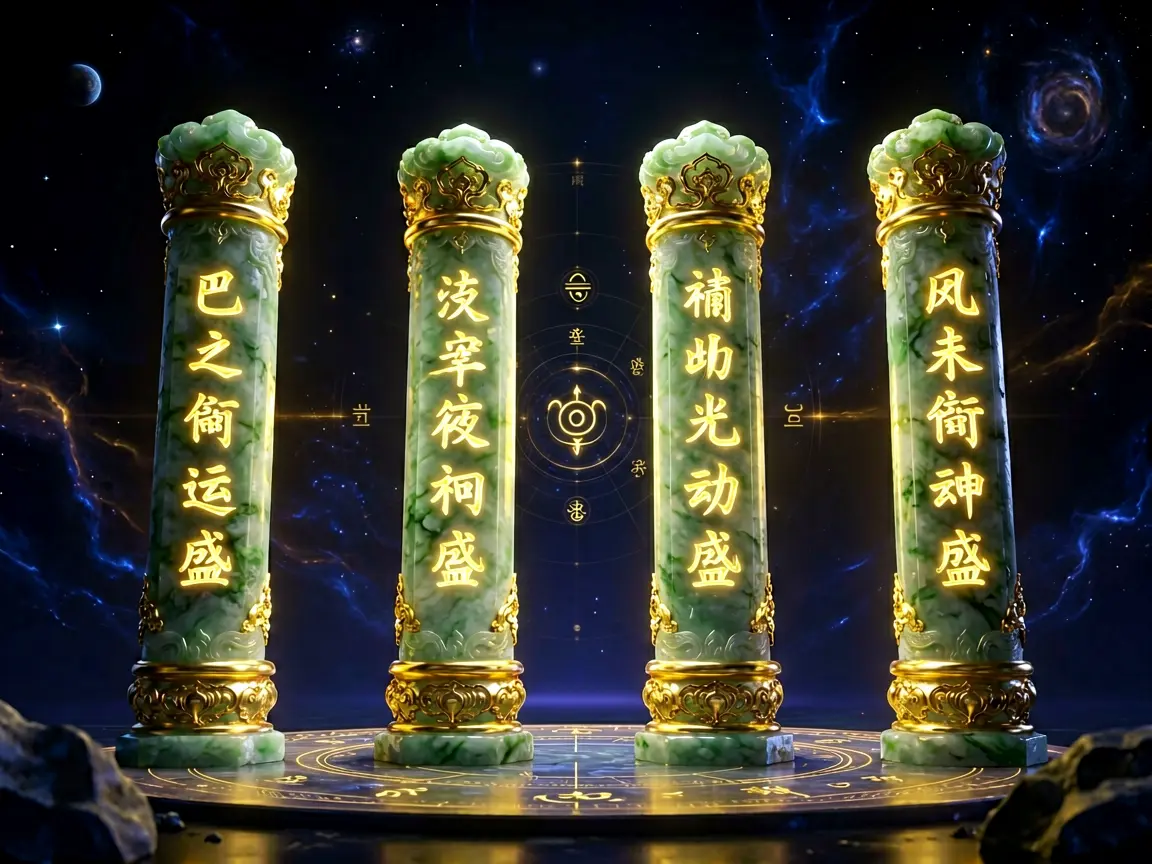
A client once held up her chart and asked me the question I hear in some form every month: "I finally learned my sun sign, my moon sign, my rising sign. Now you hand me wood, fire, and a day master. Is this even astrology?"
Yes, though not the astrology she grew up with. Western astrology draws a wheel of planets against the sky. BaZi draws four columns of Chinese characters, eight symbols total, and reads the calendar instead of the sky. Nothing moves, nothing predicts, and yet the system has been in continuous use for over a thousand years across the Chinese-speaking world.
BaZi astrology is a Chinese calendrical system, often called the Four Pillars of Destiny, that translates your birth year, month, day, and hour into four pillars of Heavenly Stems and Earthly Branches, using the Five Elements to describe how your psychic energy moves through time. Where Western astrology asks where the planets were when you were born, BaZi asks what the calendar was made of. Four Pillars of Destiny has a thorough overview of the whole framework.
Four Columns, Eight Symbols
Every chart is built from four pillars: year, month, day, hour. Each pillar stacks two symbols, a Heavenly Stem over an Earthly Branch. Ten stems paired with twelve branches produce the sixty combinations of the sexagenary cycle, the same cycle the Chinese calendar has used to mark days continuously for more than two thousand years. Sexagenary cycle explains the mechanics.
The method took its modern form in the Song dynasty. Scholars credit Xu Ziping, a tenth-century master whose name still survives in the traditional title, the Ziping method. The pillar that matters most is the day master, the stem of the day pillar, the "I" at the center of the chart that everything else exists to describe.
The year pillar holds ancestry and early environment. The month pillar carries career and the social self. The hour pillar describes the inner world and the later years. None of them is a verdict. They are context, the weather the day master moves through.
The Day Master Is the Engine, Not a Badge
Here is where the reading starts to bite. In my fifteen years of reading charts, the most common mistake is treating the day master like a sun sign, a label to wear. The day master is the engine you actually run on.
In Psychological Types (1921) Jung wrote that "the dominant function characterizes consciousness, while its opposite is repressed and characterizes the unconscious." Carl Jung was describing his personality types. He could have been describing a chart. The day master names the dominant function. The elements missing from the chart name what got repressed, and repression always comes due.
A Geng Metal client of mine leads with structure. Clean decisions, sharp boundaries, zero tolerance for vagueness. The metal in him was immaculate. The warmth he kept repressing surfaced as a marriage he managed like a quarterly report, perfectly organized and quietly starving. The axe is magnificent. The axe is also lonely.
Season shapes the same stem twice over. A Geng Metal born in autumn sits in his own season, solid, able to carry the chart. Born in spring, the same metal works against the season and leans on the other elements, and he may internalize every friction as a personal fault. I have read charts for two men born the same day, same hour, one in Oslo and one in Singapore, and watched the same metal express itself as entirely different lives. Same engine, different weather.
I tell clients to stop asking what the chart says they are. Ask instead what you lead with, and what you keep avoiding. Jung called the lifelong work of meeting both individuation, and he described its aim in Two Essays on Analytical Psychology as "to divest the self of the false wrappings of the persona." A BaZi reading, done properly, is that divestment in miniature.
The Five Elements Are Psychic Energy
Jung rebuilt the old idea of libido into something broader: psychic energy in general, of which sexual desire is only one expression. He insisted this energy "expresses itself only through symbols." Libido summarizes the argument. The five elements are symbols of exactly this kind. Wood is the push to grow, Fire the need to shine, Earth the drive to hold. Metal wants order. Water pulls toward depth. A chart is an inventory of how your energy moves and where it gets stuck.
The elements do not sit still. The generating cycle runs Wood to Fire to Earth to Metal to Water and back to Wood, each phase feeding the next. The controlling cycle cuts across it with five checks. Wood parts Earth, Earth dams Water, Water quenches Fire, Fire melts Metal, Metal chops Wood. Wuxing covers both cycles in detail. Read as an inner ecology, the two cycles describe how the psyche regulates itself: the nourishment that keeps your leading element alive and the tension that stops it from running the whole system.
What the Chart Holds
Jung wrote, in his introduction to the Wilhelm translation of the I Ching, that the book amounts to "one long admonition to careful scrutiny of one's own character, attitude, and motives." I Ching is worth reading for that introduction alone. He could have written the same sentence about the Four Pillars. A chart contains tendencies, not events: patterns you keep returning to, elements you keep outsourcing, the season of life you are moving through right now.
Two details most introductions skip. The hour pillar depends on true solar time, so I always ask clients for their birth city, never just the time on the certificate. And a full chart holds more than the four stems: the ten gods map how the elements interact, and the ten-year luck cycles show which elements get supported at forty that were starved at twenty. The same mix lives differently across a lifetime.
No client has ever grown by asking me what will happen to her. The ones who grow ask what they are avoiding. That single question turns a reading into a mirror.
An Exercise: Interview Your Missing Element
Here is what I do at the end of a BaZi session. Look at your chart and find the element that appears least, or not at all. Journal on one question: "Where does this element keep arriving in my life anyway, and what is it trying to tell me?"
A client with almost no Fire in her chart kept taking jobs that demanded constant visibility and kept hating them. Fire was never missing from her life. It kept showing up in the least useful places, as exposure without warmth. Naming that did more in one session than a year of generic horoscopes had done for her.
BaZi astrology promises no fixed future. Naming the pattern you keep returning to is where individuation starts: the work of becoming the person you actually are rather than the mask you were handed.
This article is offered for spiritual guidance and entertainment purposes only. It is not a substitute for medical, legal, or financial advice.
Curious what YOUR chart reveals?
Cast your free BaZi chart and see your Day Master, elemental balance and life patterns through a Jungian lens.
Get Your Free BaZi ChartFree · No sign-up needed
Frequently Asked Questions
What is BaZi astrology?▼
Is BaZi astrology the same as Western astrology?▼
How do I find my BaZi day master?▼
Is BaZi fortune-telling?▼
Can I use BaZi with Western astrology and tarot?▼
Recommended Reading
BaZi
The Five Combinations of the Heavenly Stems in BaZi: When a Bond Changes What You Are
BaZi
The Six Harms in BaZi: The Pairs That Wound Through the Harmony
BaZi
The Three Punishments in BaZi: The Triads That Injure What They Generate
BaZi
The Four Vaults in BaZi: Where the Elements Are Stored, and the Shadow of What We Keep