Your Natal Chart: The Blueprint of Your Psyche — A Jungian Guide to Birth Chart Astrology
Discover your cosmic blueprint
Cast your natal chart and explore the symbolic patterns that shape your personality and life journey.
Get Your Free Natal ChartFree · No sign-up needed
A natal chart is a symbolic map of the sky at the exact moment of your birth, read as a blueprint of the psyche rather than a prophecy of fate. Through Jungian analytical psychology, it becomes a mandala of the Self, revealing your conscious identity, your shadow, your persona, and your lifelong path toward individuation.
> "The stars do not compel, they incline; they do not dictate, they counsel." — Paracelsus
The first time you see a natal chart, it looks like a code. Circles and glyphs and lines radiating from a center point. It is easy to mistake it for a fortune telling device. A cosmic lottery ticket. A script someone handed you at birth with your whole life written on it.
That is the popular misunderstanding. And it keeps the real power hidden.
Your natal chart is a psychological archetype map. A symbolic snapshot of the sky at your first breath, translated into the language of the psyche. Through Jungian analytical psychology, it becomes a mirror for the soul's journey toward individuation.
The Natal Chart as a Mandala of the Self
Jung spent decades studying mandalas. Circular diagrams used in Eastern spiritual traditions as tools for meditation and self realization. He noticed that his patients spontaneously drew mandala like images during periods of deep psychological development. For Jung, the mandala was a symbol of the Self. The totality of the psyche. The organizing principle that strives to integrate all parts of who we are.
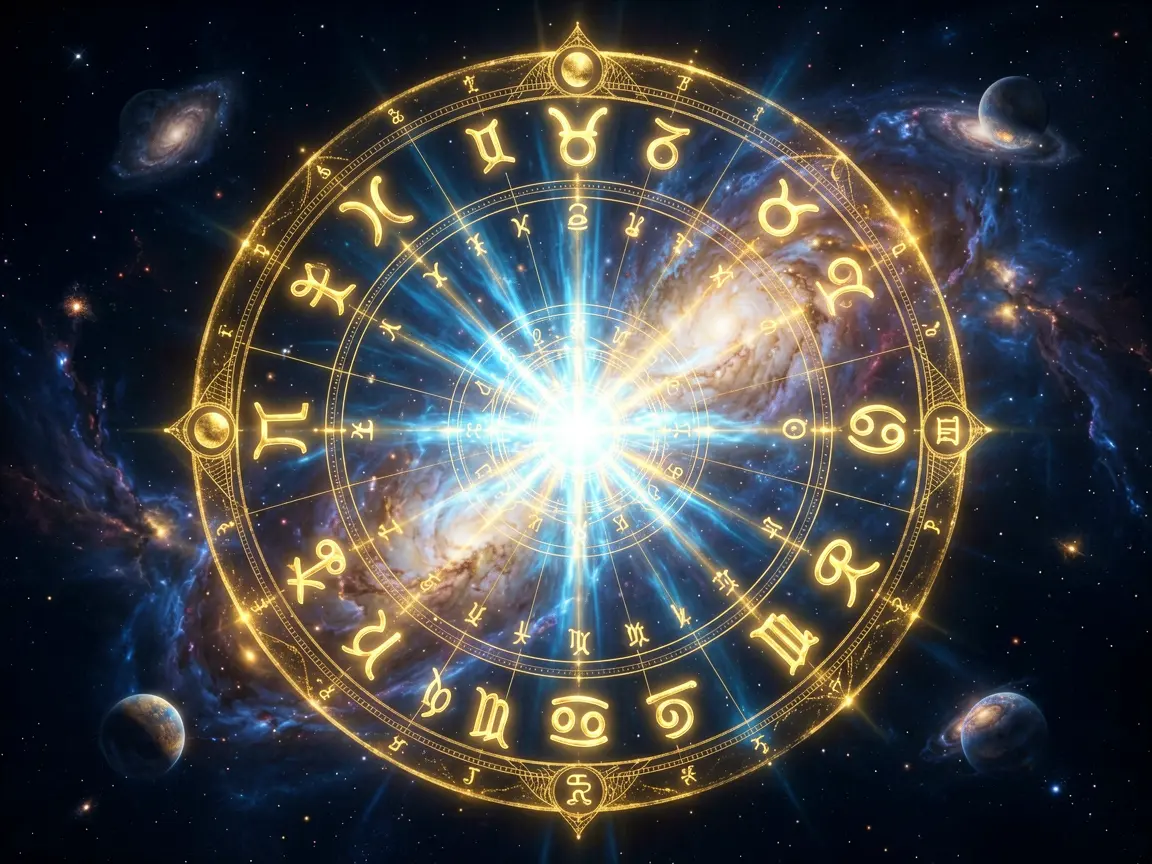
The natal chart is, quite literally, a mandala.
At its center is the Earth, or the person in the Hellenistic tradition. Around it, arranged in a perfect circle, are the celestial bodies. Sun, Moon, planets, and the horizon axes. Each occupies a specific zodiac sign and house. The chart is divided into twelve segments, governing different domains of human experience.
When you look at your birth chart, you are looking at the structure of your psyche. The innate configuration of archetypal energies you were born with, the raw material your personality, your gifts, your wounds, and your calling are formed from.
The Sun and Moon: The Self and the Shadow
In Jungian astrology, every planet corresponds to an archetypal principle. The two most significant are the Sun and the Moon. Together they tell the story of your fundamental psychological tension.
The Sun represents the archetype of the Self. Your conscious identity, your ego ideal, the direction of your individuation. Its sign and house placement describe the shape your consciousness is trying to grow into. Your Sun sign is who you are becoming.
The Moon represents the personal Shadow. The unconscious, instinctual landscape your conscious ego was built around. Your Moon sign describes how you actually feel beneath the mask of who you think you should be. It holds ancient memories, unmet needs, and raw reactions.
When a person says "I feel like two different people inside," they are describing the friction between their Sun and Moon. Jung would call this the ego shadow axis, the essential tension that drives all psychological growth.
The Ascendant as the Persona
Your rising sign corresponds to what Jung called the Persona. The zodiac degree rising on the eastern horizon at your birth.
The Persona is the mask you wear in social life. It is necessary. Without it you would have no way to mediate between your inner world and the expectations of the collective. The Ascendant describes the archetypal costume your psyche chose for navigating the outer world. The first impression you make, the defensive style you default to, the social energy that feels most natural.
But the Persona has a shadow of its own. When you over identify with your Ascendant, when you become the mask, you lose touch with the deeper layers of your psyche. An Aries rising who only charges forward without ever pausing to feel. A Libra rising who smoothes every conflict without revealing their own anger. The natal chart shows both the persona and the path beyond it.
The Outer Planets as Collective Unconscious Forces
Saturn, Uranus, Neptune, and Pluto move slowly. Their archetypal energies are transpersonal. Jung would recognize them as expressions of the Collective Unconscious, the deep layer of the psyche shared by all humanity.
Saturn represents the archetype of the Senex. The wise elder, the boundary maker, the law giver. In your chart, it shows where you will encounter limitation, discipline, and the slow work of mastery. Your Saturn return, around age 29, is the moment when the archetype of maturity knocks on your door and asks you to grow up.
Uranus is the archetype of disruption, revolution, and sudden awakening. It breaks the patterns that have become prisons. Its transits can feel like chaos, but they are the psyche's way of freeing itself from outdated structures.
Neptune is the archetype of the Mystical. Dissolution, transcendence, the longing for union with something greater. Its shadow is illusion, addiction, and escape. Its gift is compassion, imagination, and spiritual depth.
Pluto is the deepest layer. The archetype of Death and Rebirth. Pluto in your chart shows where you will be psychologically destroyed and remade. The force that strips away everything that is not authentically yours.
The Houses as the Stages of Life's Drama
If the planets are the actors and the signs are their costumes, the houses are the stages on which the drama unfolds. Each of the twelve houses represents a domain of human experience. Identity, resources, communication, home, creativity, work, relationships, transformation, philosophy, career, community, and the unconscious.
Your natal chart is an integrated system. A living ecosystem of psychological forces that interact, tension, and support each other. Pluto in the 4th house means your journey toward individuation will pass through the transformation of your relationship with your roots, your ancestry, and your inner foundation.
A Shadow Work Exercise with Your Natal Chart
The natal chart is a powerful tool for shadow integration. Try this journaling practice at home.
Find the sign and house of your Moon. Write down the first three adjectives that come to mind for that sign. For a Moon in Capricorn, you might write "controlled," "responsible," "reserved."
Now ask yourself: what was not allowed for this Moon? What emotions, needs, or expressions were discouraged by your family or culture? Write down the suppressed qualities. For Capricorn Moon: "vulnerability," "play," "open neediness."
Find the sign of your Descendant, opposite your Ascendant. This is the archetype of the Anima or Animus, the unconscious qualities you project onto others, especially in relationships. Write down what you are drawn to in others that you do not yet own in yourself.
For one week, practice embodying one of these projected qualities intentionally, in a safe context. Journal about what arises.
This is active imagination with the symbolic map of your psyche.
The Natal Chart as a Compass, Not a Script
The most transformative insight Jungian astrology offers is this: your natal chart is your starting point. It tells you what you are working with.
The houses show the arenas of your growth. The aspects, the angular relationships between planets, show the points of tension and flow in your psychological structure. The transits, the movement of current planets against your natal chart, show the timing of psychological opportunities. A Saturn transit is the psyche's call to consolidate. A Jupiter transit is an opening for expansion that still requires conscious choice.
Jung once wrote, "The meeting of two personalities is like the contact of two chemical substances: if there is any reaction, both are transformed." The same is true of the meeting between your conscious ego and the archetypal energies of your natal chart. When you engage your birth chart as a psychological map, it becomes a compass for the journey toward your own wholeness.
Your birth chart is a mandala. And a mandala's purpose is to show you the shape of your own soul.
Frequently Asked Questions
Is my natal chart a prediction of my future? No. It maps innate psychological potentials, not a fixed script. How you engage those energies is a matter of conscious choice.
Can astrology be reconciled with psychology? Yes. Carl Jung himself used the natal chart as a diagnostic tool. He found that archetypal patterns in the sky corresponded with patterns in the psyche, forming the foundation of Jungian astrology.
What does it mean if I don't relate to my Sun sign? Your Sun sign describes the direction of your individuation, not your current personality. You may still be growing toward it. Or your chart has other dominant factors, a strong Moon or a prominent Ascendant, that shape your personality more immediately.
Is the natal chart a form of fortune-telling? Only if read that way. Through a Jungian lens, it is a symbolic language for self-inquiry.
How often should I look at my chart? As often as you look in a mirror. Not to check your fate, but to see who is looking back. Most valuable during major transits, life transitions, or periods of psychological confusion.
Discover your cosmic blueprint
Cast your natal chart and explore the symbolic patterns that shape your personality and life journey.
Get Your Free Natal ChartFree · No sign-up needed
Recommended Reading
Astrology
Weekly Zodiac & Horoscope Forecast October 12 - 18, 2026: Pluto Turns Direct
Astrology
Weekly Zodiac & Horoscope Forecast October 5 - 11, 2026: The Libra New Moon
Astrology
Weekly Zodiac & Horoscope Forecast September 28 - October 4, 2026
Astrology
Astrology Compatibility Birth Chart: How to Read Two Charts Side by Side