
BaZi vs Astrology: Two Maps of the Psyche — A Jungian Comparison
Curious what YOUR chart reveals?
Cast your free BaZi chart and see your Day Master, elemental balance and life patterns through a Jungian lens.
Get Your Free BaZi ChartFree · No sign-up needed
Suggested definition (place directly under the H1, before the client anecdote):
> BaZi and Western astrology are two symbolic systems that map the same psyche from different directions. Astrology reads the sky at your birth and draws the fixed architecture of your personality. BaZi reads the elemental calendar and tracks the seasons moving through your life. Together, read through a Jungian lens, they form one map of the Self.
(57 words, quotable, snippet-ready)
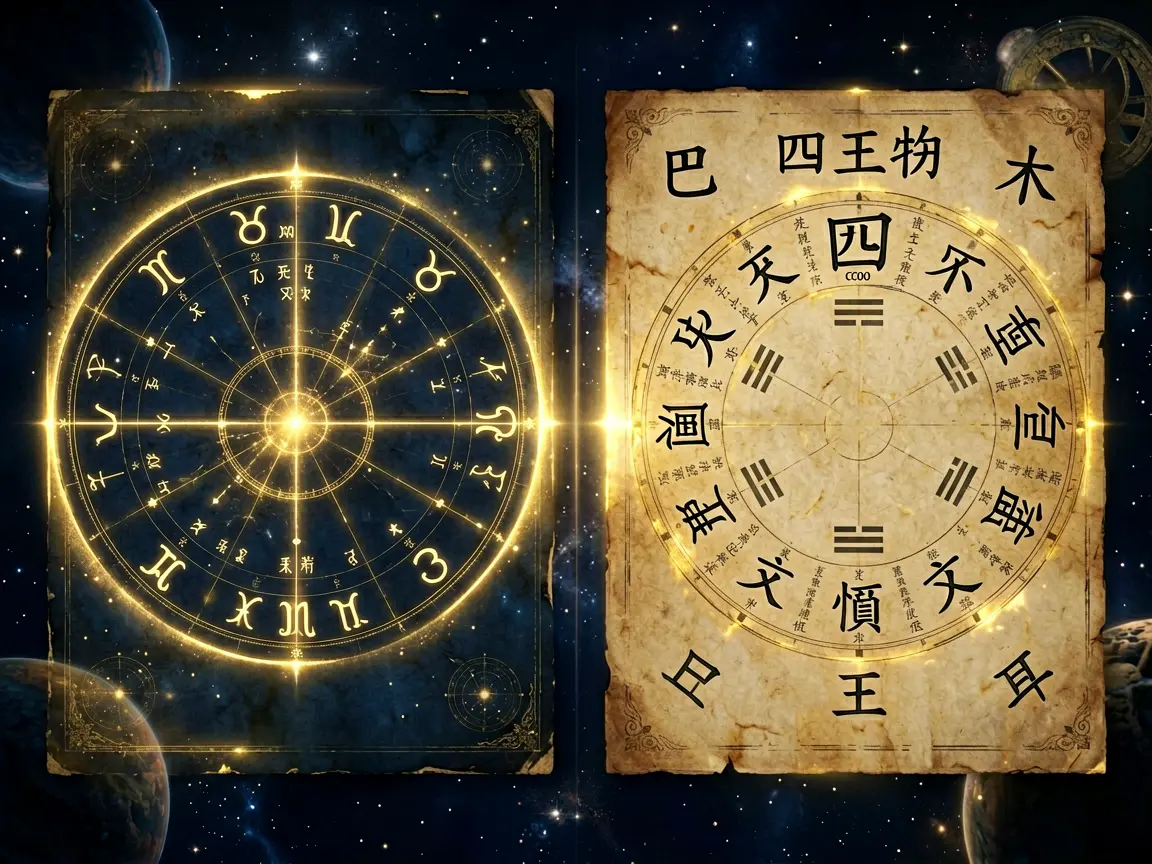
BaZi vs Astrology: Two Maps of the Psyche
A client once laid two printouts on my table. On the left, her Western natal chart, a wheel of glyphs and houses. On the right, her BaZi chart, four columns of Chinese characters. "These can't both be true," she said. "They say different things about me."
I hear this almost every week. People assume one system must be right and the other wrong. After fifteen years of reading both, I see it differently. They are two maps of the same territory, drawn in different languages, for different travelers. Jung would have understood immediately. He spent his life insisting that the psyche has more than one face, and that no single symbol system could capture it all.
Two Maps, One Psyche
What does each map actually measure? Western astrology begins with a moment: the exact position of the sky at your first breath. It treats that frozen frame as a portrait of your psyche. The planets become archetypal forces, the houses become the rooms of your inner life, the aspects become the conversations between those forces. The result is a rich still life of who you are.
BaZi begins with a different question. Instead of freezing a moment, it reads the elemental weather of your birth and the way that weather moves through time. Your chart is built from the Five Elements (Wood, Fire, Earth, Metal, Water) arranged across four pillars. It skips the frozen portrait. It asks what season you were born into, and which seasons are coming.
Both are maps of the Self. The difference is in what they choose to draw.
Astrology Draws the Architecture, BaZi Draws the Weather
I often tell clients to think of astrology as the architecture of the psyche and BaZi as its climate. The architecture is stable. Your Sun sign, your Moon, your rising sign, the fixed angles of your chart, these describe the rooms you live in, the load-bearing walls, the windows facing south. Jung called this the archetypal structure. It does not change.
The climate changes constantly. BaZi tracks the elemental currents that move through the architecture year by year, decade by decade. A Fire year heats the house. A Water year floods the basement. The walls stay the same, but how you experience living inside them shifts with the seasons.
This is why the two systems can appear to contradict each other. A client with a strong Saturn might feel heavy and bound in an Earth year, then light and free when a Wood year arrives. The architecture did not change. The weather did. Both readings were true.
The Day Master and the Sun: Two Centers of Gravity
In my practice I have found the most useful comparison is the Sun sign and the Day Master. Your Sun sign describes the ego's self-image, the identity you perform, the persona you present to the world. Jung would recognize it as the conscious center, the "I" you know yourself to be.
The Day Master is something deeper. It is the ruling element of your birth day, and in BaZi it represents the core energy of the whole chart, closer to what Jung called the Self. The ego is the sun you think you are. The Day Master is the element you actually run on. When the two are in harmony, life feels effortless. When they pull apart, you feel the split between your persona and your vitality.
I remember a client with a Leo Sun, warm and theatrical, who consulted me because she kept collapsing at the end of every social season. Her Day Master was weak Water. She was performing fire on empty fuel. Once we saw the chart this way, she stopped forcing the Leo act and started building a life that let her Water replenish. Her Sun sign was never wrong. It was just incomplete without the element underneath.
Ten Gods and Planets: Two Casts of Archetypes
Jung's greatest gift to psychology was the idea of archetypes, universal figures that shape human experience across every culture. Both systems work with archetypes, but they cast them differently.
Western astrology uses planetary archetypes. Mars is the Warrior, Venus is the Lover, Saturn is the Old King, the Moon is the Mother. These are mythic figures with long cultural histories, and your chart shows which ones sit in the foreground of your psyche and which ones work in the shadows.
BaZi uses the Ten Gods, ten relational archetypes built from the Five Elements. The Resource is the nurturing parent. The Output is the child who expresses. The Wealth is the beloved or the harvest. The Officer is the authority, the law, the discipline. The Companion is the sibling, the peer, the equal. Where astrology hands you gods, BaZi hands you a family. Both are projections of the collective unconscious. Neither is more real. They are two dialects of the same inner language.
The Zodiac Wheel and the Five Elements: Circle and Cycle
There is one structural difference I want to name plainly. The zodiac is a circle, a static symbol of wholeness. The Five Elements are a cycle, a dynamic symbol of transformation. A circle says: everything is present, all at once, forever. A cycle says: everything moves, consumes, and becomes something else.
Wood feeds Fire. Fire creates Earth. Earth bears Metal. Metal gathers Water. Water nourishes Wood. Nothing in BaZi sits still, because the psyche does not sit still. Jung wrote that individuation has no finish line. It is a lifelong process of becoming. The Five Elements encode that process. The zodiac encodes the whole at a single glance.
This is why I reach for astrology when a client needs to see the shape of their wholeness, and for BaZi when they need to understand the phase they are passing through. The question determines the tool.
A Shadow Work Practice for Both Maps
Here is an exercise I give clients who work with both systems. Take your Sun sign and write down the traits you claim proudly. Then take your Day Master element and write down the traits of that element you find hardest to express. The gap between the two lists is a map of your shadow.
One client, a Capricorn Sun with a strong Fire Day Master, had built a life on restraint and achievement. Her shadow work was Fire: pleasure, spontaneity, healthy anger. For a month she practiced one small act of Fire a day, a dance break at noon, a blunt sentence delivered to a coworker, a walk without a destination. Her chart did not change. Her experience of living in it transformed completely.
The Two Maps Are Meant to Be Read Together
I will end where I started, with the client and her two printouts. We spent the session learning to read the conversation between them instead of choosing. Her astrology showed her who she was becoming. Her BaZi showed her when the currents would carry her and when they would demand she swim. She left with both charts, and both charts were true.
The psyche is too large for one language. Jung knew this. That is why he studied astrology, the I Ching, alchemy, and the mandalas of the East, refusing to let any single tradition own the truth. You can do the same with your two charts. Let astrology show you the architecture. Let BaZi show you the weather. Then live inside both.
Frequently Asked Questions
Which is more accurate, BaZi or Western astrology? In my experience accuracy depends on the question you ask. Astrology describes the archetypal structure of your psyche with extraordinary depth. BaZi describes the elemental timing of your life with equal precision. Ask each the question it was built for, and both answer clearly. Ask the wrong question, and both confuse you.
Can I use BaZi and astrology together? Yes, and I encourage it. The two systems complement each other. In my sessions I use astrology to map the architecture of a client's psyche, then use BaZi to see which elemental season they are moving through. The two readings together give a fuller picture than either one alone.
Is BaZi just Chinese astrology? It is related but distinct. Western astrology and BaZi both use birth data and both speak in symbols, but they answer different questions. Astrology reads the positions of planets. BaZi reads the elemental composition of the birth hour. One is astronomical, the other is calendrical. Both map the psyche, from different directions.
What does the Day Master mean in BaZi? The Day Master is the element of the day pillar, the core of the entire chart. I describe it to clients as the fuel your psyche runs on. It is the closest thing BaZi has to the Jungian Self, the deeper center beneath the ego. Your Sun sign is who you think you are. Your Day Master is the energy you actually live on.
Curious what YOUR chart reveals?
Cast your free BaZi chart and see your Day Master, elemental balance and life patterns through a Jungian lens.
Get Your Free BaZi ChartFree · No sign-up needed