
BaZi Love Compatibility: The Archetypal Chemistry of the Four Pillars
Curious what YOUR chart reveals?
Cast your free BaZi chart and see your Day Master, elemental balance and life patterns through a Jungian lens.
Get Your Free BaZi ChartFree · No sign-up needed
BaZi love compatibility is the practice of comparing two people's Four Pillars birth charts to reveal how their Five Element energies interact. Rather than predicting a destined match, this Jungian-informed approach maps the archetypal chemistry between two psyches: where elements attract, where they create friction, and where they invite mutual growth.
(51 words. Place at the top of the article, before the Jung quotation, so AI-search engines extract it as the opening definition.)
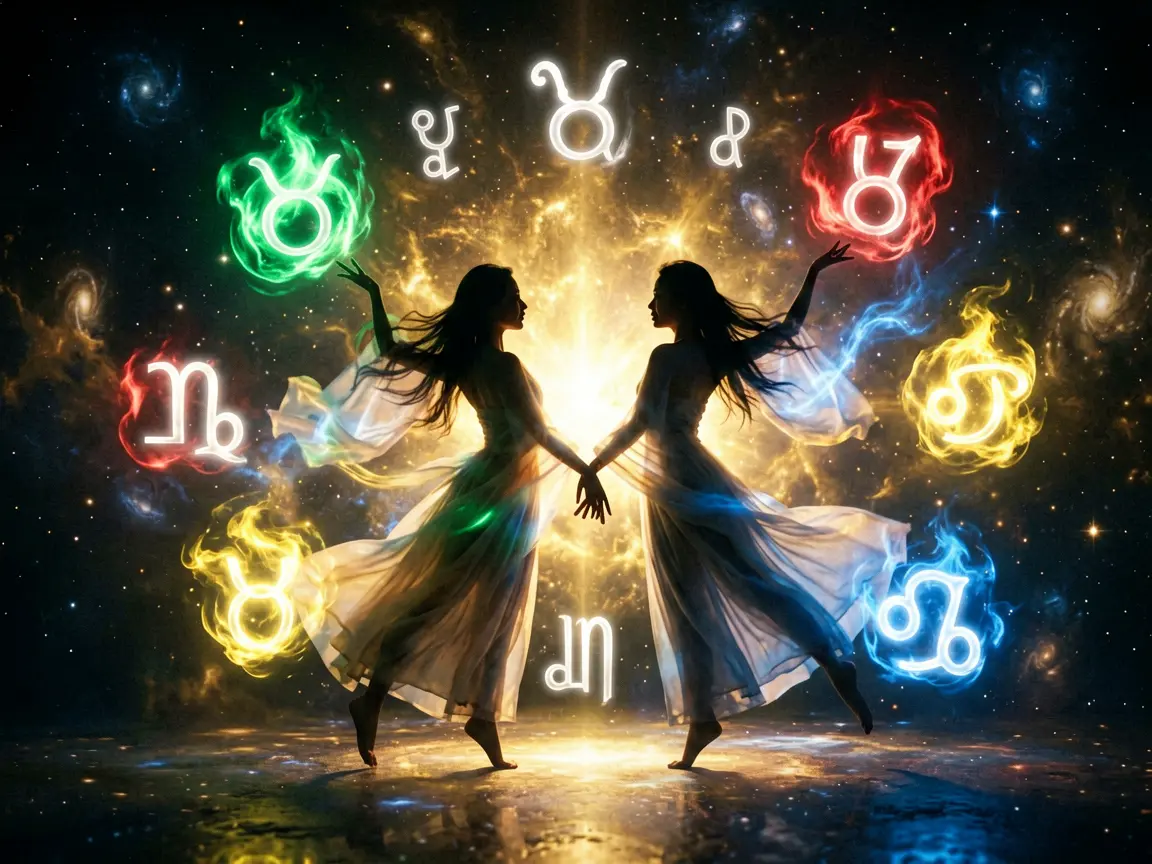
> "The meeting of two personalities is like the contact of two chemical substances: if there is any reaction, both are transformed." — C.G. Jung
You meet someone. There's a spark — electric, undeniable. You can't quite explain it. Your rational mind lists all the reasons it shouldn't work, yet something deeper keeps pulling you together. Or perhaps the opposite: everything looks perfect on paper, but the connection feels hollow, like two ships passing in the night.
What if the attraction and friction you feel in relationships are not random, but reflect a deeper archetypal chemistry — a dance of elemental energies that Jung himself would recognize as the psyche's attempt at wholeness?
BaZi, the Four Pillars of Destiny, offers a remarkably precise map of this invisible choreography. But here is the crucial distinction: BaZi love compatibility is not a fortune-telling system that tells you whether someone is your "soulmate" or "destined partner." It is a psychological tool — a blueprint of the elemental dynamics that unconsciously play out between two people. And in that sense, it may be the most sophisticated relationship psychology the ancient world ever produced.
Beyond "Do We Match?": The Jungian Reframe
The way most people approach love compatibility — in any system — is fundamentally flawed. They ask: Are we compatible? Will this work? Are we meant to be?
These are fortune-telling questions. They treat relationships as static destinies rather than dynamic, evolving encounters between two individuating psyches.
From a Jungian perspective, every significant relationship is an encounter between two unconscious systems. What you experience as "chemistry" is the interaction of archetypal energies. What you experience as "conflict" is often the friction between two different ways of being in the world — each with its own wisdom, each with its own blind spot.
BaZi does not tell you whether a relationship will "work." It reveals the nature of the chemistry between two people — the specific elements that attract, the specific elements that chafe, and most importantly, the specific elements that call each partner toward growth.
The Five Elements as Relationship Archetypes
In BaZi, your birth chart is composed of five elemental energies: Wood, Fire, Earth, Metal, and Water. Each element is not a physical substance but an archetypal quality — a fundamental pattern of being that shapes how you think, feel, love, and conflict.
Think of them as the basic psychological types of the collective unconscious, expressed through the lens of Chinese cosmology:
Wood (Tree) — The pioneer, the visionary, the one who grows through expansion. In relationships, Wood energy seeks shared adventure and mutual growth. It leads with optimism but can become rigid when it meets resistance.
Fire — The charmer, the connector, the one who radiates warmth. Fire energy falls in love passionately and seeks emotional intensity. It illuminates what is hidden but can burn out or consume if unchecked.
Earth — The nurturer, the stabilizer, the one who holds space. Earth energy creates safety and reliability. It nourishes the relationship's foundation but can become stagnant or overly protective.
Metal — The strutturer, the judge, the one who refines through discernment. Metal energy values integrity and precision. It brings clarity and standards but can cut deeply when it criticizes.
Water — The sage, the empath, the one who understands depth. Water energy navigates emotion with wisdom and flexibility. It connects intuitively but can become overwhelming if it drowns the other in emotional intensity.
When two people enter a relationship, their elemental charts interact in specific patterns — some harmonious, some challenging, all revealing. A Wood person may feel alive with a Fire person (Wood feeds Fire), but exhausted by a Metal person (Metal cuts Wood). These are not judgments of character; they are descriptions of archetypal resonance.
The Productive Cycle: Where Relationships Flow
In BaZi, the Five Elements follow a natural generative cycle: Wood feeds Fire, Fire creates Earth, Earth bears Metal, Metal carries Water, Water nourishes Wood. When two partners' dominant elements fall into this cycle, there is a natural flow of energy between them.
This feels like ease. Conversations happen without effort. You anticipate each other's needs. The relationship feels like it "works" without constant repair.
But here is the psychological insight that the ancient texts understood intuitively: ease is not the same as growth. A relationship that flows too smoothly may reinforce your blind spots rather than challenge them. You may feel comfortable, but you may also fail to individuate.
As Jung wrote, "The greatest burden a child must bear is the unlived life of the parents." In relationships, the greatest burden we must bear is the unlived parts of ourselves — and these are often held by the partner whose energy does not flow easily with ours.
The Controlling Cycle: Where the Shadow Meets
The Five Elements also have a controlling cycle: Wood breaks Earth, Earth dams Water, Water extinguishes Fire, Fire melts Metal, Metal cuts Wood.
This is where most people stop reading BaZi compatibility and conclude they are "incompatible." But this is precisely where the Jungian interpretation becomes most valuable.
When two elements clash in the controlling cycle, they activate each other's shadow. The Wood person's visionary certainty triggers the Earth person's fear of instability. The Metal person's discernment triggers the Water person's shame. The Fire person's intensity triggers the Metal person's withdrawal.
This is not a sign that the relationship is doomed. It is a sign that the relationship is doing its deepest work. The friction you feel is the psyche's attempt to integrate what it has excluded. Your partner is not your enemy — they are the mirror that shows you the parts of yourself you have not yet claimed.
In clinical Jungian terms, the partner who activates your shadow is your most powerful ally in individuation. They hold the energy you have rejected in yourself, and until you reclaim it, they will continue to trigger you.
BaZi Compatibility as a Map for Shadow Work
This reframes the entire purpose of BaZi love compatibility. Instead of asking "Are we meant to be?" — a question that belongs to fortune-telling, not psychology — you can ask:
These are not questions a fortune-teller would ask. They are questions a depth psychologist would ask. And BaZi provides the symbolic vocabulary to explore them.
A Journaling Exercise for BaZi Relationship Reflection
Take out your journal. Consider a significant relationship — past or present. Based on what you know of your BaZi chart and theirs (or your best intuitive sense of their dominant element), reflect on the following:
1. The Attraction: What elemental quality in them first drew you in? What did that quality awaken in you? (This is often the quality you have suppressed in yourself.)
2. The Friction: When you argue, what is the rhythm of the conflict? Do one of you push outward while the other pulls inward? Do you intellectualize while they emotionalize? Can you feel the elemental clash?
3. The Growth: Looking back, what did this relationship teach you about yourself that you could not have learned alone? How did you individuate through this encounter?
4. The Unclaimed: If your partner carried an elemental energy that you admire but struggle to embody yourself, what would it look like for you to develop that quality in your own life — independent of them?
Rethinking "Compatibility" in the Age of Individuation
The ancient practice of BaZi marriage matching was developed in a culture that prioritized social harmony, family lineage, and collective stability. It served a purpose — ensuring that two households could merge without catastrophic conflict.
But we live in a different era. The modern psychological task — as Jung understood better than anyone — is not to find a partner who fits neatly into our existing life. It is to find partners (romantic and otherwise) who challenge us toward wholeness.
Sometimes the most "compatible" partner, in the traditional sense, is the one who keeps you stuck. And sometimes the most challenging partner is the one who cracks you open to your own depths.
BaZi love compatibility, read through the lens of Jungian analytical psychology, is not a sorting hat that separates "soulmates" from "mismatches." It is a diagnostic tool — a way of seeing the elemental dynamics at play so that you can navigate them consciously rather than being driven by them unconsciously.
Frequently Asked Questions
Isn't BaZi love compatibility just superstition dressed up in fancy language?
It depends entirely on how you use it. Used as fortune-telling — "our charts say we're incompatible, so we shouldn't be together" — it is superstition. Used as a psychological framework — "our charts reveal a Wood-Metal dynamic that tends to create friction around control and freedom; let's explore what that means for our unconscious patterns" — it is a sophisticated tool for self-awareness, no different from the Enneagram or Jungian typology.
Can two people with "incompatible" BaZi charts have a successful relationship?
Absolutely. "Incompatibility" in BaZi is not a verdict — it is a description of the kind of work the relationship will require. A Wood-Metal couple will face different challenges than a Fire-Water couple, but both can be profoundly successful (and growth-inducing) if both partners are committed to conscious relating and shadow work.
What if I don't know my partner's birth time?
Many BaZi practitioners can perform a meaningful compatibility analysis with just the birth date, though the birth hour adds precision. For rough compatibility work, even the year and month pillar can reveal significant dynamics. The more important question is your willingness to engage with the material psychologically rather than fatalistically.
How is this different from Western astrological compatibility (synastry)?
Both systems map archetypal dynamics between partners, but they use different symbolic languages. Western astrology works with planets, signs, and houses — emphasizing planetary archetypes (Mars, Venus, Saturn) and their interpersonal geometry. BaZi works with the Five Elements and their cycles — emphasizing the quality of energetic exchange (nourishing, draining, controlling). Both are valid; the best system is the one that speaks to your psyche.
Curious what YOUR chart reveals?
Cast your free BaZi chart and see your Day Master, elemental balance and life patterns through a Jungian lens.
Get Your Free BaZi ChartFree · No sign-up needed
Recommended Reading
BaZi
The Twelve Stages of Life in BaZi: How Every Stem Travels From Birth to Renewal
BaZi
The Five Combinations of the Heavenly Stems in BaZi: When a Bond Changes What You Are
BaZi
The Six Harms in BaZi: The Pairs That Wound Through the Harmony
BaZi
The Three Punishments in BaZi: The Triads That Injure What They Generate